How to compare no added sugar snacks without guesswork
no added sugar does not mean sugar-free.
On this page
- What no added sugar does and does not tell you
- When to compare per 100g and when per serving helps
- Comparing common snack types without mixing up the numbers
- Yoghurt pots
- Cereal bars
- Dried fruit
- Nuts
- Fruit-based snacks
- What the ingredients list can reveal that the front of pack cannot
- Choosing for home, work and travel without overcomplicating it
Comparing snacks with a no added sugar claim is mostly about using the label in the right order. Start with what the claim actually means, then compare the nutrition table on the same basis, then check the ingredients list and storage details. That is usually enough to avoid the most common mistakes.
For UK adults trying to make sense of everyday options, the useful question is not whether a snack is simply "good" or "bad". It is whether two similar products are being compared fairly, whether the packet size matches what you will actually eat, and whether the ingredients and allergens work for your situation. We cover those basics a lot at Healthy Snacking because they are more reliable than front-of-pack shortcuts. If you want a separate guide to no added sugar and low sugar label claims, we have one.
What no added sugar does and does not tell you
On a UK food label, no added sugar is a regulated nutrition claim. Broadly, it means sugars have not been added to the product, and neither has any other ingredient used for its sweetening properties. That is the starting point, not the whole judgement. The rules on food information and nutrition claims are retained in UK law, and the practical result for shoppers is that a no added sugar claim has a specific meaning, not just a marketing mood. Where a product naturally contains sugars, the label should also say so, typically with wording such as "contains naturally occurring sugars". NHS guidance on reading food labels is also clear that labels need to be compared carefully and on the right basis.
What the claim does not tell you is just as important.
It does not mean sugar-free. A yoghurt pot with milk sugars, a fruit snack made mainly from purée, or a dried fruit portion can all contain sugars that are naturally present in their ingredients.
It does not mean low in sugar. "Low sugar" is a different claim with its own conditions. A product can be no added sugar without being low in sugars overall.
It does not mean low in energy, low in fat, high in fibre, or nutritionally balanced. Those are separate questions.
It does not tell you how large the packet is, how filling it feels, or whether it suits your day. A small pot and a large bag can both carry attractive wording on the front while representing quite different amounts of food.
It also does not tell you whether sweeteners are present. Some no added sugar products use sweeteners, some do not. The claim itself does not answer that. You need the ingredients list for that part.
This is why we do not treat no added sugar as a verdict. It is one useful piece of label information. For adults choosing no added sugar snacks in the UK, the better approach is to see the claim as a filter, then check the nutrition panel, ingredients and packet details before deciding.
When to compare per 100g and when per serving helps
The quickest way to get lost in snack labels is to switch between per 100g and per serving as if they mean the same thing. They do not.
Use per 100g when you want a like-for-like comparison between products in the same category. This is the standard basis that lets you compare one cereal bar with another cereal bar, or one yoghurt pot with another yoghurt pot, even if the packet sizes differ. The NHS explicitly advises using nutrition information to compare foods and notes that a portion and 100g are different comparison bases, not interchangeable ones NHS food labels guidance.
Per 100g is especially useful because manufacturers define servings differently. One bar may be one serving. Another pack may call half the pack a serving. A pouch of dried fruit may list a serving size that is smaller than what many adults would eat if the whole pack is opened.
Use per serving when you want to know what you are likely to consume from the amount actually eaten. That matters for practical decisions such as whether a desk drawer snack is enough to bridge a gap between meals, whether a travel snack is likely to be tidy or moreish, or whether a chilled snack pot is a realistic size for a commute.
The key point is this. Per 100g is for fair comparison across products. Per serving is for real-world use. One is not a replacement for the other.
A simple way to work through a label is:
- Compare similar products per 100g first.
- Check the actual serving or pack size.
- Ask whether you usually eat that stated serving, or the whole item.
- Then look back at the ingredients and storage instructions.
That order helps you avoid being impressed by a small serving number on a large packet, or by a front-of-pack claim that says nothing about quantity.
Comparing common snack types without mixing up the numbers
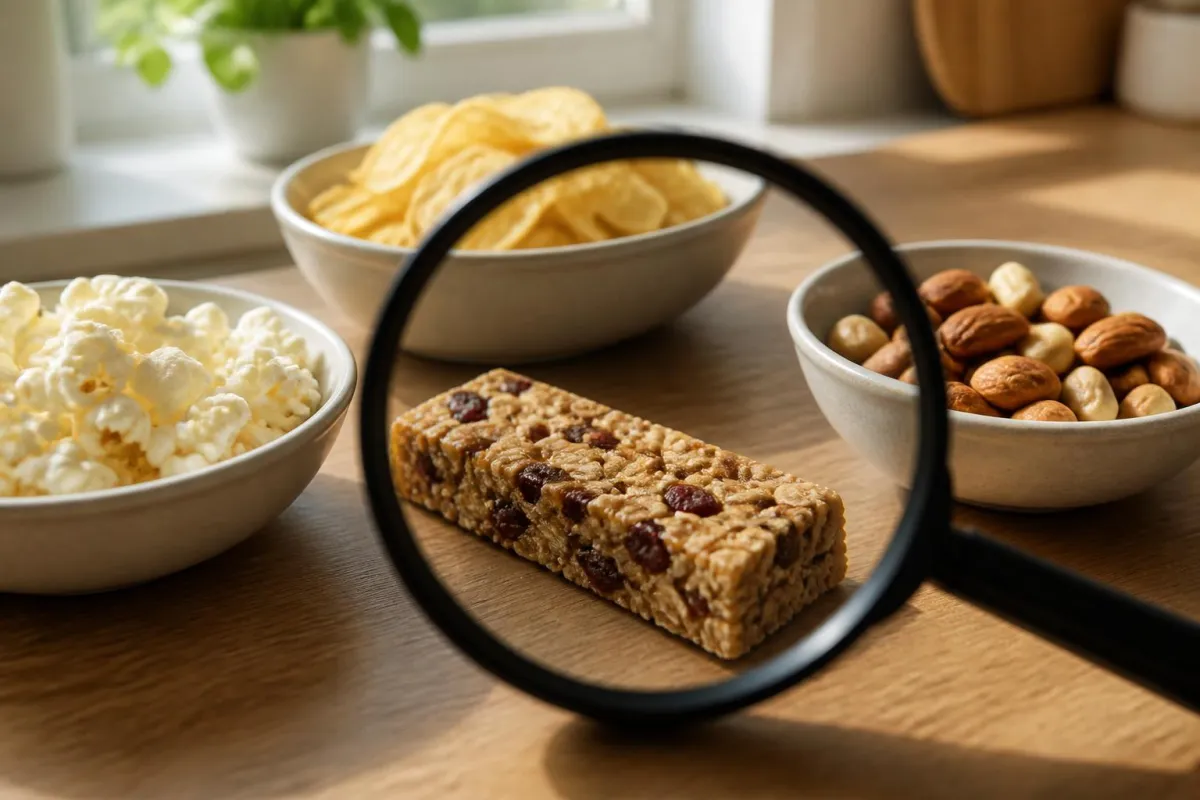
Different snack types often look as if they belong in one big comparison table, but moisture content and label structure make that misleading. A yoghurt pot, a cereal bar and dried fruit do not behave the same way on a label.
Yoghurt pots
Yoghurt pots usually have relatively high water content, so their per 100g figures can look lower than drier foods simply because more of the product is moisture. That does not automatically make them a better or worse choice. It just means you should compare yoghurt with yoghurt, not yoghurt with nuts or fruit leather.
With yoghurt pots, check whether the nutrition panel covers the whole pot or gives values per 100g plus a separate per serving column. Then check the ingredients list for fruit preparations, purées, juice concentrates, sweeteners and added flavourings. A no added sugar yoghurt may still contain naturally occurring sugars from milk and fruit.
Cereal bars
Cereal bars are usually easier to compare against each other because they are fairly similar in format and lower in moisture than chilled dairy snacks. Per 100g is useful here because bar sizes vary a lot. One bar may be compact and dense, another larger and lighter. If you only compare per serving, you can end up comparing different amounts of food without noticing.
Ingredient order also matters in bars. If syrups, dates, purées or fruit juice concentrates appear high on the list, that tells you more than the front of pack alone. That is not automatically a reason to reject the bar. It is just part of understanding what is doing the work in the recipe.
Dried fruit
Dried fruit is a classic example of why moisture matters. Once water is removed, the nutrition values per 100g become more concentrated than in fresh fruit. That is normal. It is not a sign that the label is trying to mislead you. It does mean dried fruit should be compared mainly with other dried fruit products, not directly with fresh fruit or chilled snacks.
If a dried fruit snack says no added sugar, check whether it is simply dried fruit, or whether it also contains juice, coatings, oils or flavourings. The claim can still be true while the product differs a lot from a plain fruit-only option.
Nuts
Nuts are another category where direct comparison with wetter snacks can confuse the picture. Their per 100g values are concentrated because they are dry and energy-dense by nature. That does not make them unsuitable. It just means the packet size and the amount you tend to eat matter. Comparing nuts with nuts is more useful than comparing them with yoghurt pots. We cover this in more detail in nuts in an overall eating pattern.
For flavoured nuts, the ingredients list may include sugars, honey, starches, seasonings or coatings. A plain nut product and a coated nut product can sit in the same aisle while being quite different on the back of pack.
Fruit-based snacks
Fruit-based snacks, such as fruit bars, fruit leathers, pressed fruit pieces or purée pouches, often create the most confusion. The front may lean heavily on fruit imagery, while the back shows a concentrated product with little water left in it. Again, compare like with like. A pressed fruit bar should be compared with other fruit bars, not with a pot of yoghurt or a piece of fresh fruit.
This is where no added sugar can be especially misunderstood. A fruit-based snack may have no added sugar and still be mostly fruit purée or fruit paste. That is not contradictory. It simply means the sweetness comes from the fruit ingredients already there.
What the ingredients list can reveal that the front of pack cannot
Front-of-pack wording is brief by design. The ingredients list is where you find what is actually in the product, in descending order by weight at the time of manufacture.
Start with the first few ingredients. They usually tell you the basic structure of the snack. Oats and nuts at the top suggest a different product from one led by fruit paste or syrup. Milk and fruit purée tell a different story from milk and sweeteners. You do not need to turn this into a purity test. You are just identifying what the snack mainly is.
Then look for sweeteners. A product can be no added sugar and still include sweeteners. If that matters to you, the ingredients list is the place to check. The front of pack may not make it obvious.
Fruit ingredients also need a second look. Terms such as fruit purée, fruit juice concentrate, date paste, raisin paste or dried fruit all describe different forms of fruit. They can affect texture, sweetness and stickiness, and they may explain why two products with similar front claims behave differently in practice.
Allergen information matters at least as much as the nutrition panel. In the UK, certain allergens must be emphasised in the ingredients list. The Food Standards Agency advises consumers to read ingredient and allergen information carefully and not to infer personal suitability from general wording alone Food Standards Agency consumer allergy guidance. That means not assuming a nut-free looking fruit bar is suitable for a person with a nut allergy, or that a yoghurt pot is automatically free from other relevant allergens. Check the ingredients, the emphasised allergens, and any precautionary statements on the actual pack.
Storage instructions belong in this step too. A chilled yoghurt pot, a shelf-stable bar and an opened bag of dried fruit, which may require specific techniques like those found at Crispberry, do not have the same handling needs. If a product says keep refrigerated, consume within a stated time after opening, or store in a cool dry place, follow that wording. The Food Standards Agency has general guidance on chilling and storage, but the packet instructions come first for the specific product Food Standards Agency food storage guidance.
If you want broader context beyond one claim, our everyday snack guidance pulls together the basics without turning every choice into a rule.
Choosing for home, work and travel without overcomplicating it
Once the label makes sense, the practical choice is often simpler than people expect. Most adults do not need a perfect snack system. They need a few options that fit where they are, how long they are out, and how much effort they want to spend.
At home, convenience usually means visibility and ease. If snacks are hidden at the back of a cupboard or require bowls, spoons and preparation, they are less likely to be used as intended. Shelf-stable items in sensible packet sizes can be useful for cupboards. Chilled items can work well if they are easy to see and easy to take. Mess matters too. A fruit-based bar may be less messy on the sofa than a pot and spoon. A yoghurt pot may be more satisfying at a proper break than while moving around the kitchen.
At work, think about storage, crumbs, smell and whether the snack survives a desk drawer or shared fridge. Individually packed items can be useful where timing is unpredictable. Chilled snacks depend on whether there is reliable fridge space. Nuts, bars and dried fruit travel easily but may be less suitable in some workplaces because of allergy policies or shared environments, so check local rules rather than assuming. We have a separate guide to practical snacking at work.
For travel, packet durability matters more than idealised nutrition comparisons. A no added sugar yoghurt pot may be fine for a short train journey with a cool bag, but not for a long day out without refrigeration. A cereal bar or fruit-based snack may be easier to carry. Nuts may be sturdy and compact, but loose portions can become awkward if you are walking or driving. Small details such as whether the pack reseals, whether it leaks, and whether it can be eaten one-handed often matter more than tiny differences in the label.
The NHS Eatwell Guide is a useful reminder that dietary balance is considered over a day or week, not demanded from every single snack NHS Eatwell Guide. That helps keep snack choices in scope. A snack does not need to carry every nutritional virtue. It just needs to be understood for what it is, fit the situation, and sit reasonably within your wider eating pattern.
A practical shortlist can help:
- Keep one or two shelf-stable options for busy days.
- Keep one chilled option if you regularly have fridge access.
- Choose packet sizes you are actually likely to use.
- Compare similar products per 100g first.
- Use per serving to sense-check what you will really eat.
- Read ingredients and allergen information every time you buy a new product or notice a recipe change.
That is usually enough to compare no added sugar snacks without guesswork. At Healthy Snacking, we would rather help readers build a repeatable way to read labels than hand out simplistic verdicts. If evidence changes or a point needs correction, we log that openly in our corrections and evidence process.