Healthy eating for teenagers without food battles
Teenagers do not need every snack to be perfectly balanced; overall eating patterns matter more.
On this page
- What healthy eating for teenagers usually means in practice
- Why teenagers often eat differently from adults
- How to judge snacks without calorie-fixation
- How to read labels when a teenager grabs food quickly
- What adults can organise at home, at work and on the go
- Where caution matters with allergies, claims and one-size-fits-all advice
Teenagers do not need every snack, lunch or late evening bite to look like a textbook plate. In practice, healthy eating for teenagers usually works better when adults look at the pattern across the day and week, make ordinary food easy to reach, and stop treating every choice as a pass or fail test. That lowers friction, and it is often more realistic than trying to control each item once school, travel, sport, social plans and appetite changes get involved.
At Healthy Snacking, we write about everyday food decisions, labels and routines, not strict food rules. That matters here. Food battles rarely improve eating. Clear options, decent organisation and a calm reading of labels usually help more than lectures, calorie counting or turning one snack into a verdict on a teenager's habits.
What healthy eating for teenagers usually means in practice
For most households, healthy eating for teenagers is not about finding a perfect menu and enforcing it. It is about building a pattern that is broadly balanced over time. The NHS Eatwell Guide is useful here because it frames eating across a day or week, rather than requiring every meal or snack to meet the whole standard on its own (NHS Eatwell Guide).
That distinction matters at home. NHS guidance is a public health framework. Household interpretation is the practical bit. A family might use that framework by making sure there are regular chances to eat, keeping fruit visible, having filling options for after school, and making packed lunches easier to assemble. Another household might focus on evening meals because breakfast is rushed and lunch is bought out. Both can still be moving in the same direction.
A useful way to think about it is this:
- not every snack has to contain everything
- not every day will look the same
- regular eating opportunities often matter more than trying to make one food "ideal"
- convenience counts, because food that is awkward to store, carry or open is less likely to be eaten
This also helps adults avoid moral language. Crisps are not a moral failure. A yoghurt is not a virtue signal. A cereal bar is not automatically better than a sandwich, and fruit is not automatically enough for every situation. Context matters. A snack before football training has a different job from something grabbed on a bus home.
If you want a calmer framework for weekdays, our guide to healthy eating that works on ordinary weekdays explains how to think in patterns rather than perfection.
Why teenagers often eat differently from adults
Teenagers often eat differently because their days are structured differently. That sounds obvious, but it is easy for adults to forget when comparing a teenager's choices with an adult routine built around a desk, a kettle and predictable meal breaks.
Appetite can vary a lot. Some teenagers wake up hungry. Others do not want much first thing and eat more later. School and college timetables can leave little time to eat properly, especially if lunch queues are long or breaks are short. Travel adds another layer. A snack that works at a kitchen table may be useless on a train platform or in a crowded corridor.
Sport and activity also change what feels practical. Someone going from lessons to training may want food that is quick, portable and easy to finish. Social eating matters too. Teenagers often eat with friends, buy food near school, or choose what fits the group and the budget. That is normal, not evidence that they have stopped caring about food.
Convenience has a huge effect. If adults want better choices to happen more often, the question is not just "what is healthiest?" but also:
- can it be carried in a bag without leaking or crushing?
- does it need a spoon, fridge space or reheating?
- will it still be appealing after several hours?
- can it be eaten in ten minutes?
- is it filling enough to bridge the gap to the next meal?
These practical questions explain why teenagers may choose wraps, cereal bars, nuts, crackers, yoghurt drinks, fruit, pastries, sandwiches or meal deals at different times. The point is not to turn normal variation into a problem. It is to notice the pressures shaping the choice.
That is one reason we avoid strict food-rule thinking. Our article on how to start eating healthier without strict food rules looks at how routines improve when the system gets easier, not stricter.
How to judge snacks without calorie-fixation
If adults want to compare snack options sensibly, calories are not the only useful measure, and often not the most useful one. A better starting point is to ask what the snack needs to do.
For example, is it meant to:
- keep someone going from lunch to dinner
- survive in a school bag
- be eaten quickly between activities
- add something useful to a light meal
- work without refrigeration
From there, a few label and food features are often more helpful than calorie-fixation.
First, look at fibre. Foods with more fibre can be more filling and may fit better into an everyday pattern than options that disappear fast and leave someone hungry again soon. Wholegrain crackers, oat-based options, fruit, pulses in a pot, or bread with a decent fibre content may all help, depending on the situation.
Second, look at protein in context. Protein can make a snack more substantial, but it is not a magic word and high-protein branding can distract from the rest of the label. Yoghurt, cheese, eggs, nuts, seeds, milk-based drinks and some bean-based foods may be useful because they are practical and filling, not because a claim on the front says they are superior.
Third, read the ingredients list as well as the front of pack. This is not about fearing long ingredient lists. It is about understanding what the product actually is. A flapjack, for instance, may be based mainly on oats and syrup. A yoghurt-coated bar may be mostly cereal and sugar with a thin coating. A fruit pouch may still be a concentrated sweet option even if the front looks wholesome.
Fourth, notice pack size. A large sharing pack that is easy to eat mindlessly can be less practical than a smaller item that travels well and is easy to portion out at home. Equally, a very small pack may not be enough for a hungry teenager after school. The right size depends on the job the food is doing.
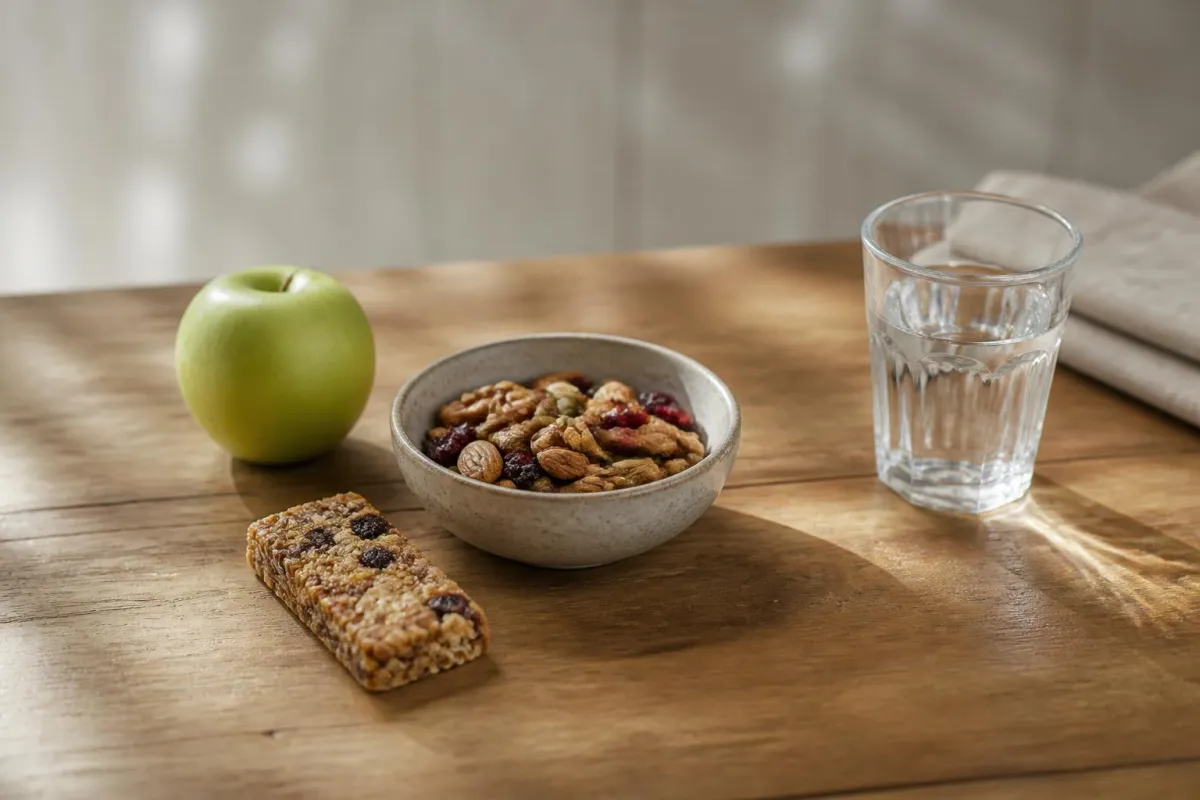
Finally, ask how filling and practical the snack is in real life. An apple and a handful of nuts may work well for one person. For another, a sandwich half and a yoghurt may be more realistic. If you want more on where nuts fit into an ordinary eating pattern, we have covered nuts in an overall eating pattern.
How to read labels when a teenager grabs food quickly
Fast decisions need simple label habits. The first one is to check whether the numbers are given per 100g or per serving. These are different comparison bases, and mixing them up leads to bad comparisons. The NHS explains this clearly in its guide to food labels (NHS food labels).
Per 100g is useful when you want to compare similar products directly, such as two cereal bars, two yoghurts or two packs of crackers. It gives a standard basis.
Per serving is useful when the serving is realistic and clearly defined, but it can be less reliable for comparison because serving sizes vary by product. One bar may count as one serving. Another product may list half a pack as one serving, even though many people would eat the whole thing.
Traffic-light labels can help with quick decisions, especially when comparing foods in the same category. But they need care. A red light on one nutrient does not automatically mean "do not buy", and a green light does not automatically mean "best choice". Portion size, how often the food is eaten, and what else is eaten that day still matter.
Claims on the front also need context. No added sugar is a good example. It tells you something specific, but not everything. A product with no added sugar may still contain sugars naturally present in ingredients such as fruit juice or purée. It may also be low in fibre or easy to overconsume because of texture and pack format. So if a teenager grabs something quickly, the useful habit is:
- check the product type
- look at the nutrition panel
- note whether values are per 100g or per serving
- glance at ingredients
- keep front-of-pack claims in proportion
For UK readers, this is also where country differences can matter. Front-of-pack traffic-light labelling is widely used in the UK, but not all EU products follow the same format. If a food has been imported, the information layout may differ, so the nutrition panel and ingredients list become even more important.
What adults can organise at home, at work and on the go
Food battles often reduce when adults change the setup instead of repeating the message. Organisation does not need to be elaborate. It needs to remove friction.
At home, visibility matters. If fruit is washed and on the counter, it is easier to grab. If yoghurt is at the front of the fridge, it is more likely to be used. If bread, wraps, crackers, peanut butter, tinned fish, hummus or cheese are scattered in awkward places, making a quick snack becomes more effort than opening a packet.
Storage matters too. Some foods need chilling and some do not. If you are packing food for later, check the packet instructions and follow storage advice. The Food Standards Agency guidance on chilling, freezing and defrosting is a useful reference for safe handling and storage (Food Standards Agency food storage guidance). In practice, that can mean not leaving perishable items in a warm car all day, using an insulated bag where helpful, and not assuming a food is fine unrefrigerated just because it is sold in a multipack.
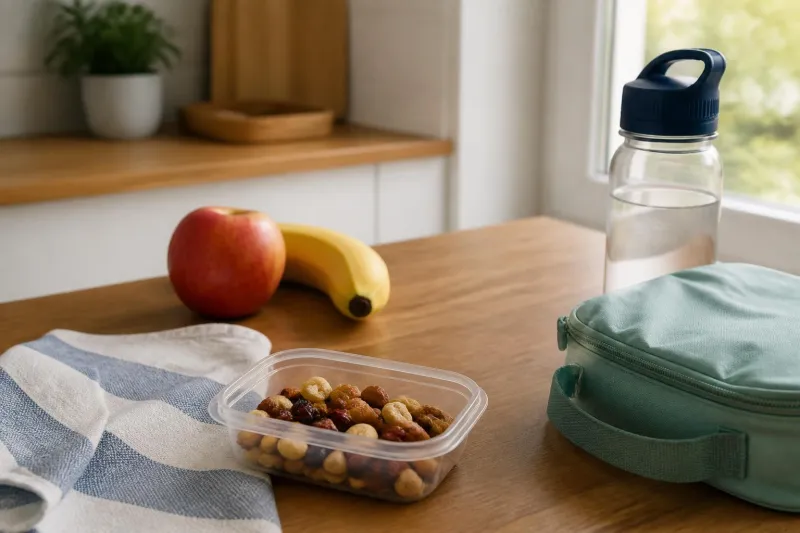
Transport is another practical issue. A snack that leaks, bruises or needs cutlery may stay in the bag untouched. Reusable tubs, napkins, freezer blocks and a small routine for packing the night before can make a big difference. So can keeping backup foods in predictable places, such as a cupboard at home, a desk drawer at work for adults, or a standard shelf in the kitchen for grab-and-go items.
Routine helps more than pressure. A simple structure might be:
- breakfast or a portable fallback if mornings are rushed
- a packed or bought lunch with at least one filling element
- one after-school or after-college option ready to eat
- something portable for travel or training days
- ingredients visible enough that making a quick plate is easier than skipping food and getting ravenous later
Adults at work can use the same logic for themselves. If the household food system only works for calm evenings, it will break down on ordinary weekdays. We have written more about eating well for less without overthinking every snack, because cost, waste and convenience are part of the real decision, not side issues.
Where caution matters with allergies, claims and one-size-fits-all advice
General articles can explain principles, but they cannot judge whether a specific food suits a specific person. That matters especially with allergies, intolerances, medical conditions, texture needs, religious requirements and personal preferences.
For allergies, adults should not assume a food is suitable because it seems simple, because a similar product was fine before, or because the front of pack looks reassuring. Ingredient lists and allergen information must be checked on the actual pack. The Food Standards Agency guidance for consumers is the right starting point here (Food Standards Agency consumer allergy guidance).
This is also where claims can mislead if read too broadly. Gluten free, dairy free, vegan, high protein, baked not fried, wholegrain, natural, and no added sugar all tell you something limited. None of them tells you everything you need to know about ingredients, allergens, fibre, fillingness, suitability for a packed lunch, or whether one teenager will actually eat the food.
One-size-fits-all advice is rarely useful. A snack that works well for one teenager may be impractical for another because of timetable, appetite, braces, sensory preferences, sport, travel time or family budget. That does not mean "anything goes". It means adults are usually better off making a short list of workable options than chasing a perfect answer.
At Healthy Snacking, Fleeta Limited publishes practical editorial guidance, not individual dietary advice, and we are careful about what evidence can and cannot show. If a claim sounds bigger than the label supports, or if a general article starts acting as though it can decide personal suitability, it needs more caution, not more confidence. If you want to see how we handle evidence and updates, our corrections and evidence policy sets that out.
The most useful goal is not to win every food decision. It is to make everyday eating easier, calmer and more workable. For teenagers, that usually means fewer battles, better organisation, clearer label reading and a wider view of what a healthy pattern looks like over time.