Eating well for less without overthinking every snack
Budget-friendly eating is about patterns over a day or week, not making every snack perfect.

On this page
- What eating well on a budget actually means
- How to compare labels without getting misled
- Where the budget usually slips in daily snacking
- Low-fuss ways to organise snacks at home, work and while travelling
- How to read claims such as no added sugar in context
- A simple weekly approach that stays flexible
Eating well for less does not require a perfect trolley, a spreadsheet for every snack, or a daily attempt to match an idealised basket. For most adults, the practical version is simpler. Build a few repeatable habits, compare labels on the right basis, keep everyday options where you actually need them, and accept that balance is something you look at over time, not in every single eating moment.
That is especially true if you are trying to make healthy eating on a budget in the UK feel manageable rather than like another admin task. The NHS Eatwell Guide is useful here because it frames balance across a day or a week, not as a pass or fail test for each snack or meal (NHS Eatwell Guide). Our job at Healthy Snacking is not to tell you that one packet is virtuous and another is not. It is to help you read what is in front of you and organise food in a way that works on ordinary weekdays.
What eating well on a budget actually means
Lower-cost eating is often described as if there is one correct basket and everyone should simply copy it. Real life is messier. A workable budget approach usually means three things.
First, you have a basic routine. That might be regular meals, a few planned snacks for commuting or work, and some back-up cupboard foods for the days when cooking does not happen. Routine matters because repeated convenience buying is often what pushes spending up, not one dramatic shop.
Second, you aim for overall balance rather than perfection. The NHS Eatwell Guide shows proportions for a general healthy pattern and makes clear that you do not need to achieve that balance with every meal, or every snack (NHS Eatwell Guide). That is a useful limit on interpretation. It does not mean every low-cost option suits every person, and it does not replace individual advice for medical needs, allergies or intolerances. It does mean a biscuit with tea does not tell you everything about how you eat.
Third, you make realistic trade-offs. Sometimes the cheaper option is the one with the longer shelf life because it reduces waste. Sometimes the better value choice is a larger pack, but only if you will use it before quality drops or storage becomes awkward. Sometimes a more expensive snack earns its place because it stops two separate impulse purchases later in the day. Budget eating is not only about the cheapest item on the shelf. It is about the cost of the pattern you repeat.
If you want a calmer starting point, our guide to healthy eating that works on ordinary weekdays sets out the same principle in day-to-day terms.
How to compare labels without getting misled
A lot of label confusion disappears once you separate two jobs. One job is comparing products fairly. The other is understanding what you are likely to eat.
For fair comparison, use per 100g. That is the standard basis for checking similar foods against each other, and the NHS specifically uses it this way in its food label guidance (how to read food labels). If you are choosing between two cereal bars, two yoghurts, or two savoury snacks, per 100g helps because pack sizes and serving suggestions can vary.
For real-life intake, per serving matters. If one pack says 120 calories per serving but the serving is half the packet, that may not reflect what many people will actually eat. The same applies when a bag contains more than one serving but is easily eaten in one sitting. The label is not wrong, but it can still mislead if you stop reading too early.
A few practical checks help:
- Compare similar foods using per 100g first.
- Then check the actual pack weight.
- Then check how many servings the manufacturer says are in the pack.
- Ask whether that serving size matches how the food is normally eaten in your life.
This is where front-of-pack colour coding and claims can be helpful, but only up to a point. They are designed to summarise, not replace the full panel. A product can look appealing on the front and still be easy to overestimate or underestimate if the serving basis is small, unusual, or split across a multipack.
It is also worth remembering that rules can differ between the UK and the EU generally. Since Brexit, food labelling law is not simply identical by default, even though many practical label features remain familiar to shoppers. For UK readers, use current UK-facing pack information and guidance rather than assuming an EU explainer always maps perfectly onto what is in your hand.
If label reading tends to become overcomplicated, our piece on how to start eating healthier without strict food rules may be a more useful frame than trying to optimise every number.
Where the budget usually slips in daily snacking
For many adults, the expensive part of snacking is not the planned food. It is the unplanned gap.
Commuting is one common pressure point. Leaving home without breakfast is one issue, but leaving with no back-up at all is often the bigger one. A station purchase, a petrol stop, or a coffee chain add-on can become the default simply because there is no alternative within reach.
Desk drawers create a different problem. Some people keep nothing at work and end up buying whatever is nearby by mid-afternoon. Others keep a random stash, forget what is in there, then buy duplicates while older items sit untouched. Neither pattern is about lack of willpower. It is usually just poor visibility.
Meal gaps matter too. If lunch is late, small, or uncertain, the chances of grabbing the most convenient option rise sharply. Again, that is not a moral failure. It is a predictable response to hunger plus time pressure. The practical fix is often less dramatic than people expect. One or two reliable foods kept where the gap happens can do more than a complete pantry makeover.
Travel days are another leak. Trains, motorway services, airports, and long meetings all narrow your choices. If you know those settings are expensive or limited, treat them as planning points rather than surprises. A snack packed the night before is usually easier than trying to make a perfect decision at 6.30 am.
The point is not to ban convenience purchases. It is to reduce the number of times they happen by accident. We cover that mindset in more detail in thinking about snack habits, especially where snacking is driven by routine rather than appetite alone.
Low-fuss ways to organise snacks at home, work and while travelling
Organisation helps most when it is boring enough to keep doing.
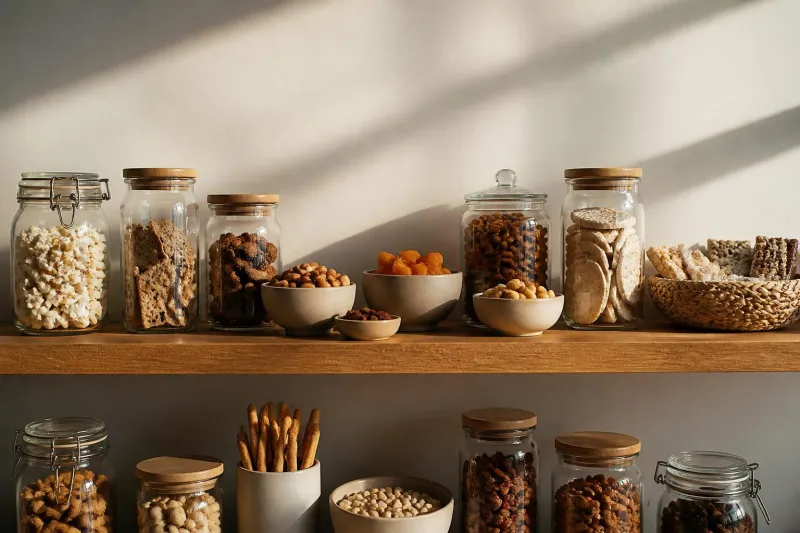
At home, it is often useful to separate snacks by use rather than by food type. For example, keep one visible area for foods that travel well, one for foods that need eating soon, and one for back-up cupboard items. That makes it easier to spot what should be used first and what can stay as reserve stock.
If you buy larger packs, portioning can help with convenience, not just quantity. Decanting some items into smaller containers or bags can make weekday use easier, especially for packed lunches, car journeys, or office days. But do not assume every food keeps the same once opened or repacked. Check the packaging for storage instructions and use-by or best-before information, then follow those instructions. The Food Standards Agency guidance on chilling, freezing and defrosting is clear that correct storage matters for food safety, and product instructions should be followed (Food Standards Agency storage guidance).
At work, a simple rotation system is usually enough. Keep a small set of shelf-stable options in one place, check them weekly, and replace only what has actually been used. If your workplace has a fridge, label your own items clearly and pay attention to any office hygiene rules. If it does not, do not assume a food is fine in a warm bag all day just because it was sold chilled in the supermarket. Storage conditions matter.
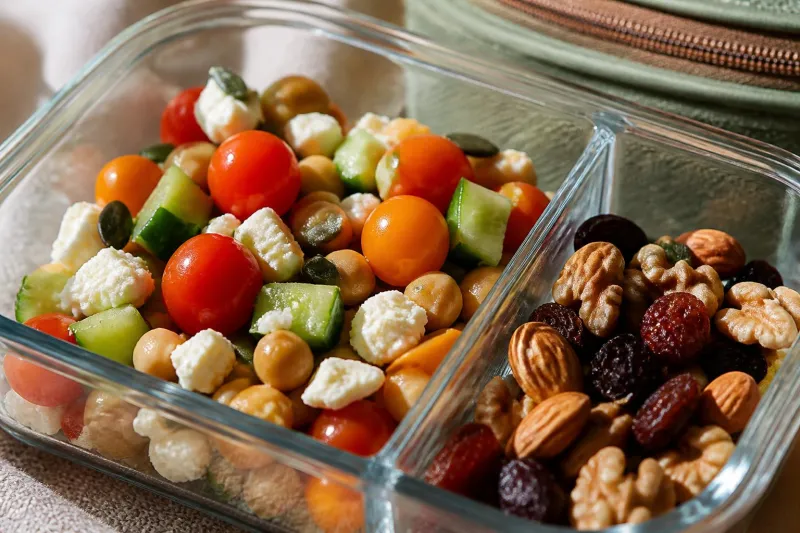
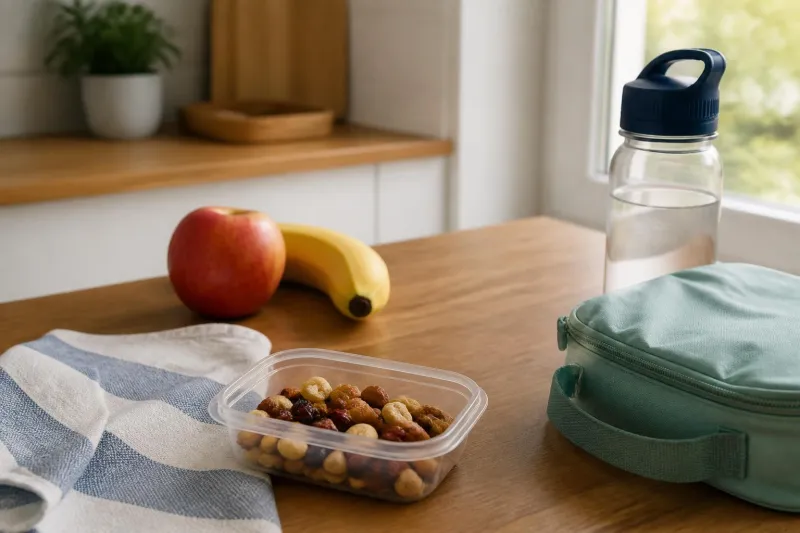
For travel, think in layers. Carry one item you expect to eat, one item you may need if plans slip, and a drink if practical. That is usually more realistic than packing a full day of “just in case” food that comes home untouched. Reusable containers can help, but only if they are cleaned properly and suit the food being carried.
At household level, avoid turning snack storage into a hidden inventory system. If people cannot see what exists, they often buy more. A clear basket, a labelled cupboard shelf, or a regular “use this first” spot in the fridge is often enough.
How to read claims such as no added sugar in context
Claims like no added sugar can be useful, but only if you read them as one piece of information rather than a final verdict.
In UK labelling, no added sugar means sugars have not been added during manufacture, and the claim comes with rules. But it does not mean the food contains no sugar at all. Ingredients such as fruit and milk naturally contain sugars, so the total sugar figure on the nutrition panel may still be significant. That is why the ingredients list and full panel still matter more than the headline claim.
The same principle applies to other claims and front-of-pack messages. They may tell you something true, but not everything you need to know. A product can highlight one positive feature while being less remarkable in other respects. That does not make the claim deceptive by default. It just means the claim answers a narrower question than shoppers often assume.
For everyday comparison:
- Use the claim as a prompt, not a conclusion.
- Read the ingredients list.
- Check the nutrition panel.
- Notice whether the numbers are given per 100g, per serving, or both.
- Check the pack size and how you are likely to eat it.
This also matters for allergies and intolerances. General claims do not decide personal suitability. A product being labelled no added sugar tells you nothing about whether it is suitable for someone with a nut allergy, milk allergy, coeliac disease, or another specific need. The Food Standards Agency consumer guidance is the right baseline here. Read the ingredients, read allergen information carefully, and do not infer safety from a broad marketing-style label (Food Standards Agency consumer allergy guidance).
That point is worth stating plainly because readers are often encouraged to treat front-of-pack language as shorthand for “good for me”. It is not. Labels can support decisions, but they do not replace context.
A simple weekly approach that stays flexible
A useful weekly system is usually less detailed than people expect.
Start with what is already in the cupboard, fridge and freezer. Before adding to the shop, identify what needs using, what works as a snack or meal back-up, and what is missing from your regular week. This avoids the common pattern of buying new “healthy” foods while older basics sit unused.
Next, plan for your actual pinch points. If Tuesday is your office day and Thursday is your longest commute, those are the moments to cover first. If weekends are less structured, keep a few easy options visible at home so you are not making every decision from scratch.
Then repeat a short list of dependable choices. Not identical every day, but familiar enough that they do not require thought. Repetition is often what keeps costs and effort down. Variety still matters, but constant novelty usually makes shopping harder and waste more likely.
It also helps to judge progress by convenience and consistency, not by whether every choice looks ideal in isolation. The NHS guidance is clear that balance is considered over time (NHS Eatwell Guide). In practice, that means asking questions like:
- Did we have something on hand when plans changed?
- Did we use what we bought?
- Did label reading help us compare similar options more clearly?
- Did fewer snack decisions happen in a rush?
Those are often better signs of a workable routine than strict rules or constant number-checking.
If you want to make this even simpler, keep one default list for home, one for work, and one for travel. Review it weekly. Remove the foods that never get eaten. Restock the ones that genuinely make the day easier. That is often enough structure for healthy eating on a budget in the UK to become less of a project and more of a background habit.
At Healthy Snacking, published by Fleeta Limited, we think that is the point. Food information should help you navigate ordinary life, not turn every snack into a test.