Adult lunch and snack packing without overthinking it
A packed day can be planned by format, not by strict food rules.
On this page
Packing food for a busy day does not need to turn into a project. For most adults, the useful question is not what the perfect lunch looks like, but what kind of day you are packing for, how long the food needs to last, and what you will realistically want to eat when you are tired, distracted or between trains.
A sensible approach to packing an adult lunch and snack for a busy day is to match the food to the day, not to an ideal. A desk day with a fridge and a microwave is different from a day in the car, a day on site, or a day with long gaps between meals. The best plan is often the one with the fewest points of failure.
What are you actually packing for
Before choosing containers or browsing labels, define the day.
A short office day with a proper lunch break gives you one set of options. You may have access to a fridge, a kettle, cutlery, a sink and perhaps a microwave. In that case, leftovers, yoghurt, salad, soup and other foods that need chilling can be practical.
A travel day is different. If you are moving between stations, driving for hours, or carrying everything in one bag, weight, mess and shelf stability matter more. Food that can be eaten one-handed, does not leak, and survives being jostled usually works better than a carefully layered lunch box.
A long-gap day needs another approach again. If breakfast is early and dinner will be late, one lunch may not be enough in practice. That does not mean you need a large formal meal. It may mean you need a lunch plus one or two planned snacks that bridge the gap without relying on whatever happens to be available at 4pm.
Then there is the limited-fridge day. Some workplaces have crowded shared fridges, no reliable cold storage, or no reheating option. In those cases, the question is less about what sounds appealing at home and more about what still works safely and acceptably a few hours later. The Food Standards Agency advises keeping chilled food cold and following storage instructions, rather than assuming any packed food will be fine all day without temperature control (Food Standards Agency storage guidance).
It also helps to separate appetite from schedule. Some adults prefer one clear lunch. Others do better with several smaller eating points because meetings, driving or shift patterns make a sit-down break unlikely. Neither pattern is automatically better. The useful test is whether your plan still works when the day goes slightly wrong.
Three practical ways to build an adult lunch and snack
We see three common approaches that work in real life.
The first is the full packed lunch. This is the classic lunch box approach, such as a sandwich or wrap, something crunchy on the side, fruit, and perhaps a yoghurt or another snack. It works well when you know you will get a defined break and have somewhere to sit. It can also be easier to remember, because it feels like one complete task.
Where it falls down is flexibility. If your lunch break is delayed, if the sandwich gets squashed, or if you are not hungry enough for the main item at midday, you may end up buying extra food anyway. A full packed lunch can also become repetitive if every day is built around the same format.
The second is the split grazing approach. Instead of one main lunch event, you pack several items that can be eaten separately across the day. That might mean a roll or pasta pot for later, plus fruit, crackers, a pot of something savoury, and another snack for the late afternoon. This often suits travel days, shift work, or jobs where breaks happen in fragments rather than in a neat hour.
Its strength is that it matches unpredictable schedules. Its weakness is that it can be harder to judge whether you have packed enough actual lunch, rather than just a collection of odds and ends. This is where labels and some basic planning help. A bag with three sweet snack items and no more substantial option may not carry you well through a long day, even if each individual item looked convenient.
The third is the buy-some, pack-some approach. This is often the most realistic option, especially if you commute. You might pack your snack insurance, such as fruit, nuts, crackers or a cereal bar, and plan to buy lunch near work. Or you might bring the main lunch and leave one snack to buy later if needed. This can reduce morning friction and can work well when refrigeration is limited.
Where it falls down is cost creep and over-reliance on whatever is available nearby. It also helps to know in advance what you mean by “buy lunch”. If that means a supermarket meal deal, a station kiosk, or a café with limited options, your packed items should fill the gaps those places often leave, rather than duplicating them.
None of these methods is the correct adult method. They are tools. The point of packing an adult lunch and snack for a busy day is not to prove organisational virtue. It is to make the day easier.
How to compare convenience foods and cupboard staples properly
Convenience foods are not automatically worse than cupboard staples, and cupboard staples are not automatically simpler. The comparison only becomes useful when you compare like with like.
The first check is the label basis. In the UK, nutrition information may be shown both per 100g and per serving. Those are not interchangeable. The NHS advises using the nutrition panel to compare foods carefully, and notes that a portion and 100g are different comparison bases (NHS guide to reading food labels).
Per 100g is useful when you want to compare two similar products directly, such as two savoury snack mixes or two soups. It gives you a standard basis. Per serving can be useful if the serving is realistic and clearly defined, but it can also confuse the picture if one packet contains more than one serving or if the suggested serving is smaller than what people usually eat.
For example, if one packet looks lower in sugar or salt per serving, check how large that serving actually is. If the servings are very different, compare per 100g first. Then look at how much of the pack you are likely to eat.
The second check is claims on the front of pack. A claim such as no added sugar has a specific meaning, but it does not mean sugar-free, and it does not tell you everything about the product. It means sugars have not been added as ingredients, but sugars may still be present naturally from fruit, milk or other ingredients. That can be relevant if you are comparing, say, a fruit pouch with plain nuts, or a breakfast bar with oatcakes.
The same goes for claims such as high in protein, source of fibre, or baked not fried. These can tell you one true thing about a product, but not the whole picture. If you want a clearer method, our guide on how to compare savoury lunch snacks without label mix-ups goes through the label bases in more detail, and our broader guide to understanding food labels covers what front-of-pack and back-of-pack information can and cannot tell you.
A practical way to compare a convenience item with a cupboard staple is this:
Look at the ingredients, then the nutrition panel, then the likely amount you will eat.
That order matters. Ingredients tell you what it is. The nutrition panel tells you the declared amounts of energy and nutrients. The likely amount tells you what the comparison means in your actual day.
This is also where certainty has limits. A label can help you compare products. It cannot tell you whether a food will keep you satisfied for a whole afternoon, whether you will fancy eating it after a delayed train, or whether it suits your own medical or allergy needs. For allergy and intolerance information, the Food Standards Agency advises checking ingredients and allergen information carefully rather than inferring suitability from a general claim (Food Standards Agency allergy guidance).
A realistic example for one busy adult day
Take one adult leaving home at 7am, commuting by train, working partly from an office and partly elsewhere, with no guarantee of a proper lunch break and dinner unlikely before 8pm.
This person knows three things in advance.
First, the office fridge is small and unreliable. Second, they may need to eat on the move. Third, if they do not pack enough, they usually end up buying something random at a station at 5pm.
So the plan is built around reliability rather than perfection.
They decide to pack one substantial lunch item that can be eaten cold, two snacks that serve different purposes, and a refillable water bottle. The lunch item is a wrap made the night before. Not because wraps are ideal in general, but because it is less messy than a pasta salad on a train and less likely to be crushed than a soft sandwich. They avoid a filling that becomes unpleasant after a few hours without good chilling.
For the first snack, they choose something easy to eat mid-morning during a short gap, such as a banana and a small savoury item from the cupboard. The decision point here is speed. If the snack needs assembling, peeling with a knife, or balancing on a laptop bag, it is less likely to be eaten when needed.
For the second snack, they choose something that can sit in the bag until late afternoon without becoming inedible. This is the insurance snack, not the aspirational one. It is there for the 4.30pm delay, the cancelled meeting break, or the train platform wait.
They also decide whether to buy anything. In this example, they plan to buy a drink near the office if needed, but not to rely on buying food. That reduces one decision during the day.
Now the label decisions. If choosing between two packaged savoury snacks for the bag, they compare per 100g first because the packets are different sizes. Then they check per serving to see what the manufacturer counts as one portion. If one packet looks modest but actually contains several servings, that matters. If another carries a no added sugar claim, they do not treat that as a shortcut to overall suitability, because the claim answers only one question.
The final packed set is simple. One wrap, one fruit item, one savoury snack, one back-up snack, one bottle of water, napkins, and a small spoon only if one item truly needs it.
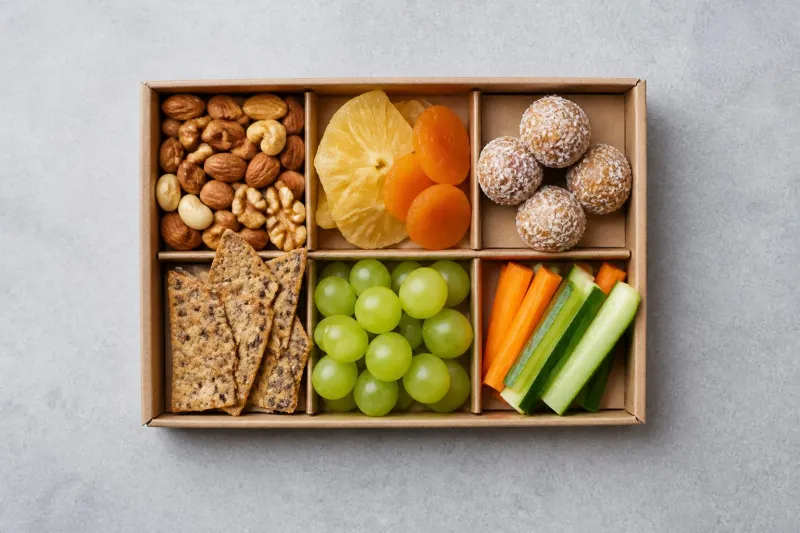
Could this person have packed chopped vegetables, a yoghurt pot and homemade energy bites? Possibly. But the day described does not reward fragile, fiddly food. A realistic packed day is the one that still works when lunch happens standing up.
The NHS Eatwell Guide is also useful here because it frames dietary balance over a day or week, not as a standard every single snack must meet (NHS Eatwell Guide). That is a better fit for adult planning than treating each item as a test of virtue.
Storage, timing and workplace practicality
Practicality often decides whether packed food gets eaten.
Start with temperature. If a food needs to be kept chilled, plan how you will keep it chilled. An insulated bag and ice packs may help for a few hours, but they are not a licence to ignore the pack instructions. The Food Standards Agency advises appropriate chilling and following storage instructions, especially for foods that require refrigeration (Food Standards Agency storage guidance). In the UK, that is the baseline to work from. If a product says keep refrigerated, do not assume a warm office bag is close enough.
Timing matters too. A packed lunch made the night before may be entirely practical. One made several days ahead may be less so, depending on the food and storage instructions. We should not overstate shelf life where the product guidance does not support it.
Then there is workplace reality. Messy food can be a genuine barrier. So can strong smells, drippy sauces, difficult packaging, and anything that requires a full set of cutlery plus a clean desk. If you regularly avoid eating what you packed because it is awkward, the problem is not your willpower. It is the design of the lunch.
Reheating is another point people over-assume. Some workplaces have microwaves, some ban them in certain areas, some have long queues, and some foods simply do not reheat well. If your lunch only works hot, ask whether that is dependable enough for your routine.
Keep a small practicality check in mind:
Can I carry it? Can I store it safely? Can I eat it without making a scene? Can I eat it if the day runs late?
If the answer to two of those is no, rebuild the plan.
For shared workplaces, courtesy matters as much as nutrition. Foods with very strong odours, noisy packaging during meetings, or ingredients that spill easily can all be sensible at home and irritating elsewhere. Practical adult lunch packing includes social practicality.
How to make the plan easier next week
The easiest packed lunch system is usually the one with some repetition.
That does not mean eating the same food every day. It means reducing the number of decisions. Keep two or three lunch formats in rotation. Keep a short list of bag-friendly snacks you already know are useful. Keep one back-up shelf-stable option in your work bag if your workplace allows it, and replace it when used.
A simple weekly routine might look like this:
Choose the day type the night before. Pick one main lunch format. Add one easy snack for an early gap. Add one back-up snack for a late gap. Check whether chilling, cutlery or reheating is needed. Pack water if you usually forget it.
That is enough structure for most people. It turns packing an adult lunch and snack for a busy day into a repeatable task rather than a daily puzzle.
A short checklist can help:
Main item One snack you are likely to want One snack for delays Drink or bottle Napkin Cutlery only if needed Cold pack if needed A quick label check if using packaged foods
If you want to get better at comparing packets without getting lost in claims and serving sizes, our guide to understanding food labels is the best next step. If your difficulty is more about routine than labels, our piece on thinking about snack habits is a better fit. And if you want occasional updates in the same plain-English format, you can see an example of the food information newsletter format.
Healthy Snacking is an editorial publication by Fleeta Limited, so our aim is not to sell a system or prescribe a perfect lunch. It is to make everyday decisions clearer. If your packed food is safe to carry, practical to eat, and good enough for the day you actually have, that is usually a better result than overthinking it.