How to compare savoury lunch snacks without label mix-ups
Compare like with like: per 100g and per serving answer different questions.

On this page
- Start with the comparison basis before the ingredient list
- What the ingredients list can tell you at a glance
- Compare oils, flavourings and seasoning without overclaiming
- Oils
- Salt-heavy seasonings
- Flavour powders
- Sweeteners and “no added sugar”
- Use a real packed-lunch example to compare two plausible options
- Step 1, compare per 100g
- Step 2, check the stated serving
- Step 3, include pack size
- Check allergens, storage and handling before you pack it
- Put the snack in context without turning it into a diet rule
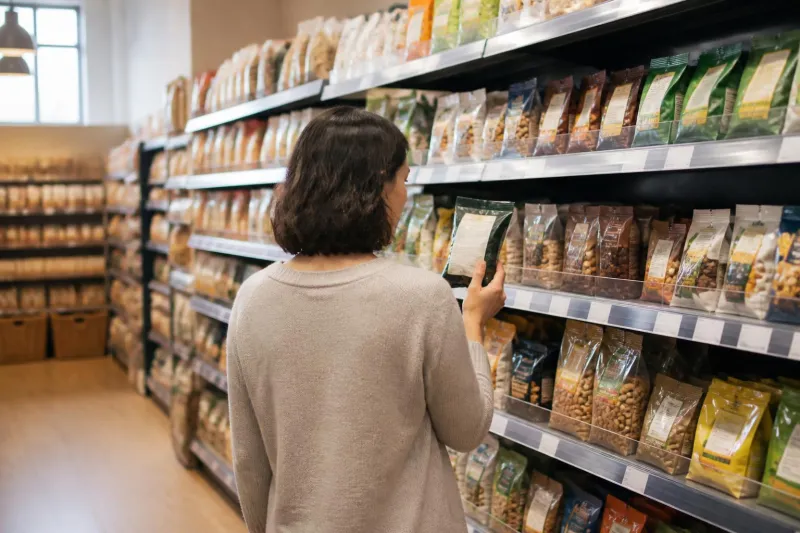
When you are comparing savoury lunch snacks, start with the comparison basis before you start reading the ingredients. A packet can show nutrition values per 100g, per serving, or both, and those are not interchangeable. Two snacks can look similar on the shelf but seem very different if one brand calls 25g a serving and another calls 40g a serving. The NHS is clear that a portion and 100g are different comparison bases, and that matters when you use labels to compare foods (NHS guidance on reading food labels).
That first step changes how you read almost everything else on the pack. If you want a fair label comparison for an adult packed lunch, use per 100g first so the products are on the same footing. Then check per serving and the actual pack size to see what you are likely to eat or pack. For a fuller explanation of the difference, our guide to comparing labels using per 100g and per serving covers the basics in one place.
Start with the comparison basis before the ingredient list
It is tempting to turn the pack over and go straight to the ingredients. In practice, the better order is this:
- Check whether the nutrition panel gives values per 100g, per serving, or both.
- Check the stated serving size in grams.
- Check the total pack weight.
- Then read the ingredients list.
Why this order? Because ingredient comparisons are often shaped by how much of the product you are actually comparing.
If one snack is dense and another is light, the same bowlful or handful can weigh very differently. A puffed lentil snack and a thick cheese biscuit may both look like modest lunchbox extras, but 30g of one may fill more space than 30g of the other. If you compare only the front of pack or only a branded serving suggestion, it is easy to think you are making a like for like comparison when you are not.
In the UK, prepacked food labels commonly show nutrition per 100g, and many also show per serving. Per 100g is the standard basis for comparing one product with another. Per serving can be useful for planning what goes into a packed lunch, but only after you have checked what that serving actually is. A manufacturer-defined serving is not a universal rule for what adults eat at work, on a train, or between meetings.
This matters for ingredients as well as for the numbers. If two packs both say cheese and onion, but one serving is 20g and the other is 35g, the amount of seasoning, oil, salt and flavour powder you end up eating can differ even before you get into the recipe differences.
What the ingredients list can tell you at a glance
Once you have sorted out the comparison basis, the ingredients list becomes much easier to use.
In the UK, ingredients are listed in descending order by weight at the time of manufacture. That means the first few ingredients usually tell you most of what the product is made from. You do not need to decode every additive or seasoning term before you can learn something useful.
Start with the first three ingredients. Ask simple questions.
What is the base? Is it mainly potato, gram flour, maize, wheat flour, rice, oats, peanuts, cashews, cheese, or a mix?
What comes next? Oil, starch, seasoning, cheese powder, sugar, yeast extract, or something else?
Is the product built from one main ingredient or from a blend? A potato crisp is different in structure from a baked wheat snack, a roasted chickpea snack, or a cheese crisp, even if the flavour on the front is similar.
This is where similar-looking savoury snacks can turn out to be quite different. For example:
- A potato crisp may begin with potatoes, sunflower oil, seasoning.
- A lentil curl snack may begin with lentil flour, potato starch, rapeseed oil.
- A wholegrain cracker may begin with wheat flour, oats, vegetable oil.
- A nut mix may begin with peanuts, almonds, cashews.
- A cheese crisp may begin with cheese, milk proteins, seasoning.
Those are not value judgements. They are simply different product types. For an adult packed lunch, that can affect texture, crumb level, how filling the snack feels, how well it travels, and which allergens are relevant.
Also watch for ingredients that sound alike but are not the same thing. “Cheese flavour seasoning” is not the same as cheese being one of the main ingredients. “Smoky bacon flavour” does not tell you whether any bacon is present. “Sea salt and vinegar” may mean a seasoning blend rather than visible vinegar. The ingredient list usually clears this up more reliably than the front of pack name.
If a percentage is given for a highlighted ingredient, often because it is emphasised in the product name or image, that can help too. A “cheese and onion” snack may state the percentage of cheese powder or onion powder. That lets you compare products with similar branding but different actual composition.
Compare oils, flavourings and seasoning without overclaiming
After the base ingredients, most comparisons come down to oils, flavourings and seasoning.
Oils
Look at which oil appears and where it sits in the list. Common examples in savoury snacks include sunflower oil, rapeseed oil and, in some products, palm oil or mixed vegetable oils. The label can tell you what is used. It cannot, by itself, tell you every detail of sourcing, processing or how a product fits into someone’s overall diet.
If one snack lists oil as the second ingredient and another lists it later, that is a factual difference in composition. It does not automatically settle which product is “better” for every purpose. A denser cracker and an airy puff can distribute ingredients differently.
Salt-heavy seasonings
Salt can appear directly as salt, sea salt, or within seasoning blends. It may also sit alongside ingredients such as yeast extract, cheese powder, soy sauce powder, stock powder or other savoury flavour components. If you are comparing labels, the most reliable way to compare salt content is the nutrition panel, ideally per 100g first, then per serving for the amount you are likely to pack.
Do not assume that a more artisanal-sounding seasoning means less salt, or that a plainer-looking product is automatically lower in it. Check the panel.
Flavour powders
Powdered flavour ingredients are common in savoury snacks. You may see onion powder, garlic powder, tomato powder, vinegar powder, cheese powder, whey powder, skimmed milk powder, maltodextrin, yeast extract, spice extracts and natural flavourings. These tell you something about how the flavour is built, but not everything about taste intensity or quality.
For example, a snack with cheese powder high in the list may differ materially from one where “cheese flavouring” appears much later. Equally, “natural flavouring” is a label term, not a shorthand for a universal health claim.
Sweeteners and “no added sugar”
Some savoury snacks include sugar, dextrose or glucose syrup in the seasoning. Others may use sweeteners. If a pack says no added sugar, treat that as one factual label point, not a full verdict on the snack. In savoury products, a small amount of sugar can be there for flavour balance rather than sweetness. The right question is not whether one word sounds cleaner, but what the full ingredients list and nutrition panel show.
The calm approach is the useful one. Labels can support comparison. They do not support dramatic claims about a product’s overall effect on health from one line alone.
Use a real packed-lunch example to compare two plausible options
Take a practical weekday example. You are packing lunch for work and want one savoury snack to sit alongside a sandwich, fruit and a drink. You are deciding between:
- Option A, a lentil-based crunchy curl snack in a 90g sharing-style bag
- Option B, a baked wholegrain cheese cracker in a 35g single pack
Both are plausible office or travel choices. Both are savoury. Both may be sold as lunch-friendly. Here is how we would compare them.
Step 1, compare per 100g
Suppose both packs provide nutrition per 100g and per serving. Start with per 100g because that is the common basis.
Option A might list ingredients in this order: lentil flour, potato starch, rapeseed oil, cheese and onion seasoning
Option B might list: wheat flour, wholegrain oats, cheese, sunflower oil, seasoning
At a glance, these are different products. Option A is pulse-based with starch and oil before the flavouring. Option B is grain-based, with cheese as a main component rather than only in a seasoning blend. That alone may matter to someone choosing for texture, ingredient preference, or allergen reasons.
Then compare the salt line, fat line and any fibre declaration per 100g if shown. This is where the label gives you actual comparable numbers, rather than assumptions based on “lentil” or “wholegrain” on the front.
Step 2, check the stated serving
Now look at per serving.
Option A might define a serving as 22.5g, meaning the 90g bag contains four servings. Option B might define the whole 35g pack as one serving.
This is where many comparisons go wrong. If you look only at per serving, Option A may appear lower in salt, energy or fat simply because the serving is smaller. But if you are likely to eat half the bag at your desk, or the whole bag on a train, the comparison changes immediately.
For packed lunch planning, ask yourself a practical question: what amount would actually go in the lunch bag?
- If you portion 22.5g of Option A into a small container, the manufacturer serving is relevant.
- If you routinely pack half the bag, 45g is the more realistic basis.
- If you often finish the bag, the whole 90g matters more than the printed serving.
Option B is simpler because the pack is already a single portion unit, but that does not automatically make it the better comparison. It just makes the likely amount easier to estimate.
Step 3, include pack size
Pack size often changes the conclusion more than the ingredient list does.
A larger multi-serve bag may look economical or convenient, but for a work lunch it can become an unplanned desk snack if it is not portioned before leaving home. A smaller single pack may have a different ingredient profile yet be easier to handle, less messy in a bag, and less likely to be crushed.
So the comparison might end up like this:
- Option A has a pulse-based ingredient list and may appear lighter per serving, but the bag contains multiple servings and needs portioning if you want the serving comparison to mean anything.
- Option B has a grain-and-cheese base and a more straightforward single-pack format, which may suit travel or workplace routines better even if some per 100g figures are higher or lower.
Neither conclusion is moral. It is organisational. The right choice depends on what you are actually packing and eating, not just which front-of-pack message sounds more suitable.
If you want more general help with label terms and layout, our page on understanding food labels in everyday use is the better next step than trying to turn one snack comparison into a fixed rule.
Check allergens, storage and handling before you pack it
Ingredient comparison is not enough on its own.
For many adults, the most important label information on a savoury snack is the allergen information. In the UK, allergenic ingredients must be emphasised in the ingredients list on prepacked foods. The Food Standards Agency also advises consumers to check ingredient and allergen information carefully and not to infer personal suitability from general assumptions about a food type (Food Standards Agency allergy guidance).
That means:
- Check the emphasised allergens in the ingredients list.
- Check any “contains” statement if one is provided.
- Check precautionary wording such as “may also contain” where it appears.
- Do not assume that two cheese crackers, two nut mixes or two lentil snacks have the same allergen profile.
Cross-contamination wording matters too, where provided. A product with no peanut ingredient can still carry a precautionary statement about peanuts. A snack based on pulses or grains may still be produced in a site handling milk, sesame or nuts. That is not a minor detail to leave until the morning commute.
Storage and handling also belong in the packed-lunch decision. Some savoury snacks are shelf-stable until opened, then best eaten promptly to keep texture. Others may include dips or cheese elements that need more careful handling. Follow the storage instructions on the pack. The Food Standards Agency’s consumer guidance on chilling and storage explains why correct storage matters for food safety, especially where a product needs to be kept chilled or used within stated conditions (Food Standards Agency storage guidance).
For workplace or travel use, practical checks include:
- Will the pack stay sealed until lunch?
- Does it need chilling?
- Will it go stale or spill if decanted?
- Is it likely to be crushed in a work bag?
- If sharing, is the allergen information still available once repacked?
If you decant a snack into a container, keep the label or take a clear photo first if anyone in the household needs to recheck ingredients later.
Put the snack in context without turning it into a diet rule
A savoury snack is one part of lunch, not a moral test and not a complete picture of someone’s eating pattern. The NHS Eatwell Guide presents balance across a day or week, not as a demand that every single item must do everything at once (NHS Eatwell Guide).
That is why we prefer practical questions over rigid rules.
Does the snack fit the lunch you are actually packing? Is the amount clear? Can you compare it fairly on per 100g first, then per serving? Have you checked allergens and storage? Will it travel well and be easy to eat where you are?
Those questions are more useful than trying to sort savoury snacks into “good” and “bad”. An adult lunch might include a sandwich, leftovers, soup, fruit, yoghurt, crackers, crisps, nuts, or none of those. Label reading helps you organise choices. It does not need to become calorie-fixation or guilt.
If you want a broader framework for reading packets without overinterpreting them, our existing guide to practical snacking at work is a useful companion. It looks at the routine side of snack planning rather than turning one label into a lifestyle rule.
At Healthy Snacking, published by Fleeta Limited, our aim is to make this kind of comparison easier to do calmly. When comparing savoury snack ingredients for an adult packed lunch, the key is to get the units right first, read the ingredient order second, and keep the result in context. That usually prevents the label mix-ups that make two ordinary snacks seem more different, or more similar, than they really are.