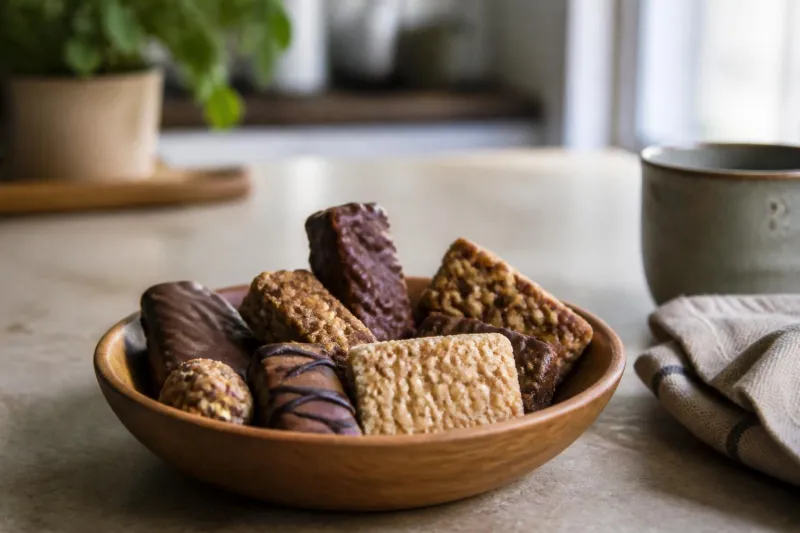
Shelf-stable snacks that travel well and read clearly on labels
A snack does not need to be chilled to fit an overall balanced diet.

On this page
- What counts as a fridge-free snack, and what does not
- What “healthy” can reasonably mean for a snack
- How to compare labels without getting misled by pack sizes
- Useful categories to keep at a desk, in a bag or in the cupboard
- Desk drawer snacks
- Bag and commute snacks
- Cupboard back-ups at home
- Snacks that are easy to overestimate
- Storage, allergens and other checks before you rely on a snack
Many adults want snacks they can leave in a cupboard, keep in a desk drawer, or carry through a working day without needing a fridge. That is possible, but it only works if we separate two questions that often get blurred together. First, will the food keep safely unopened at room temperature? Second, what happens after opening, or once it has been prepared?
When people look for healthy snacks that dont need fridge storage, the most useful starting point is not a marketing claim but the pack. A practical choice is one that is shelf-stable when unopened, has clear storage instructions, and fits reasonably into an overall eating pattern. That does not mean every snack has to be perfectly balanced on its own, and it does not mean every item sold as convenient is automatically suitable for a desk, bag or train journey.
What counts as a fridge-free snack, and what does not
For everyday adult use at home, at work and while travelling, a fridge-free snack is usually one that can be stored safely unopened in a cool, dry place and eaten without refrigeration. Common examples include plain crackers, oatcakes, rice cakes, nuts and seeds, dried fruit, roasted pulses, shelf-stable cereal bars, nut butter sachets, and some long-life packaged foods.
What does not count is just as important. A snack is not automatically shelf-stable because it looks dry, comes in a small packet, or is sold near the checkout. Chilled yoghurt, cut fruit from a chilled cabinet, opened dips, fresh sandwiches, and many meat or dairy items are not cupboard foods. Some products are shelf-stable only until opened. Others are safe unopened but need refrigeration after opening, or need to be eaten quickly once the seal is broken.
This is where the distinction between unopened storage and once-opened handling matters. The Food Standards Agency guidance on food storage is straightforward in principle. Storage instructions on the packaging are there for a reason, and once a product says “keep refrigerated after opening” or gives a short use window after opening, that instruction takes priority over assumptions about how dry or convenient the food seems Food Standards Agency food storage guidance.
In practice, that means:
- A sealed pack of oatcakes may be fine in a cupboard until the best before date, but once opened it may go stale or pick up moisture unless resealed.
- A long-life dip or sauce pot may be shelf-stable unopened, but not suitable for carrying around all day after opening.
- Individual nut butter sachets are often more practical for travel than a jar, because the whole portion is used at once and there is no opened container to manage.
- Shelf-stable does not mean heat-proof. Leaving snacks in a hot car, on a sunny windowsill, or next to a radiator is not the same as storing them in a cool, dry cupboard.
For travel, there is also a difference between “does not need a fridge” and “survives being crushed, melted or leaked on”. Chocolate-coated bars may be shelf-stable but messy in heat. Crispbreads travel well nutritionally, but not always physically. A snack that stores well at home may still be a poor choice for a backpack or commuter bag.
What “healthy” can reasonably mean for a snack
A lot of confusion comes from treating “healthy” as if it were a fixed badge that belongs to certain foods and not others. For everyday snacking, that is not a very useful way to think. The NHS Eatwell Guide is a better starting point because it frames balance across what we eat over a day or week, not as a test each individual snack has to pass on its own NHS Eatwell Guide.
That matters because a snack is only one part of an overall pattern. A plain handful of nuts, a packet of wholegrain crackers, a fruit-and-oat bar, or some dried fruit with seeds can all fit differently depending on the rest of the day. One person may want something more filling between meetings. Another may need a small practical option for a train. Another may simply want something that is easy to keep in a cupboard for busy days.
So what can “healthy” reasonably mean here?
Usually, it means looking for snacks that are useful rather than magical. They may offer fibre, protein, or ingredients you recognise. They may be less reliant on confectionery-style formulations. They may have a shorter ingredient list, though that is not automatically better. They may be easier to portion, or less likely to be eaten mindlessly from a large bag. But none of those points alone settles the question.
It also helps to distinguish public guidance from personal preference. The NHS sets out broad principles for a balanced eating pattern. It does not tell every adult that each snack must hit a perfect target, nor does it turn food into moral categories. Personal preference still matters. You may prefer savoury snacks to sweet ones, crunchy foods to soft ones, or foods that are less messy at a desk. Those are practical choices, not evidence that one person is “doing snacking right” and another is failing.
At Healthy Snacking, we find it more useful to ask, “Does this snack make sense in context?” than “Is this snack pure enough to count?” If you want more on that wider context, our guide to everyday snack guidance sets out the same approach in more detail.
How to compare labels without getting misled by pack sizes
If you compare snacks only by the front of pack, you will get misled. Pack size, serving suggestions and marketing claims can make similar foods look very different. The most reliable first comparison is the nutrition table per 100g, because that puts products on the same basis NHS food labels guidance.
Using per 100g helps with like-for-like comparisons such as:
- one oat bar against another oat bar
- roasted chickpeas against roasted broad beans
- one cracker against another cracker
- dried fruit mixes from different brands
After that, check the per serving figures, if given. This is where many people stop too early. A serving on the label may not match what is actually in the packet, and the packet may contain more than one serving. A “single pack” can still contain multiple labelled servings. Equally, a very small suggested serving can make the numbers look modest even when the product is dense.
The practical sequence is:
- Compare similar products per 100g.
- Check the per serving column.
- Check how many servings are actually in the pack.
- Ask yourself how much you would realistically eat.
That last step matters because the nutritional impact of a snack depends on the amount actually eaten, not the amount the manufacturer would ideally like to present.
Claims also need context. A front-of-pack statement such as no added sugar can be relevant, but it is not a shortcut to “healthy”. It tells you something specific, not everything you need to know. A product with no added sugar may still contain sugars that occur naturally in ingredients such as dried fruit, fruit purée or juice concentrates, and it may still be high in energy density or sticky enough to be less practical than it first appears. The claim is one data point, not a verdict.
That is why we suggest reading claims alongside the full nutrition table and ingredients list. If you want a worked example of how to do that without guessing, see our guide on how to compare no added sugar snacks without guesswork.
One UK-specific point is worth noting. In the UK, food labels commonly show both per 100g and per serving, and the NHS guidance explicitly explains that these are different comparison bases. If you also buy products imported from the EU, the format may vary slightly, but the same principle applies. Per 100g is the fairer basis for comparing similar foods. Per serving tells you what the maker says a portion is, not necessarily what you will eat.
Useful categories to keep at a desk, in a bag or in the cupboard
The most practical way to build a shelf-stable snack routine is to think by use, not by hype. Different settings call for different kinds of food.
Desk drawer snacks
For a desk, the best options are usually tidy, durable and easy to store for a while without fuss. Examples include:
- plain or seeded crackers
- oatcakes
- crispbreads
- unsalted or lightly salted nuts
- seed mixes
- roasted chickpeas or broad beans
- shelf-stable cereal or oat bars
- plain popcorn in sealed packets
These tend to work well because they are easy to portion, usually survive storage well when unopened, and can be paired if needed. For example, crackers plus a single-serve nut butter sachet can be more practical than carrying an opened jar around.
Bag and commute snacks
A bag snack needs to cope with movement, delay and limited handwashing. Good options often include:
- small packs of nuts or trail mix
- dried fruit in modest packets
- cereal bars that do not melt easily
- rice cakes in protective wrapping
- roasted pulse snacks
- long-life fruit pots if the pack instructions allow room-temperature storage before opening
Here, packaging matters almost as much as the food itself. A large family bag decanted into a flimsy container may be less practical than a sealed smaller portion. Crumbly foods, sticky fruit bars and easily squashed crispbreads can all be fine nutritionally but poor in use.
Cupboard back-ups at home
At home, cupboard snacks can be slightly less portable and a bit more flexible. Useful examples include:
- crackers, oatcakes and crispbreads
- peanut butter or other nut butters
- tinned pulses for quick savoury snack assemblies
- dried fruit
- nuts and seeds
- plain popcorn kernels or shelf-stable ready-popped popcorn
- shelf-stable soups or crispbread accompaniments, where the pack supports that storage
This category is less about eating straight from the packet and more about having ingredients that can become a quick snack without a special shopping trip.
Snacks that are easy to overestimate
Some foods look practical on paper but need more caution:
- fruit bars and balls made from puréed dried fruit can look simple, but they are often sticky and easy to eat quickly
- large bags of nuts are convenient, but the amount eaten can drift if you snack while working
- savoury rice or lentil chips may feel lighter than crisps, but labels still need comparing carefully
- “protein” bars vary widely and often read more like confectionery than a simple cupboard snack
That does not make them bad choices. It just means the label and the actual amount eaten still matter.
If you want another example of comparing snack categories without turning it into a product review, our piece on movie night snacks that are easier to compare on labels uses the same method in a different setting.
Storage, allergens and other checks before you rely on a snack
Before treating any snack as a reliable staple, it is worth checking a few basics.
First, read the ingredient list and allergen information carefully. The Food Standards Agency advises consumers to use the ingredients list and allergen emphasis on labels, and not to assume a general category such as “nut bar” or “seed cracker” tells the whole story Food Standards Agency consumer allergy guidance. Ingredients can change, recipes can be updated, and similar-looking products can differ substantially.
For UK readers, allergen labelling rules are specific and practical. Allergens that must be declared are emphasised within the ingredients list when ingredients are listed. Prepacked food should provide this information clearly. But that still does not make a food suitable for every individual with an allergy or intolerance. Pack wording, precautionary statements and personal medical advice all matter.
Second, check the packaging condition. Do not rely on snacks in torn wrappers, punctured pouches, leaking pots or packs that appear swollen or otherwise damaged. A shelf-stable product depends on its sealed packaging and stated storage conditions. Once that protection is compromised, the original shelf life and handling assumptions may no longer apply.
Third, understand best before in context. Best before is mainly about quality, not the same thing as a use-by date on perishable foods. A cracker past its best before date may be stale rather than dangerous, but that is not a licence to ignore pack instructions or eat visibly spoiled food. If the packaging says store in a cool, dry place, reseal after opening, or consume within a set period once opened, follow that instruction.
Fourth, do not generalise from one format to another. A dried fruit snack, a fruit purée pouch, and a chilled fruit pot are not interchangeable just because fruit is the main ingredient. A shelf-stable soup carton and a chilled fresh soup pot are not the same category. Storage is determined by the product and its packaging, not by the broad type of food.
Finally, build in a little realism. The best snack for a drawer at work may not be the best snack for a warm summer journey. The best snack for a cupboard at home may not be the one you actually remember to take out with you. A practical routine usually beats an idealised one.
Healthy snacks that dont need fridge storage are entirely possible, but the useful test is simple. Check that the food is genuinely shelf-stable unopened, follow the pack once it is opened, compare labels on a per 100g basis before looking at per serving, and treat front-of-pack claims as clues rather than conclusions. That gives you a calmer and more reliable way to stock a desk, a bag or a cupboard without turning snack choices into a moral test.