Pregnancy snacks that make label reading simpler
Use labels to compare like with like: per 100g and per serving are not interchangeable.

On this page
This topic needs editorial work because Healthy Snacking does not usually publish pregnancy articles. What we can cover, without turning this into individual medical advice, is the label-reading side of snack choices. If you are trying to make everyday eating feel simpler, the most useful approach is usually not to hunt for a perfect snack. It is to compare packets properly, notice what you are actually likely to eat, and keep claims in proportion to the full label.
That matters just as much if you are searching for healthy snacks in pregnancy as it does at any other time. Appetite can vary, convenience matters, and a snack that works on a workday commute may look different from one kept at home. A practical choice is often one you can store, carry and recognise easily on the label, rather than one that promises everything at once.
What makes a snack choice practical during pregnancy?
A practical snack is one that fits real life. That sounds obvious, but it gets lost quickly when food choices start to feel like a running assessment. In everyday terms, practicality usually comes down to a few plain questions.
Can you keep it where you need it? Can you eat it when your appetite is changeable? Does the packet make clear what is in it, how much is in one portion, and how it should be stored? If the answer is yes, you are already making the job easier.
That is one reason we are cautious about articles that reduce snack choices to a single rule. People do not eat in laboratory conditions. Some days a snack is there because lunch is late. Some days it is because travelling, meetings or commuting make a full meal awkward. Some days you may want something dry, plain or easy to nibble. None of that means every snack has to achieve dietary perfection on its own.
It also helps to separate convenience from marketing. A multipack may be convenient because it travels well, but the useful question is still what each pack contains, not whether the front suggests virtue. A chilled snack may look straightforward, but if it spends hours in a warm bag, storage becomes part of the decision. A larger bag may seem better value, but if you usually eat much more than the stated portion when the packet is open, the label picture changes.
In practice, the easiest way to simplify healthy snacks pregnancy decisions is to think in patterns rather than verdicts. You might keep a few shelf-stable options at work, a couple of chilled options at home, and one or two familiar choices for travel. That is often more realistic than expecting one ideal snack to cover every situation.
If you want broader help with everyday label reading beyond this topic, our everyday snack guidance goes into the same principles without turning food into a test.
How should you compare labels properly?
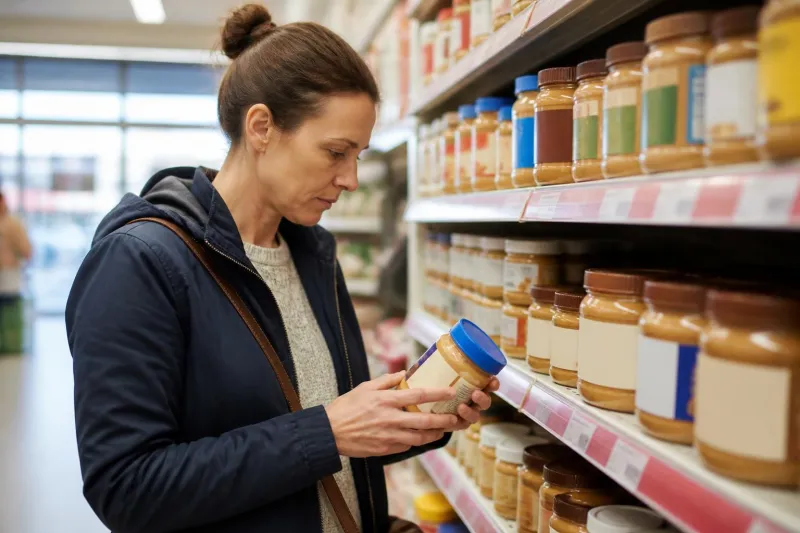
The most common label mistake is comparing one product per serving and another per 100g as though they were the same thing. They are not. The NHS explains that per 100g and per serving are different comparison bases, and both can be useful if you know what you are looking at (NHS guidance on reading food labels).
Use per 100g when you want the cleanest like-for-like comparison between products. If you are deciding between two cereal bars, two yoghurts, or two savoury snack mixes, per 100g strips away some of the brand presentation and lets you compare the nutrition information on the same basis.
Use per serving when you want to understand what you are more likely to consume in one go. That matters because manufacturers define servings differently. One packet might count half the pack as a serving. Another might treat the whole pack as one serving. If you eat the whole thing either way, the packet size matters more than the serving suggestion.
A simple example shows why this matters. Imagine Snack A looks lower in sugar per serving than Snack B. That may be true only because Snack A has a much smaller stated serving. When you switch to per 100g, the order may reverse. The opposite can happen too. A food may look high per 100g but come in a genuinely small pack that you actually eat once and finish.
This is why we encourage readers to check three things together:
- The per 100g column.
- The per serving column.
- The actual weight of the pack and how much you are likely to eat.
That third point is often the one that clears up confusion. If a bag is 45g and the label gives values per 22.5g serving, but you know perfectly well you will eat the full 45g, then the practical comparison is the whole bag. If a tub contains multiple portions and you usually eat a few spoonfuls rather than the lot, then the stated serving may be closer to reality.
This is also where category matters. With nuts, dried fruit, crackers, yoghurt pouches, dessert-style pots and popcorn, serving sizes vary widely between brands. Comparing only the front of pack can hide that. Our piece on nuts in an overall eating pattern looks at this kind of context in more detail, because foods that seem simple often become confusing once portion assumptions creep in.
The same method applies whether you are looking at energy, fat, saturates, sugar or salt. We are not suggesting that everyone should fixate on every number on every packet. We are saying the numbers only make sense when the basis matches the question. Per 100g is for fair comparison. Per serving is for likely intake. The packet size tells you whether the serving claim reflects real life.
Which front-of-pack claims are easy to misread?
Front-of-pack claims can be useful prompts, but they are not a shortcut past the full label. One of the easiest claims to overread is no added sugar.
No added sugar means sugar has not been added as an ingredient. It does not mean the product contains no sugar at all. Sugar may still be present naturally in ingredients such as fruit, milk or fruit juice concentrates. It also does not tell you the whole nutritional picture. A product can carry no added sugar on the front and still be high in energy, high in saturated fat, or easy to eat in large amounts without noticing.
That is why the ingredients list and nutrition panel matter more than a single claim. The ingredients list tells you what is actually in the product, in descending order by weight at the point of manufacture. The nutrition panel shows the declared values. Together, they tell you much more than a headline on the front.
Other claims can create similar confusion. Words such as natural, source of fibre, high protein, baked, or made with wholegrains may all describe one feature without answering the wider question of what the snack is like overall. A high-protein snack can still be heavily sweetened. A baked crisp product can still be salty. A fruit-based snack can still be concentrated and easy to overeat compared with the amount you intended.
This does not make such claims meaningless. It just means they are partial. If you need a quick first filter, front-of-pack wording can help you decide whether to pick up the packet. It should not be the last step.
A practical habit is to read the front as an invitation, then verify with the back. Check the ingredients. Check the nutrition table. Check whether the serving is realistic. If relevant to you, check allergens and storage too. That sequence is usually enough to cut through most packet spin.
For readers who want more examples of this style of comparison, our guide to lower-sugar snacks without label guesswork shows how a single claim can be less informative than it first appears.
Do all snacks need to be balanced on their own?
No. The NHS Eatwell Guide is clear that balance is considered over a day or a week, not demanded from every single food choice (NHS Eatwell Guide).
That is a useful correction to the idea that every snack must contain the ideal mix of everything. In real life, snacks do different jobs. Some are there because they are portable. Some because they are easy to keep in a desk drawer. Some because they are plain and familiar. Some because they help bridge a long gap between meals.
A snack does not fail because it is not nutritionally complete. The more helpful question is how it fits into the broader pattern of eating. If one snack is mainly carbohydrate, that does not make it a bad choice. If another is richer or saltier, that does not automatically make it unsuitable. The point is to understand what it is, rather than asking it to perform every role at once.
This is especially important when people start using broad search terms like healthy snacks pregnancy and end up with rigid lists that imply every bite must be carefully engineered. That is not what the NHS Eatwell Guide says. It gives a framework for overall dietary pattern, while also recognising that individual medical needs need appropriate advice.
For an editorial publication like Healthy Snacking, that means staying in our lane. We can explain labels, categories and practical habits. We cannot decide what is right for an individual person, and we should not imply that one snack is universally suitable because it ticks a marketing box.
A calmer way to think about it is this. If you regularly eat a range of foods across the day or week, a snack can simply be a snack. It may contribute fibre, protein or calcium. It may contribute convenience. It may just be something you can manage easily when the day is busy. Those are all ordinary reasons to choose it.
What should you check for allergens and storage?
For many readers, allergens and storage are the parts of the label that matter most in practice. They are also the parts people skip when they are in a hurry.
If you or someone in your household needs to avoid particular allergens, read the ingredients list every time and check the allergen information on pack. The Food Standards Agency consumer guidance is clear that ingredient and allergen information matters, and that people should not infer personal suitability from a general label or broad category description (Food Standards Agency allergy guidance).
That matters because recipes and manufacturing arrangements can change. A snack you bought before may not be identical now. A product type that sounds simple, such as oat bars or trail mix, can still contain or come into contact with allergens that are relevant to you. We do not label foods as safe for a person with an allergy, because that judgement depends on the exact product and the person involved.
Storage is just as practical. The Food Standards Agency guidance on chilling, freezing and defrosting food safely makes the basic point that appropriate chilling and storage help control food safety, and that product instructions should be followed (Food Standards Agency storage guidance).
For snacks, that means checking whether a product is designed for the cupboard, the fridge, or immediate use after opening. A yoghurt pot, soft cheese snack, chilled dip or cut fruit product may need refrigeration. If you are taking it to work or carrying it while travelling, think about how long it will be out of the fridge and whether the packet gives specific instructions. Shelf-stable products can be simpler for commuting or keeping in a bag, but they still need sensible storage, especially once opened.
It is also worth checking whether the label refers to storage before opening and after opening. “Store in a cool, dry place” is not the same as “refrigerate after opening and consume within the stated time.” With multipacks, one item may be fine in a cupboard while another version of the same product line is chilled only. Similar branding can hide different storage rules.
At home, organisation helps. Keeping snacks in their original packaging preserves the ingredients list, allergen information, best before or use by date, and storage instructions. Decanting into an unlabelled tub may look tidy but removes the details you may need later. At work, it can help to keep a few clearly labelled cupboard snacks for days when plans change, rather than relying on whatever is available nearby.
The useful habit here is simple. Before you buy, read beyond the front. Before you pack it, check how it should be stored. Before you eat it, make sure the amount you are counting matches the basis on the label.
That will not turn snack choices into certainty, and it does not need to. It just makes them clearer, which is often what people are really looking for when labels start to feel noisy.