How to compare no added sugar muesli in the UK
Use per 100g first when comparing one muesli with another.
On this page
If you are trying to work out which is the best no added sugar muesli in the UK, the quickest useful method is not to look for one magic claim on the front of pack. Start with the nutrition table and ingredients, compare products on a like for like basis using per 100g, then check how the packet defines a portion per serving. After that, look at what is actually making up the mix, because oats, dried fruit, nuts and seeds can change the numbers quite a lot without any of them meaning the label is misleading.
The key point is that no added sugar tells you something specific, but not everything. It can rule out certain added ingredients, yet the muesli may still contain sugars that occur naturally in fruit, milk if served with it, or grain ingredients. For general label reading in the UK, the NHS advises using nutrition information to compare foods and remembering that a portion and 100g are different comparison bases NHS guidance on reading food labels.
What no added sugar means on a muesli label
On a UK muesli pack, no added sugar means sugars have not been added as an ingredient, and the product has not had another ingredient added for its sweetening properties. That is the core point readers often need. It does not mean sugar-free, and it does not mean the sugars line on the nutrition panel will be zero.
That matters with muesli because many mixes include dried fruit such as raisins, dates, apricots or apple pieces. Those ingredients naturally contain sugar, so the nutrition table can still show a noticeable amount in the sugars row even where the front says no added sugar. The same applies if the cereal includes fruit purée concentrates or fruit powders, although in practice those need careful reading because whether a product can carry the claim depends on what has been added and why.
This is also where readers get tripped up by wording. A no added sugar claim is narrower than a general idea of “low sugar”. A muesli can be no added sugar and still show more sugars per 100g than another cereal that does not use the claim, simply because one contains more dried fruit. We have covered that distinction in our guide to no added sugar and low sugar label claims.
For UK readers, this is a point where local rules matter. Food labelling in Great Britain and Northern Ireland broadly follows retained and related food information rules, but claim wording and enforcement sit within the UK framework. If a rule differs between the UK and the EU generally, do not assume the headline wording on a blog or social post covers your pack exactly. For day to day shopping, the practical step is simpler, read the ingredients list and the nutrition table together rather than relying on the front of pack alone.
It also helps to separate the cereal from what you eat it with. If you pour muesli into a bowl with cow's milk, yoghurt or a sweetened plant drink, the sugars in your breakfast will be different from the sugars in the muesli itself. The pack only tells you about the product as sold, unless it explicitly gives prepared values as well.
If you want a broader explanation of what the claim does and does not tell you on UK labels, see our piece on what no added sugar tells you on a UK food label.
Start with per 100g, then check per serving
The fairest first comparison is per 100g. That removes one common source of confusion, brands choosing different serving sizes. The NHS is clear that per 100g and per serving are different comparison bases, and per 100g is the more reliable starting point when you are comparing one packaged food with another NHS guidance on reading food labels.
For muesli, this matters because one pack might define a serving as 40g, another as 45g, and another as 60g. If you compare only the per serving column, the product with the smaller declared serving can look lower in sugars, fat or calories simply because the portion used for the calculation is smaller.
A practical routine is:
- Put two or three packs side by side.
- Read the nutrition table per 100g first.
- Compare sugars, fibre, fat, saturates and salt on that basis.
- Then look at the stated serving size on each pack.
- Only after that, use the per serving figures to think about your own routine.
Per serving still has a use. It can help if you are planning breakfast at home, keeping a bag at work, or portioning cereal into containers for travel. But the number is only meaningful if you check what the manufacturer means by a serving. A 45g serving and a 60g serving are not interchangeable just because both columns are labelled per serving.
This is especially relevant when people are searching for the best no added sugar muesli UK options and end up comparing products from memory rather than from the pack. Two cereals can look similar on the shelf, both can claim no added sugar, and both can seem moderate in sugars per serving, yet one may be much denser in dried fruit and nuts. Per 100g shows that more clearly.
There is another reason not to stop at the serving column. Some people do not eat the suggested serving. At home you may use a larger bowl. At work you may use a mug or a food tub. If you regularly eat more or less than the packet example, the per serving line is not wrong, but it is not your serving.
We find it useful to treat per serving as a planning tool, not as the main comparison tool. Use it to estimate how many breakfasts you will get from a pack, whether a desk drawer portion pot is enough, or whether you need to pair a smaller bowl with yoghurt, fruit or toast to make a more filling meal. The NHS Eatwell approach is also worth keeping in mind here, balance is considered over a day or week, not demanded from every single item NHS Eatwell Guide.
Which label details matter most when comparing muesli
Once you have standardised the comparison to per 100g, the most useful label details are usually these.
Sugars. This tells you how much sugar is present in the product, whether naturally occurring or otherwise. In a no added sugar muesli, a higher sugars figure often reflects more dried fruit. It does not by itself tell you that the pack is less suitable for everybody, but it does tell you the mix is sweeter by composition.
Fibre. Muesli often varies a lot here depending on how much wholegrain oat, wheat bran, rye flakes, seeds and fruit it contains. Higher fibre can be one sign that the cereal is based more heavily on wholegrain ingredients, but check the ingredients list rather than assuming from one number.
Fat. This often rises when the mix contains more nuts and seeds. That is not automatically a problem or a benefit. It is simply part of what you are buying. If you are comparing two no added sugar mueslis and one has much more fat per 100g, look to see whether it contains almonds, hazelnuts, sunflower seeds or pumpkin seeds in larger amounts.
Saturates. This is usually not the standout figure in plain muesli, but it is still worth checking. Coconut, if included, can push saturates up more than oats or most dried fruit would.
Salt. Many mueslis are low in salt, but not all are identical. If one pack seems unexpectedly higher, the ingredients may include added flavouring components or processed inclusions.
Ingredient order. In UK food labelling, ingredients are listed in descending order by weight at the time of manufacture. That makes the first few ingredients especially useful. If oats come first and fruit appears much later, you are likely looking at a grain-led mix. If raisins or dates appear very high up, the product may have a sweeter profile and a higher sugars figure even though it still qualifies as no added sugar.
Wholegrain wording can also be helpful, but use it carefully. “Whole oats” or “wholegrain wheat flakes” tells you more than a front of pack design cue. If the packet highlights nuts or berries on the front, check how far down the ingredients list they actually appear.
One more practical check is whether the nutrition table is for the cereal alone or for the cereal “as prepared”. Some breakfast cereals show values with milk. If that appears, make sure you are comparing the same basis across brands.
How dried fruit, nuts and grains change the comparison
This is where many side by side comparisons become easier to understand. Two no added sugar mueslis can both be correctly labelled and still look very different nutritionally because they are built from different ingredients.
Take dried fruit first. Raisins, sultanas, chopped dates and dried apple all contribute sugars that occur naturally in the fruit. A fruit-heavy muesli may therefore show a noticeably higher sugars figure per 100g than a plainer oat and seed mix. That does not mean sugar has been added. It means the natural composition of the mix is different.
Now look at nuts and seeds. Almonds, hazelnuts, walnuts, sunflower seeds and pumpkin seeds usually raise fat per 100g, and they may also affect fibre. If one no added sugar muesli contains a generous nut and seed blend and another is mostly oats with a little fruit, the first may be higher in fat and the second higher in sugars. Neither figure tells the whole story on its own.
The grain base matters too. Oats are common, but some mueslis include wheat flakes, rye flakes or barley. The balance of these ingredients can shift texture, density and fibre. A coarse wholegrain mix can compare differently from a softer oat-dominant one even before fruit and nuts are added.
This is one reason front of pack comparisons can mislead. A packet covered in berries and nuts may suggest one nutritional profile, but the actual percentages may be modest. Conversely, a fairly plain-looking own-label cereal may contain a substantial amount of dried fruit. The ingredients list and nutrition table are more dependable than the photography.
Texture also affects everyday use. A mix with more large flakes and nuts may feel more filling to some people simply because it takes longer to eat and has more bite, while a finer mix may be easier to eat quickly at work. That is not a medical or nutritional ranking, just a practical difference that can influence which pack suits your routine.
If you are comparing muesli for regular use, it can help to ask four plain questions:
- Is this mostly grain, or mostly fruit and extras?
- Are nuts and seeds a major part of the mix?
- Does the sugars figure make sense in light of the fruit content?
- Does the fat figure make sense in light of the nut and seed content?
If the answer to those questions matches the ingredients list, the label is usually telling a coherent story.
Allergens, storage and everyday use at home or work
Nutrition is not the only thing worth checking. For many households and workplaces, allergen information is as important as the sugars or fibre line. In the UK, allergen details should be available on the label, and ingredients that are recognised allergens are commonly emphasised in the ingredients list. The Food Standards Agency advises consumers to read ingredient and allergen information carefully and not to rely on assumptions based on product type or previous packaging Food Standards Agency consumer allergy guidance.
With muesli, common allergens can include cereals containing gluten, nuts and sometimes soya. Some packs also carry precautionary wording such as “may contain” statements because the product is made in an environment handling other allergens. That wording is not the same as an ingredient list, but it still matters for people managing allergy risk. We do not suggest treating a general article like this as personal suitability advice. The pack in your hand is the one to check.
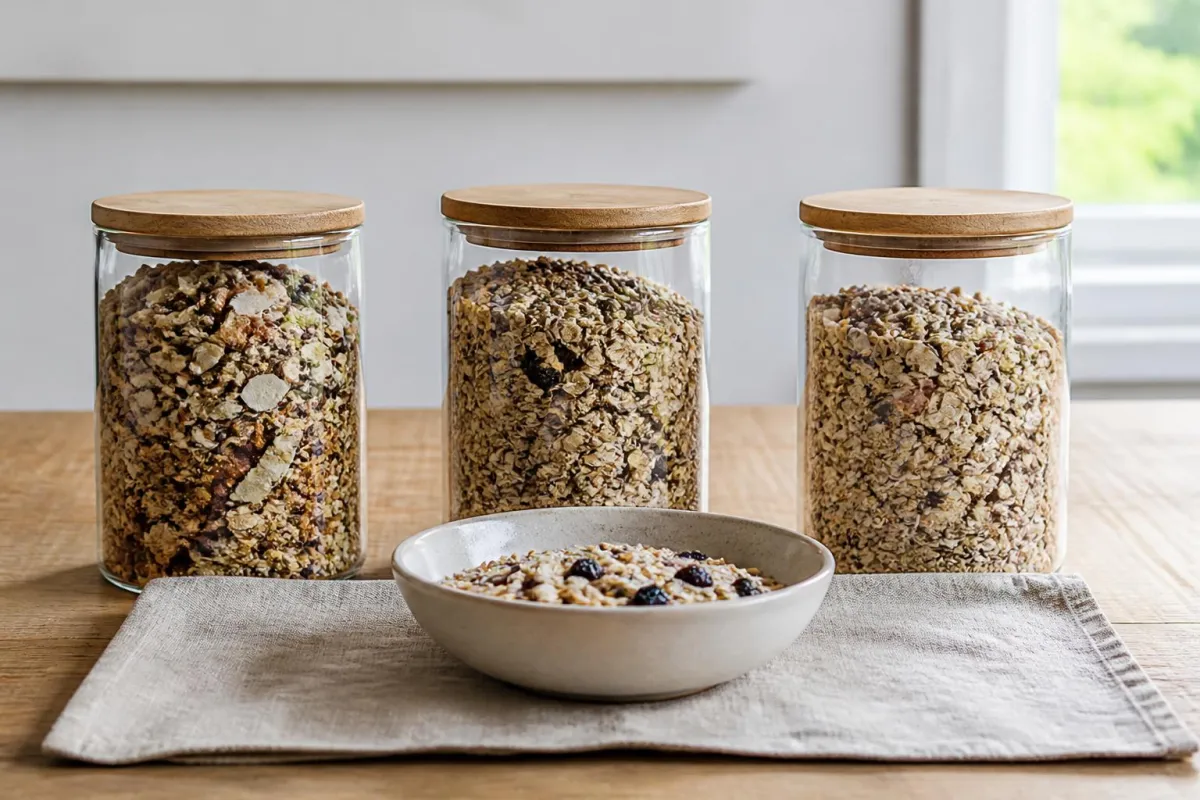
Storage instructions deserve more attention than they usually get. Dry cereal is shelf stable, but the packet may still tell you to store it in a cool, dry place and reseal after opening. That is not filler text. Muesli with nuts and seeds can lose quality faster if left open to air, warmth or moisture. If you decant it into a jar or tub, keep the original label until the pack is finished so you still have the ingredients, allergen and best before details to hand.
For workplace use, portion planning is often what makes a cereal actually practical. If you keep muesli at your desk or in a shared kitchen, think about how you will measure it. A scoop, a small container or a reusable pot can make your routine more consistent than pouring from the bag each time. That is not about rigid control, it is simply easier than guessing when you are busy.
At home, it can help to separate “comparison” from “use”. When comparing products, use per 100g. When organising breakfasts for the week, use the packet's per serving as a rough planning reference, then adjust to the bowl or container you actually use. If several people in the household eat from the same pack, checking how many declared servings it contains can also stop the common problem of running out midweek.
Finally, remember that muesli is only one part of what you may eat with it. Milk, yoghurt, fruit, seeds added at home, or a spoonful of nut butter will all change the overall meal. The pack is still useful, but it cannot tell you everything about the breakfast once you have assembled it.
A sensible UK comparison, then, is not about finding one universally superior cereal. It is about reading no added sugar correctly, comparing per 100g before per serving, checking the ingredient order, and noticing how fruit, grains, nuts and seeds explain the numbers you see. That method will get you much closer to a useful answer than any front of pack shortcut.