Can two meals a day work for healthy eating?
Two meals a day is not automatically healthy or unhealthy.

On this page
Whether two meals a day are healthy depends much more on what those meals contain, how regularly you eat across the week, and whether the pattern actually works in your real life, than on the number two itself. For some adults, two meals plus a planned snack or two can be a workable routine. For others, it leads to long gaps, rushed convenience food, or a day that is harder to balance.
So if you are asking whether eating two meals a day is healthy, the most accurate answer is, sometimes, but not automatically. The NHS does not set a rule that healthy eating means a fixed number of meals. Its guidance is about overall balance and variety, considered over a day or week rather than judged meal by meal NHS Eatwell Guide. That leaves room for different routines, but it does not mean every two-meal pattern is equally practical or balanced.
What a two-meal pattern can and cannot tell you
Meal frequency is easy to notice, which is why it often gets treated as more important than it is. “Two meals a day” sounds like a complete description of an eating pattern, but it tells us very little on its own. It does not tell us whether those meals include vegetables, fruit, beans, pulses, wholegrains, dairy or alternatives, or protein sources such as fish, eggs, tofu, or lean meat. It does not tell us whether someone is eating regularly enough to stay comfortable and focused through work, commuting, meetings, or travel. It also does not tell us what happens on the other five days of the week if the pattern changes constantly.
This is where careful wording matters. Established UK guidance does support looking at the overall pattern of eating, rather than trying to make every single eating occasion “perfect” NHS Eatwell Guide. What it does not do is declare that two meals a day are healthier than three, or that fewer meals are inherently better organised, more efficient, or more nutritious.
That distinction matters because people often mix guidance with interpretation. A person might say, “I only eat twice a day and I feel fine,” which may be true for them. Another might say, “Two meals must be healthier because it cuts out mindless eating,” which is an interpretation, not a general rule. Someone else may skip one meal most weekdays and then spend the afternoon low on energy, relying on whatever is available from a station kiosk, office vending machine, or motorway service stop. That is also a two-meal pattern, but a very different one.
In other words, meal count is a description, not a verdict. It can form part of a healthy routine, or part of a chaotic one. The useful question is not whether the number is good or bad. It is whether the whole pattern is balanced, manageable, and realistic.
What matters more than the number of meals
For everyday healthy eating, four practical factors usually matter more than whether you eat two meals, three meals, or three meals with snacks.
First, overall balance. Across a day or week, are you broadly lining up with the Eatwell approach, with fruit and vegetables, higher fibre starchy foods, beans and pulses, protein foods, and dairy or alternatives in sensible proportion? The NHS is clear that balance is considered over time, not demanded from every snack or every plate NHS Eatwell Guide. That means a lighter lunch does not ruin the day, but it also means a repeated pattern that crowds out whole food groups can become less useful.
Second, variety. Two large meals can look substantial while still being repetitive. If lunch is always a sandwich and crisps grabbed in a hurry, and dinner is always takeaway pizza, the issue is not the number of meals. It is the narrow range of foods. Variety helps with practical nutrition because different foods bring different nutrients, fibre levels, textures, and levels of fullness. It also makes the routine easier to maintain without boredom.
Third, regularity. Some adults do well with a later first meal and an evening meal. Others function better with breakfast, lunch, and dinner. The point is not to force sameness. It is to notice whether long gaps leave you distracted, irritable, or overly hungry by the time food appears. If your pattern repeatedly ends in grabbing whatever is nearest, the timing may not be serving you well.
Fourth, the actual food choices, including labels. A cereal bar labelled with “wholegrain” on the front may still be worth comparing with alternatives using the nutrition panel. A yoghurt sold as “light” may be small enough that you end up eating two. A smoothie may sound like a full replacement for a meal but leave you hungry an hour later. When comparing packaged foods, the NHS advises checking both per 100g and per serving, because they are different bases and can tell different stories NHS food labels. A small packet can look modest per serving but be high per 100g, and the reverse can also happen.
Claims such as no added sugar can also be misunderstood. They can be useful, but they do not automatically make a product low in sugar overall, nor do they tell you much about fibre, protein, salt, or how filling it is. For readers trying to organise everyday choices, our guide to a simple healthy eating table for everyday snack choices can help turn those comparisons into something more practical.
When two meals a day may work reasonably well
A two-meal pattern can be reasonably workable in ordinary adult life when it happens by routine rather than by constant accidental skipping.
One common example is someone who is not hungry first thing, has a late breakfast or brunch at home, then eats an evening meal and keeps a snack available for the afternoon if needed. Another is a person working an early shift who prefers a substantial meal after work, then dinner later, rather than trying to fit in a formal lunch. Some people on desk-based days simply prefer fewer, more substantial eating occasions because it feels less fragmented than grazing.
Travel can also play a part. A person catching trains or driving between sites may find that two proper meals, plus a prepared snack in a bag, are easier to manage than trying to build a textbook three-meal day around changing timetables. In those situations, “two meals plus backup” is often more realistic than “two meals and nothing in between”.
The key point is that workable does not mean superior. It means the pattern is doing its job. You are not spending the whole afternoon distracted by hunger. You are not arriving home so hungry that planning disappears. You are not repeatedly missing out on basic food groups because there are only two chances to fit them in.
For some adults, this can look like a late breakfast with porridge, yoghurt, fruit, and nuts, then an evening meal built around vegetables, potatoes or rice, and beans, fish, eggs, or another protein source. For someone else it might be a substantial lunch, then dinner, with fruit, crackers, or a yoghurt in between. If the day still broadly reflects the Eatwell approach, two meals need not be a problem.
This is also where snacks stop being “failure” and become logistics. A planned banana, pot of yoghurt, oatcakes, or a small container of nuts can make the difference between a manageable gap and a miserable one. We cover this kind of routine planning in healthy eating activities that make snacks easier to manage.
When it may be less useful in everyday life
Two meals a day can become less useful when the gaps are too long for your routine, or when it looks tidy on paper but falls apart in practice.
Long gaps are the most obvious problem. If breakfast is at 8am and dinner is not until 8pm, that is a very different pattern from brunch at 11am and dinner at 6.30pm. On a busy weekday, a long gap can mean low energy, poor concentration, headaches, or simply being more likely to buy whatever is quick and nearby. That does not mean everyone must eat at the same times. It means timing has practical consequences.
Another issue is convenience-driven overeating. Skipping a meal does not automatically lead to a balanced larger meal later. Often it leads to the easiest combination of highly convenient foods. That might be pastries from a coffee chain, a meal deal chosen in two minutes, or repeated snacking from whatever is in the office kitchen. Again, the problem is not moral weakness. It is environment and timing.
Workplace and travel disruption matter too. A two-meal routine may look fine on calm home days, then become awkward on days with early departures, delayed trains, client visits, or back-to-back meetings. If there is no place to store food, no microwave, or no reliable lunch break, the pattern can turn into “one proper meal and bits”. That is usually harder to keep balanced.
There is also the question of variety. Fitting enough different foods into two meals is possible, but it can be harder if both meals are rushed or repetitive. Fruit and vegetables, pulses, wholegrains, dairy or alternatives, and protein foods all need some room. If one meal is mostly coffee and toast and the other is takeaway, the day may feel full enough while still being narrow nutritionally.
For some readers, the biggest sign that a two-meal pattern is not helping is not hunger itself but food admin. You run out of suitable options, forget to take snacks, rely on service stations, or repeatedly buy food without checking the label. If that sounds familiar, the answer may be better organisation rather than a debate about whether two meals are “allowed”. Our piece on building a shopping list that makes everyday eating easier is useful here.
How to make a two-meal day more practical
If you naturally prefer two meals, practicality matters more than trying to make the day look disciplined.
Start with structure, not rules. Think in terms of two proper eating occasions that each include more than one element, rather than two random stops for food. For example, if lunch is your first meal, make it substantial enough to carry the afternoon better. That might mean including a starchy base, a protein source, and some fruit or vegetables, rather than relying on a single packaged item.
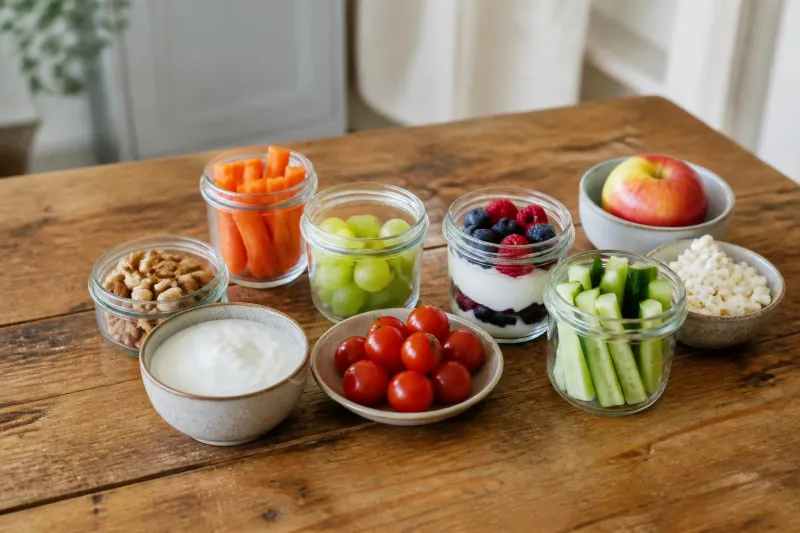
At home, this can be as simple as keeping components ready. Bread that freezes well, eggs, tinned beans, soup, microwaveable grains, tomatoes, carrots, yoghurt, fruit, and cheese all make it easier to build a meal quickly. The point is not to create an idealised fridge. It is to reduce the number of days when “there is nothing in” really means “there is nothing easy”.
At work, storage and portability matter. If you have access to a fridge, a lunch bag, or a cool pack, use them. The Food Standards Agency advises following storage instructions and keeping chilled foods properly chilled where needed Food Standards Agency food storage guidance. If you are carrying prepared food for several hours, the packet or container instructions matter. For allergy concerns, ingredient lists and allergen information matter as well, and a general article cannot tell any individual reader what is suitable for them Food Standards Agency consumer allergy guidance.
On the move, organise “bridge snacks”. These are not meant to replace meals forever. They are there to stop a manageable gap turning into a raid on the first available counter. Useful examples can include fruit, a pot of yoghurt if you can keep it chilled, oatcakes, plain crackers, a small pack of nuts, or a sandwich split so part can be eaten later. If you buy packaged foods, compare labels properly. Per 100g lets you compare products more consistently, while per serving can help if the serving is realistic and the whole pack is not likely to be eaten at once NHS food labels.
This is also where front-of-pack claims need a second look. No added sugar, high protein, or source of fibre may all be relevant, but none of them settles the question on its own. Check what else is in the product, the size of the pack, and whether it actually fits the gap you are trying to cover.
A practical two-meal day usually works best when there is some slack in the system. Not a rigid script, just enough backup that one delayed meeting does not turn the whole day into an afterthought.
What the evidence and guidance actually support
The clearest support from UK guidance is not for a specific number of meals. It is for an overall balanced eating pattern, informed label reading, and sensible food handling.
The NHS Eatwell Guide supports the idea that healthy eating is judged over a day or week, not by whether every eating occasion is perfect NHS Eatwell Guide. The NHS also supports using food labels to compare products and stresses that per 100g and per serving are not the same comparison base NHS food labels. The Food Standards Agency supports careful attention to allergen information and proper storage and chilling where relevant Food Standards Agency consumer allergy guidance, Food Standards Agency food storage guidance.
What this guidance does not claim is that two meals a day are inherently healthier, safer, or better balanced than three. It does not say adults should skip breakfast, avoid snacks, or compress all eating into a narrow window. It also does not say that more frequent eating is automatically better. On that point, evidence is mixed and highly dependent on what people actually eat, how the routine fits their lives, and what outcome is being discussed. For this reason, any article claiming a universal health advantage from two meals a day would need editorial work unless it could support that claim properly.
That is why our answer at Healthy Snacking stays practical. If two meals a day suit your appetite, schedule, and food organisation, they can fit within healthy eating. If they leave you underprepared, overhungry, or stuck with the same limited foods, the pattern may be less useful than it sounds. The better question is not “How many meals should a healthy adult have?” but “Does this routine help us eat a balanced range of foods, regularly enough, in the places where real life happens?”