What usually changes when you start eating better
Early changes are often about routine, appetite and food choice, not dramatic physical effects.
On this page
When people start eating better, the first changes are often quite ordinary. Meals may feel a bit more filling, snacking can become less random, and it may get easier to notice when you are actually hungry rather than simply eating because food is nearby. Some people also find their day feels more organised once they have a few reliable options at home, at work or in a bag.
That is usually what people mean when they ask how your body changes once you start eating healthy. The answer is not a dramatic overnight reset. It is often a series of small shifts in appetite, routine, digestion and energy, shaped by what you eat across days and weeks rather than by one “good” lunch or one less balanced afternoon. The NHS also makes the broader point that a healthy pattern is judged over time, not by a single food or snack NHS Eatwell Guide.
The first changes people often notice
One of the earliest things people mention is fullness. If you move from grazing on whatever is easiest to eating more regular meals and snacks with some fibre and substance, you may notice that you stay satisfied for longer. That does not mean every “healthy” food is filling, and it does not mean hunger disappears. It simply means the shape of the day can start to feel less erratic.
Appetite cues can also become easier to read. A day built around skipped meals, a couple of biscuits, then a large evening meal can make it hard to tell the difference between hunger, habit and convenience. When meals are more regular, people often become better at spotting patterns such as “I need something mid-morning if breakfast was light” or “I snack more on long travel days unless I pack ahead”.
Digestion is another area where change can be noticeable, but it is also where people often expect too much, too quickly. If you start eating more beans, wholegrains, fruit, vegetables or nuts, your digestion may feel different for a while. For some people that means feeling more comfortable once meals are more consistent. For others it means a temporary adjustment period if fibre intake changes quickly. That is not a reason to panic or to assume a food is automatically right or wrong. It is a reminder that routine matters, and that “better eating” is usually easier to tolerate when changes are gradual rather than all at once.
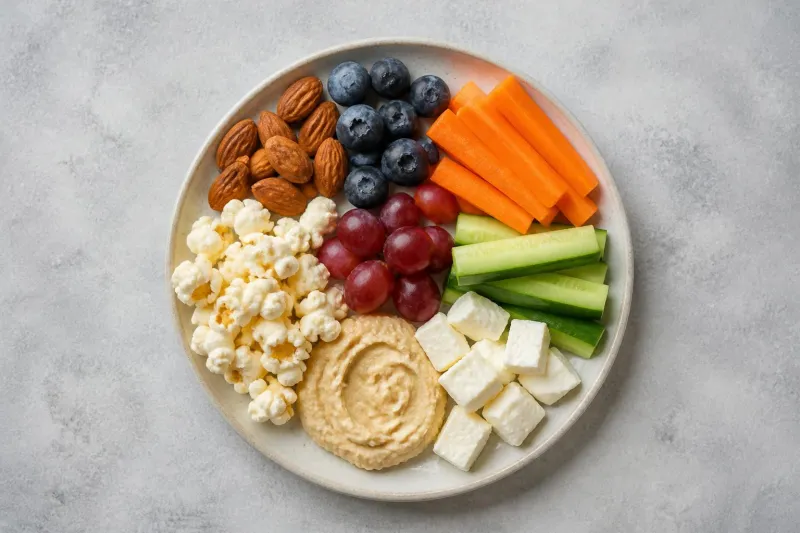
The practical side matters as much as the food itself. Early improvements often come from reducing decision-making. If there is yoghurt in the fridge, crackers in the cupboard, fruit on the counter and something portable in a work bag, people are less likely to end up eating whatever happens to be available at 4 pm. We see this repeatedly in everyday snack planning. The body change is not separate from the routine change. They tend to happen together.
This is also why restrictive thinking often backfires. If you start by banning half your usual foods, the day can become harder to manage. If you start by adding structure, such as a better lunch, a more useful desk snack, or a more realistic shopping list, the change is often more noticeable and more sustainable. Our guide to starting healthier eating without strict food rules goes into that practical side in more detail.
Why energy can feel more steady
When people say they want to “eat healthier”, they often mean they want to stop feeling up and down through the day. In everyday terms, steadier energy usually comes less from one special ingredient and more from pattern.
Regular eating helps. If breakfast is skipped, lunch is delayed, and the first proper meal arrives late afternoon, it is not surprising if concentration and mood feel patchy. A more regular pattern can make the day feel less reactive. That might mean breakfast before leaving home, a packed snack for the train, or a proper lunch break rather than relying on whatever is left in the office kitchen.
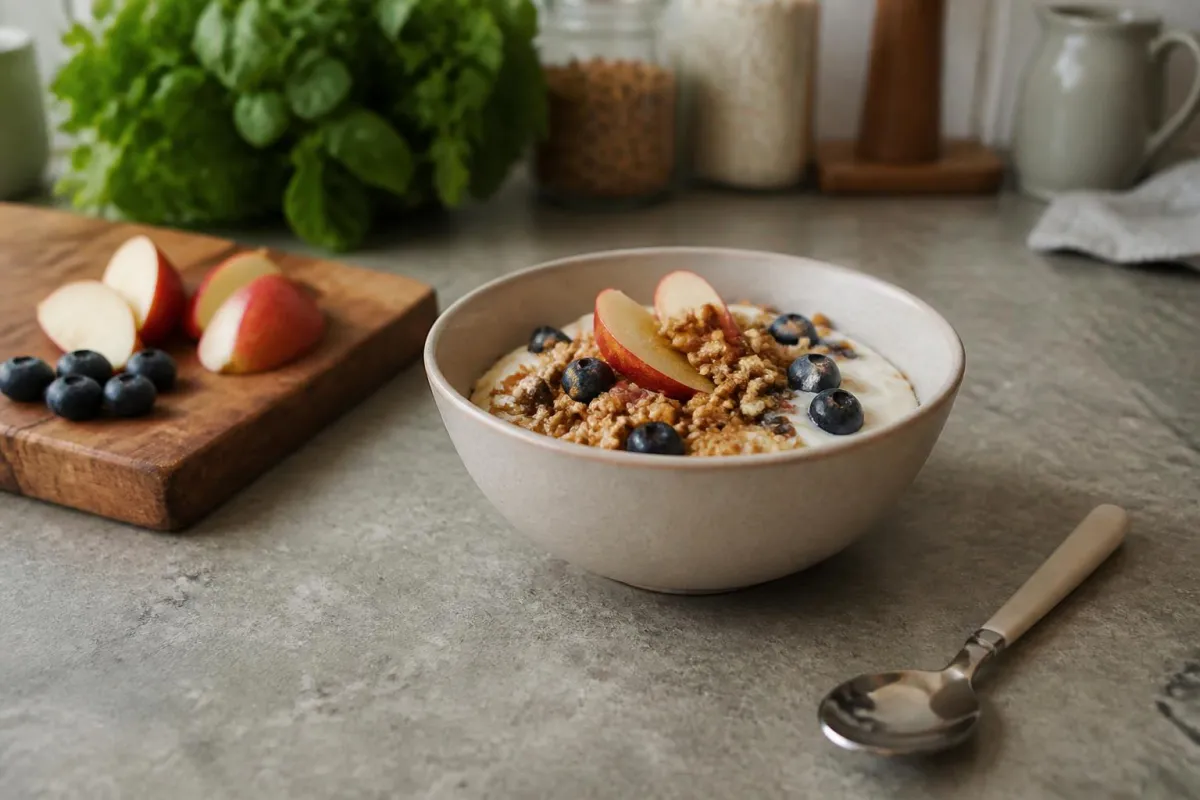
Fibre can play a part here too. Foods with more fibre often take longer to eat and can be more satisfying in a mixed meal or snack. In practice, that might look like oatcakes instead of a very light crisp snack, fruit with yoghurt instead of sweets on their own, or a sandwich with a more substantial filling rather than just grabbing a pastry and hoping for the best. The point is not to build a perfect plate every time. It is to make it easier for your intake across the day to feel more even.
Snack planning matters more than people expect. A lot of “energy dips” are really planning gaps. If you know you will be out from 11 am to 3 pm, the useful question is not “what is the healthiest snack in theory?” but “what will still be edible, practical and appealing when I actually need it?” For one person that may be nuts and fruit. For another it may be crackers, a cereal pot, or a sandwich saved from lunch. If you want a grounded look at one common option, we have written about nuts in an overall eating pattern.
It also helps to separate “steady” from “constant”. Healthy eating does not mean feeling exactly the same at every hour of the day. People get tired, busy, stressed and distracted. A better eating routine supports the day, but it does not remove the effects of poor sleep, long commutes or back to back meetings. That is one reason we try not to overstate cause and effect. Food can contribute to steadier day to day eating, but it is not a magic switch.
What healthy eating does not mean
Healthy eating does not mean one biscuit has ruined the day. It does not mean a takeaway cancels out a week of ordinary meals. It does not mean a cereal bar is “bad” and a banana is “good” in some moral sense. Food is not a test of character.
This matters because all-or-nothing thinking makes it harder to notice real change. If you believe every choice must be ideal, then any ordinary compromise can feel like failure. In reality, most adults are balancing work, cost, travel, storage space, appetite and convenience. A packed lunch on Monday, a meal deal on Tuesday and leftovers on Wednesday can all sit within a normal eating pattern.
The NHS approach is useful here. The overall balance of what you eat matters more than trying to make every single item perfect NHS Eatwell Guide. That is especially relevant for snacks. A snack is one part of a day, not a full nutritional verdict on your lifestyle.
This is also why we avoid language that treats foods as morally loaded. Calling foods “clean”, “cheat”, “guilty” or “naughty” usually adds more noise than clarity. A chocolate biscuit is a chocolate biscuit. A pot of yoghurt is a pot of yoghurt. The useful questions are practical ones. Does this keep me going until dinner? Is this easy to store at work? Does the label say what I assumed it said? Will I actually eat it before it goes off?
One of the most helpful mindset shifts is to stop judging a whole diet by isolated moments. If lunch was light and you needed two snacks in the afternoon, that is information, not failure. If you bought a multipack because it was convenient and realised it did not keep you full, that is also useful information. Better eating often starts with observation rather than self-criticism.
How labels help you notice real changes
Food labels are one of the most practical tools for understanding what is actually changing in your routine. They do not tell you everything, but they are useful when you know how to compare like with like.
The first step is checking whether you are looking at values given per 100g or per serving. These are not interchangeable. The NHS advises using both carefully, because per 100g helps compare similar products, while per serving shows what you may actually eat in one go NHS food labels. A cereal bar may look modest per serving, but if the bar is small, it may not be directly comparable with a larger snack. Equally, a food may look high per 100g while the actual serving is much smaller. Neither number is “the truth” on its own. They answer different questions.
Using per 100g is especially helpful when comparing products in the same category, such as two granolas, two yoghurts or two cracker brands. It gives a standard base. Using per serving is useful when the packet is clearly divided into portions, or when you want to understand what your usual amount looks like in practice. The important thing is not to mix them up halfway through a comparison.
Claims on the front of pack need context too. Take no added sugar. In the UK, this claim has a specific meaning in food labelling. It does not mean sugar-free, and it does not mean the food contains no sugars at all. It means sugars have not been added as ingredients in the way the claim rules allow. The product may still contain sugars naturally present in ingredients such as fruit or milk. So if you see no added sugar on a snack, the next step is still to read the nutrition table and ingredient list rather than stopping at the headline.
That bigger-picture approach helps with many label claims. “High protein”, “source of fibre”, “baked not fried”, and similar wording can all describe one aspect of a food without telling you how it fits into your own day. Sometimes that is useful. Sometimes it is mostly marketing emphasis. The nutrition panel, ingredients list and actual portion size give a more complete picture.
Labels also matter for safety and suitability, not just nutrition. If you are buying for someone with an allergy or intolerance, do not infer suitability from broad claims or from the fact that a product seems simple. The Food Standards Agency guidance is clear that ingredients and allergen information matter, and people should check the actual pack Food Standards Agency consumer allergy guidance.
If you want to make labels more useful in daily life, we have also covered food labels that keep your fridge and desk drawer organised. Often the biggest benefit of label reading is not perfection, it is fewer surprises.
What can change over weeks rather than days
The longer-term changes are usually less dramatic but more meaningful. Over a few weeks, people often get better at shopping for the life they actually have, rather than the life they imagine they will have on a very organised Monday morning.
That may mean buying fewer highly perishable items if evenings are unpredictable. It may mean keeping a small set of reliable cupboard foods instead of constantly buying aspirational ingredients that go unused. It may mean learning that some snacks belong in a desk drawer, some in the fridge, and some in a travel bag. The change here is not just nutritional. It is operational.
Storage and food organisation play a bigger role than many people expect. If food is easy to see, easy to reach and easy to take out with you, you are more likely to use it. If it is hidden at the back of the fridge or needs more prep than a weekday allows, good intentions often stay theoretical. The Food Standards Agency guidance on chilling and storage is useful for the basics, especially where foods need refrigeration and where pack instructions matter Food Standards Agency food storage guidance.
Shopping habits often become more realistic with time. Instead of asking “what should I eat to be healthy?”, the question becomes “what can I keep on hand that works on office days, home days and travel days?” That is where habits settle in. A regular breakfast option, one or two portable snacks, a few dependable lunch components, and a short list for top-up shops can change the week more than a burst of enthusiasm followed by no plan at all. Our piece on building a shopping list that makes everyday eating easier is built around exactly that problem.
This is also the point where it helps to distinguish guidance from interpretation. Established guidance can tell us that overall eating patterns matter, that labels should be compared carefully, and that safe storage matters. What it cannot do is tell every adult exactly which snack at 3 pm will suit their appetite, budget, commute and preferences. That part is interpretation and personal routine.
So, how does your body change once you start eating healthy? Usually through repetition, not revelation. You may notice steadier eating, clearer appetite cues, more useful fullness, and fewer moments where the day runs on convenience alone. Over time, the bigger shift is often that food takes up less mental drama. You know what to buy, what to keep where, and what label details are actually worth checking. For most adults, that is a more realistic and more useful form of change than waiting for a dramatic transformation after a few “good” meals.