Healthy eating that works on ordinary weekdays
Use overall eating patterns across the day or week, not one “perfect” snack, as your main guide.

On this page
Ordinary weekday eating works best when it is built around repeatable habits, not perfect choices. Most of us do not need a flawless snack drawer or a strict set of food rules. We need a way to get through work, travel, shopping and tired evenings with food that is reasonably balanced, clearly labelled and actually available when we want it.
That is where practical healthy eating tips are most useful. At Healthy Snacking, we focus on the decisions that come up in real life, such as what a label is really telling you, how to compare one packet with another, and how to make the easier option at 4pm a decent one, rather than whatever happens to be nearest.
Start with the pattern, not a perfect snack
A useful starting point is to stop treating a single food as a verdict on your whole diet. The NHS Eatwell Guide is about overall balance across a day or week, not about every individual snack or meal having to be nutritionally complete on its own (NHS Eatwell Guide). That matters because weekday eating is often uneven by nature. Breakfast may be rushed, lunch may be later than planned, and one day may involve a train journey while the next is spent at a desk.
So instead of asking whether one biscuit, yoghurt, sandwich or handful of nuts is “good” or “bad”, it is usually more helpful to ask how it fits into the wider pattern. If lunch was light and dinner is still hours away, a snack with some substance may make sense. If the day already includes several foods high in salt or saturated fat, that gives context for what you might choose later. Food is part of a pattern, not a morality test.
This is also why broad labels such as “healthy” can mislead if they are taken too literally. A food can be useful in one context and less useful in another. Nuts are a good example. They can contribute fibre and unsaturated fats, but that does not mean every nut product is identical, or that portion size and preparation never matter. We look at that in more detail in our guide to how nuts fit into an overall eating pattern.
The same applies to snacks often dismissed too quickly. A cereal bar, pot of yoghurt, toast with peanut butter, fruit, crackers, soup, or leftovers from the night before can all play a part, depending on the rest of the day. The point is not to force every eating decision into a narrow health category. The point is to make ordinary routines a bit easier to manage.
There is also an important limit here. General guidance can explain patterns and label reading, but it cannot tell an individual adult exactly what they personally should eat. Medical conditions, allergies, intolerances, prescribed diets and professional advice all change the picture. The NHS Eatwell Guide itself is general population guidance, not a substitute for individual assessment where that is needed. We can explain the framework, but we cannot confirm personal suitability or outcomes.
How to compare labels without mixing up the numbers
One of the most useful healthy eating tips is also one of the easiest to get wrong. When you compare labels, make sure you are comparing the same basis.
Most UK packaged foods show nutrition information both per 100g and, in many cases, per serving. These answer different questions. The NHS explains that a portion and 100g are different comparison bases, and both can be useful if you use them properly (NHS food labels).
per 100g is the better tool when you want to compare similar products directly. If you are choosing between two granolas, two soups, or two packs of crisps with different packet sizes, per 100g gives you a standard basis. It removes some of the distortion created by manufacturer-defined servings.
per serving is more useful when you want to know what you are likely to eat in practice from that specific product. If a microwave meal is sold as one serving, or a yoghurt pot is clearly one pot for one person, per serving may reflect your real intake more closely than per 100g.
Problems start when people switch between the two without noticing. For example, one packet may look lower in sugar simply because the front or back panel highlights a smaller serving size. Another may look higher in calories because the serving is larger and more realistic. If you compare Product A per 100g with Product B per serving, you are not comparing like with like.
A few straightforward checks help:
- First, decide what you are comparing for. Use per 100g for product-to-product comparison, and per serving for what you expect to consume.
- Second, check whether the stated serving is plausible. A manufacturer can define a serving in a way that is technically allowed but less useful for how adults actually eat.
- Third, look at the pack size. A bag may contain more than one serving even if many people would eat it in one sitting.
- Fourth, keep an eye on units. Drinks may use per 100ml rather than per 100g, so compare drink with drink on the same basis.
This matters particularly when packets are different sizes. Suppose one flapjack bar is 45g and another is 70g. Looking only at per bar may tell you what you would consume if you ate the whole item, which is useful. But if you want to know which recipe is denser in sugar or saturated fat, per 100g is the cleaner comparison. Both numbers have a place. They just should not be mixed.
Front-of-pack traffic light colours can help you scan quickly, but they do not remove the need to check what the numbers refer to. In Great Britain, front-of-pack traffic light labelling is widely used on a voluntary basis. That is different from saying every product must use the same front design. If a packet presents information in an unusual way, go back to the full nutrition panel.
If you want a fuller walkthrough, our page on understanding food labels in everyday shopping goes into the common comparison traps in more detail.
What front-of-pack claims can and cannot tell you
Front-of-pack claims are often designed to help people make quick decisions, but they only tell part of the story. A phrase such as no added sugar may be relevant, but it is not a full nutritional summary.
Taken literally, no added sugar means sugar has not been added as an ingredient. It does not mean the food contains no sugar at all. Sugars may still be present naturally from ingredients such as fruit or milk. It also does not tell you everything about the product’s energy, fibre, salt, saturated fat, texture, or how filling it is likely to be.
That is why claims work best as prompts, not conclusions. If a product says high in protein, source of fibre, baked not fried, or no added sugar, the next step is still to check the ingredients list and nutrition information. A claim may highlight one feature while saying little about the rest.
Ingredients matter because they tell you what the product is made from, in descending order by weight at the time of manufacture. Nutrition information matters because it gives the measurable content. Context matters because the same claim can mean different things in different foods. A fruit purée pouch and a plain yoghurt may both have no added sugar, but they are not nutritionally interchangeable.
It is also worth remembering that claims can shape expectations. Packaging can make a snack look lighter, simpler or more balanced than it really is. That does not mean the claim is false. It means the claim is selective. The packet is not a full explanation of how the food fits into an ordinary weekday.
For that reason, we suggest a simple order of reading:
- Look at the claim.
- Check the ingredients.
- Check the nutrition panel, ideally per 100g first if comparing products.
- Consider how and when you would actually eat it.
That last step is often missed. A claim may be technically accurate, while the product still does not suit the situation you are buying for. A tiny “better for you” snack may not be much help if you need something that will keep you going between meetings and your next proper meal is hours away.
Make everyday choices easier at home, at work and on the move
The most practical healthy eating tips are often about environment rather than willpower. People usually eat what is available, visible and easy to carry. If the only option at 3pm is a vending machine or a petrol station meal deal, convenience will do most of the deciding.
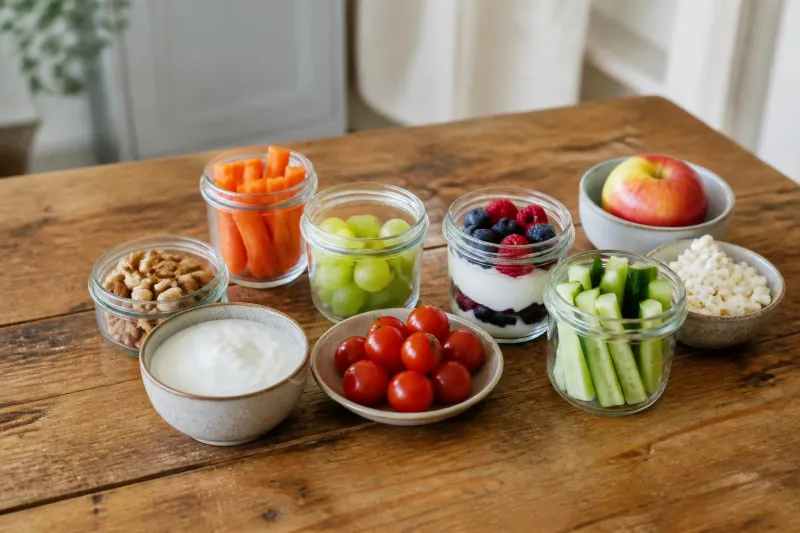
At home, the simplest improvement is to make the useful options the obvious ones. That may mean keeping a short list of regular foods you actually eat, rather than buying aspirational ingredients that sit untouched. Yoghurt, fruit, bread, eggs, soup, oatcakes, cheese, hummus, nuts, tins of beans, and leftovers that can become lunch the next day are all ordinary examples. The aim is not to create a “clean eating” kitchen. It is to reduce the gap between hunger and a workable choice.
A few routines help:
- Put ready-to-eat items where you can see them.
- Keep one or two freezer options for evenings when plans change.
- Portion leftovers into containers before you are too tired to bother.
- Pair foods when it helps them feel more substantial, such as fruit with yoghurt, toast with eggs, or crackers with hummus.
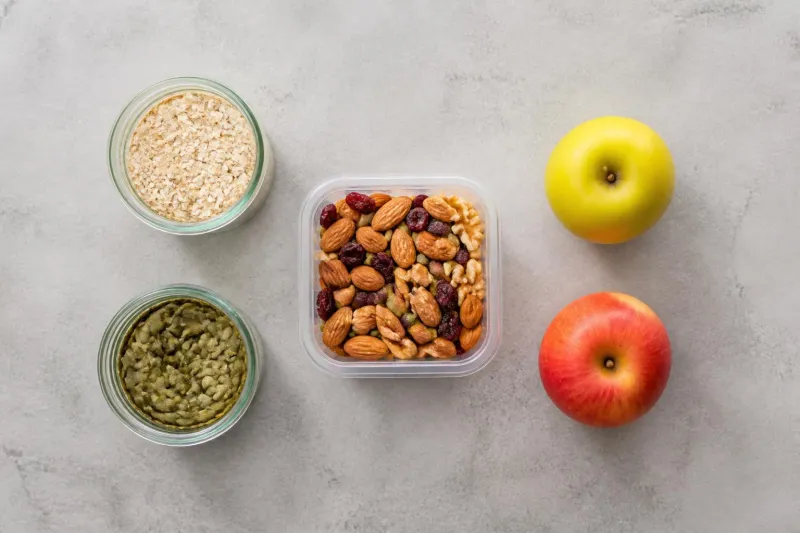
At work, the same principle applies. If your desk, locker or office kitchen contains only emergency sweets and stale biscuits, that is what the afternoon will look like. A better setup is to keep a small back-up supply that matches how you actually work. That might include shelf-stable options such as plain crackers, nuts, oatcakes, or soup, alongside fresh items brought in for the day.
Planning for work does not need to mean meal prep in the social media sense. It can be as basic as packing one snack and one lunch before bed, or checking in the morning whether the day includes a late meeting, a long drive or a commute that will push dinner back. We cover that in more detail in our guide to practical snacking at work.
On the move, the key question is usually timing. If you know you will be travelling through lunch, waiting until you are already hungry tends to narrow the options. Buying something earlier, when choice is wider, often leads to a better result than relying on the last place available. Train stations, airports and motorway services can all be managed more calmly if you think one stop ahead.
This is also where neutral planning matters more than strict rules. Some days the sensible choice is to bring food from home. Some days it is to buy a sandwich, yoghurt and fruit because that is what fits the journey. Some days it is a supermarket stop before getting on the road. Healthy eating on ordinary weekdays is usually less about ideal menus and more about giving yourself a decent fallback.
If you are trying to change long-set patterns rather than just stock a cupboard, our guide to thinking about snack habits without strict rules may be useful.
Where caution matters most
Practical eating advice is helpful up to a point. Beyond that point, caution matters.
The clearest example is allergy and intolerance. A general article cannot tell you whether a product is suitable for your needs. Always check the ingredients list and allergen information on the actual pack, because recipes and manufacturing information can change. The Food Standards Agency’s consumer guidance is the relevant starting point here (Food Standards Agency consumer allergy guidance). We do not describe foods as safe for a person with an allergy, because that judgement depends on the current label, the individual and, where relevant, professional advice.
Storage is another area where ordinary routines matter. Food that looks fine can still be mishandled. Follow use-by dates, chilling instructions and any guidance on freezing or reheating. The Food Standards Agency has consumer guidance on chilling, freezing and defrosting food safely, which is worth following for packed lunches, leftovers and batch-cooked meals (Food Standards Agency food storage guidance). If a packet says refrigerate after opening or consume within a stated period, treat that as part of the product information, not a suggestion.
There are also limits to what labels can prove. A neat ingredients list does not tell you how satisfying a food will be for you personally. A front-of-pack claim does not confirm that a product belongs in every diet. A favourable comparison per 100g does not automatically mean a food is the better choice in the amount you will actually eat. And no article can promise that following general healthy eating tips will produce a specific personal outcome.
Rules can differ slightly between the UK and the EU generally, especially in how labelling schemes are applied in practice and how products are presented across markets. For UK readers, it is best to use the information on the pack you are actually holding and to rely on UK guidance from the NHS and Food Standards Agency where relevant. Imported products may present information differently, so check the basis carefully.
At Healthy Snacking, which is an editorial publication by Fleeta Limited, our role is to make this everyday information clearer. We are not a shop, a nutrition clinic or a diet programme. We explain what labels, guidance and routines can tell you, and where uncertainty remains. If you want to see how we handle evidence and updates, our page on corrections and evidence standards sets that out.
Healthy weekday eating is rarely about finding one perfect snack. It is about understanding the packet in front of you, seeing how it fits into the rest of the day, and arranging your routine so convenience does not make every decision for you.