Healthy eating ideas that work on ordinary days
Use the week, not one snack, as the main frame for balance.
On this page
- What counts as a practical healthy eating idea?
- How to build better snack choices from what you already use
- What to check on a label before calling something healthier?
- Healthy eating ideas for home, work and travelling
- How to organise food so the easier option is also the useful one
- Where healthy eating advice has limits
Healthy eating ideas that work on ordinary days are usually the ones that fit the day you are actually having. That means food you can get hold of, carry, store, prepare and eat without turning every snack into a project. It also means looking at the wider pattern, not expecting every single bite to do everything at once.
At Healthy Snacking, we write about everyday eating in that practical sense. We are not looking for perfect foods, strict rules or dramatic promises. We are looking for choices that make ordinary routines easier to manage, while keeping labels, ingredients and the wider balance of a day or week in view, in line with the NHS Eatwell Guide, which frames overall balance across time rather than demanding it from each individual item NHS Eatwell Guide.
What counts as a practical healthy eating idea?
A practical idea is one you can still use on a rushed Monday, a train journey, a late office afternoon or a day when the fridge is nearly empty. In that setting, healthy eating ideas are less about finding the single best snack and more about making everyday choices a bit more useful.
Useful usually means a few things at once. The food is available. You are likely to eat it. It keeps reasonably well for the situation. It is satisfying enough that you do not immediately need something else. And if you are comparing packets, you can tell what you are actually buying from the label.
That is different from moral language. Food is not "clean", "naughty" or "bad". A chocolate biscuit is not a personal failure, and an apple is not a certificate of virtue. The more practical question is whether your usual pattern gives you enough variety and whether your snack choices work with the rest of the day.
The NHS approach is helpful here because it puts balance in context. The Eatwell Guide is about the pattern of what we eat overall, across a day or week, not about turning each snack into a miniature ideal plate NHS Eatwell Guide. That matters because a snack at 4pm on a workday has a different job from a full evening meal. It may simply need to bridge a gap, travel well and stop you arriving home ravenous.
So a practical healthy eating idea might be very modest. Swapping from plain crisps on their own to crisps plus a yoghurt when you know you need something more filling. Keeping fruit where you can see it rather than in the bottom drawer. Choosing a cereal bar after comparing the label properly rather than trusting the packaging. Taking food from home when station options are limited. None of that is dramatic, but all of it is usable.
How to build better snack choices from what you already use
Most people do not need a completely new snack identity. They need a better version of the things they already buy, keep in a desk, throw in a bag or pick up on the way somewhere.
Start with what is familiar. If your default home snack is toast, the practical upgrade may be about what goes on it, or what goes with it. Toast with peanut butter and a banana is not a miracle food, but it is often more satisfying than dry toast grabbed in a hurry. If your usual work snack is biscuits, adding something alongside them, such as fruit or yoghurt, may work better than expecting yourself to stop wanting biscuits altogether.
The same applies to packaged snacks. A familiar packet can still be compared sensibly. If you regularly buy popcorn, crackers, cereal bars or flavoured yoghurt, the useful question is not whether the category is "healthy" in the abstract. It is what the label says about this version compared with another version sitting next to it.
Convenience matters. So does satisfaction. A snack that looks impressive on paper but leaves you hungry in twenty minutes is often not practical. Equally, a cupboard full of ingredients that need chopping, soaking or careful assembly may not help on ordinary days. We are generally better off building from real habits than pretending we have more time than we do.
This is also where label awareness helps without becoming obsessive. If two products serve the same purpose for you, compare them. Check the nutrition panel. Check whether the comparison is per 100g or per serving. Check the ingredient list if that matters to your household. If a product says no added sugar, remember that this only tells you one thing about formulation. It does not tell you everything about the food, and it does not automatically make one option better in every context.
For readers who want a broader framework for changing routines rather than chasing one-off swaps, our guide to thinking about snack habits goes into the day-to-day side of that process.
What to check on a label before calling something healthier?
Labels are useful, but only if we compare like with like. The NHS guidance on reading food labels is clear on this point. per 100g and per serving are different comparison bases, and confusing them can make one product look better or worse than it really is NHS food labels.
per 100g is the standard basis for comparing similar products. If you are choosing between two granolas, two yoghurts or two packs of crackers, per 100g lets you compare them directly even if the suggested serving sizes differ.
per serving can still be useful, but only if the serving is realistic and clearly defined on the packet. One brand's serving may be much smaller than another's. A cereal bar that looks modest per serving may simply have a smaller bar. A drink may list values for half a bottle when most people will drink the lot.
Front-of-pack claims also need context. "High protein", "source of fibre", "baked not fried", "natural", "light" and no added sugar all focus attention on one feature. That feature may be relevant, but it is not the whole label. A snack can be high in fibre and still be something you would want to compare carefully with alternatives. A product with no added sugar may still contain sugars naturally present in ingredients such as fruit or milk. The phrase describes one aspect of formulation, not the full nutritional picture.
Traffic light labelling can help with a quick comparison where it appears, but it still sits alongside the full panel rather than replacing it. And some products are easier to compare within their own category than across completely different foods. Comparing salted nuts with chocolate biscuits may be less useful than comparing one nut mix with another, or one biscuit option with another.
Ingredients matter too. If you are trying to work out why two similar products differ, the ingredient list often explains it. One may use more dried fruit, more oil, more nuts, more sweeteners or a different flour base. That does not automatically settle the choice, but it gives context.
We cover this in more detail in our guide to understanding food labels, and for fibre claims specifically, our piece on what "high fibre" and "source of fibre" actually mean on pack is useful if those phrases often influence your choices.
Healthy eating ideas for home, work and travelling
The best ideas change with the setting. A snack that works well at home may be awkward on a commute. A desk drawer option may be unappealing on a warm day. Practical eating starts with the limits of the situation.
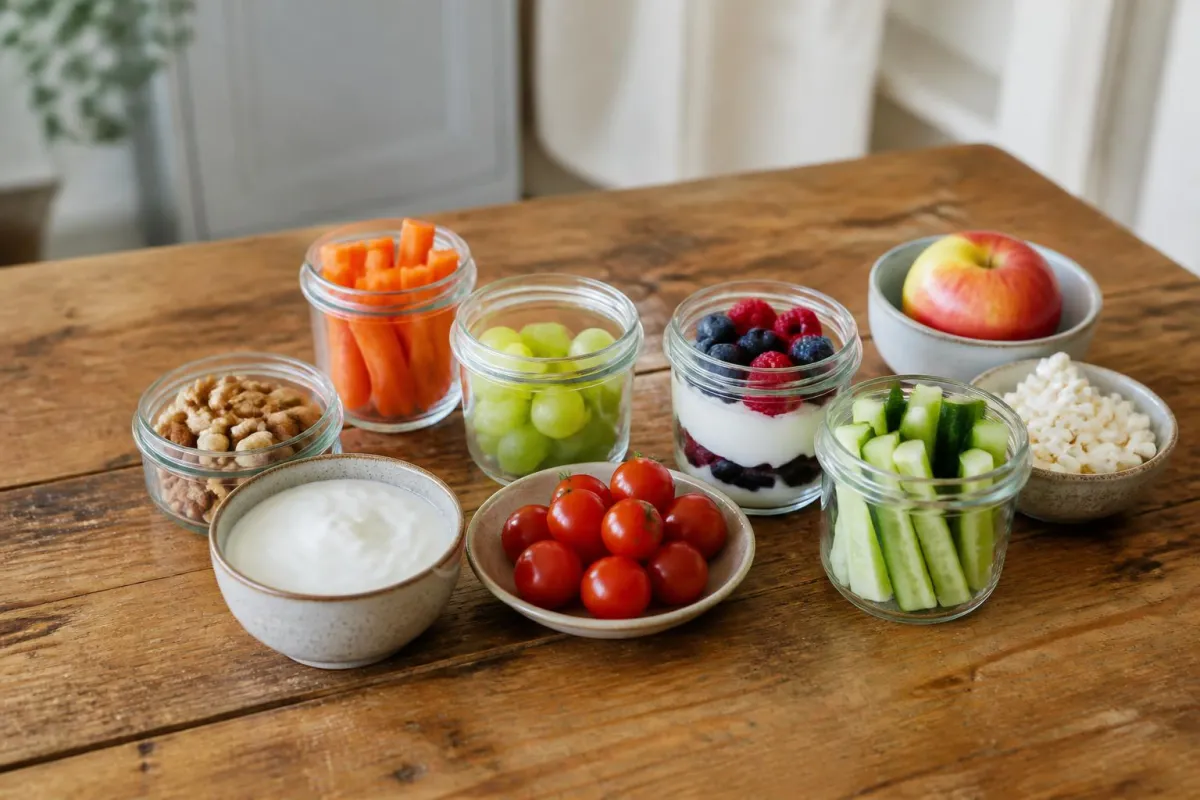
At home, refrigeration and basic preparation usually make things easier. This is where yoghurt, cut vegetables, toast, fruit, leftovers, boiled eggs, hummus or cheese may be realistic options if they suit you. The main advantage at home is flexibility. You can combine foods more easily, use up leftovers and choose something that is not packaged for portability. If evenings are when you become aimless around the kitchen, a prepared shelf in the fridge or a visible fruit bowl can matter more than buying unusual ingredients.
At work, the constraints are different. You may have limited fridge space, no proper kitchen, short breaks or food that sits in a bag until mid-afternoon. Here, durability and tidiness matter. Crackers, oatcakes, nuts, seeds, dried fruit, cereal bars, rice cakes and shelf-stable pots may be convenient, but they vary a lot, so labels still matter. If you do have access to a fridge, adding yoghurt, milk, fruit or a prepared sandwich can make the whole day easier. We have written more specifically about practical snacking at work for that setting.
Travelling adds another layer. Carrying space may be limited, refrigeration may disappear for hours, and the alternatives available en route may be expensive or narrow. In that situation, healthy eating ideas often mean planning for inconvenience rather than pretending it will not happen. A banana, a sandwich, a tub of grapes, a packet of plain nuts, a pot of yoghurt eaten before leaving, or crackers packed in a hard container may all be more practical than buying whatever is left at a station kiosk. For longer journeys, think about mess, smell, crushing and whether the food can be eaten without cutlery.
None of this needs to become a product list. The point is to match the food to the conditions. If there is no fridge, shelf stability matters more. If there is no time, preparation matters more. If you are carrying everything all day, weight and packaging matter more. The sensible choice changes with the circumstance.
How to organise food so the easier option is also the useful one
Organisation does a lot of the work that willpower is often asked to do. If the easier option is visible, ready and fits the day, you are more likely to use it.
Start with visibility. Foods you want to remember are easier to use when you can see them. That may mean fruit on the counter, yoghurt at eye level in the fridge, or a specific shelf for work snacks. Less useful choices do not need to be banned, but where things are placed affects what gets picked first.
Then look at timing. Many ordinary-day food problems are really timing problems. If lunch is late, a planned mid-morning snack may stop the 11.30am vending machine run. If the commute home is long, packing something at 8am may prevent buying the first thing available at 6pm. A practical routine often beats a perfect intention.
Storage matters as well. If you batch-cook or portion foods in advance, label containers if needed and use foods within the packet guidance. For chilled, frozen and defrosted items, the Food Standards Agency guidance is worth following. Appropriate chilling, freezing and defrosting help with food safety, and product instructions should be followed where they are provided Food Standards Agency food storage guidance.
For packed lunches and work bags, think in combinations rather than single items. A piece of fruit plus something more substantial may work better than fruit alone if you know you need staying power. Equally, if you tend to overpack food "just in case", a simple routine of one fresh item and one cupboard item may reduce waste.
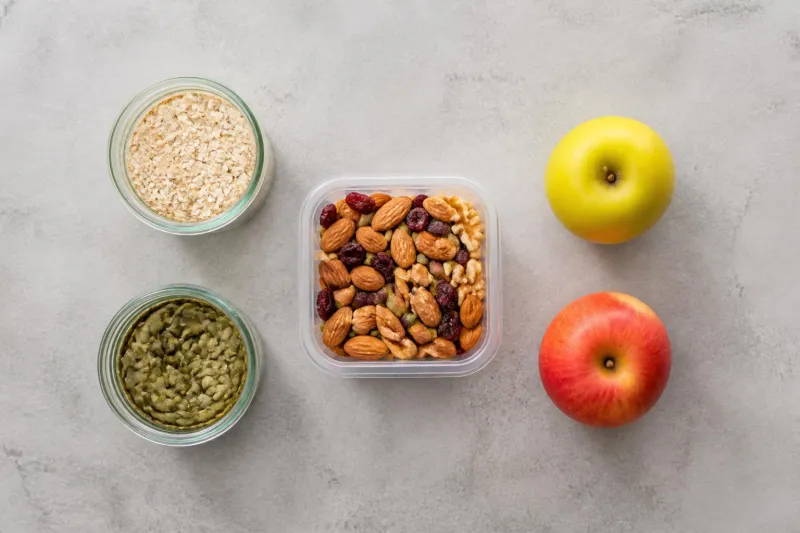
It also helps to keep a short list of fallback options. Not an aspirational meal plan, just a few combinations you can repeat without thinking. Toast and fruit. Yoghurt and oats. Crackers and cheese. Sandwich and apple. Nuts and a banana. Leftovers in a container. Repetition is not failure. It is often what makes decent routines stick.
At Healthy Snacking, we also try to be clear about what evidence can and cannot show. If you want to see how we handle that more broadly, our page on how we write about food evidence and uncertainty sets out the editorial approach we use at Fleeta Limited.
Where healthy eating advice has limits
General advice can help with comparisons and routines, but it does not decide what is suitable for every person. That limit matters.
First, broad guidance is not personal medical advice. The NHS Eatwell Guide is designed for the general population, and the NHS notes that some people may need advice tailored to their individual circumstances NHS Eatwell Guide. An article like this can explain patterns, labels and practical options, but it cannot tell an individual reader exactly what they should eat.
Second, labels and claims do not settle allergy or intolerance questions. Ingredients and allergen information still need to be checked on the actual product. The Food Standards Agency consumer guidance is clear that people with allergies or intolerances should use the ingredient list and allergen information to assess foods, rather than inferring suitability from general descriptions or front-of-pack messages Food Standards Agency consumer allergy guidance. Where UK and EU rules differ in presentation or regulatory detail, readers should still rely on the label on the product sold in the UK and any accompanying guidance relevant here.
Third, categories can mislead. Nuts, flapjacks, smoothies, protein bars, yoghurt drinks and savoury snack packs can all vary a lot. A food's reputation does not remove the need to read the packet. For example, if nuts are part of your routine, it is more useful to think about nuts in an overall eating pattern than to treat them as automatically better in every quantity and context.
Finally, evidence has gaps. We do not always have a neat answer to every everyday food question, and when evidence is limited or a claim goes beyond what guidance supports, we would rather say so than fill the space with certainty we do not have. If you want to see how we handle updates and mistakes, our page on corrections and evidence standards explains that process.
The most useful healthy eating ideas are usually the least dramatic. Compare labels carefully. Match food to the situation. Keep the wider week in mind. Make the easier option easier still. That is often enough to improve ordinary days without turning eating into a rulebook.