How to start eating healthier without strict food rules
Start with one repeatable change, not a full diet overhaul.
On this page
If you want to eat better without turning food into a set of strict rules, start smaller than you think. A healthier start usually means making everyday choices a bit easier, a bit more balanced and a bit more repeatable, not trying to make every meal and snack ideal from day one.
For most adults, the useful question is not “Was this snack perfect?” but “Is my overall pattern moving in a better direction this week?” That is a more realistic way to think about how to start eating healthy, especially if you are choosing food around work, travel, family routines and whatever happens to be in the cupboard.
What counts as a healthier start
A practical definition matters, because “healthy eating” is often treated as if it means a flawless diet, constant restraint or never eating convenience food. That is not a useful standard for ordinary life.
For UK adults, a healthier start usually means building a more balanced overall pattern of eating, with a mix of foods over the day and week rather than trying to get every single snack exactly right. The NHS Eatwell Guide is clear on this point. Balance is judged over time, not by expecting every meal or snack to match a model plate on its own.
That matters because snacks often get judged more harshly than meals. A biscuit at 3pm can end up carrying more guilt than it deserves, while a skipped lunch or an unplanned evening takeaway gets treated as normal. We think it is more helpful to ask:
- Are you eating regularly enough to avoid getting overly hungry?
- Do you have some options available that are filling, enjoyable and easy to reach for?
- Are you comparing similar products in a sensible way when you shop?
- Are you making decisions based on the actual packet, rather than front-of-pack marketing?
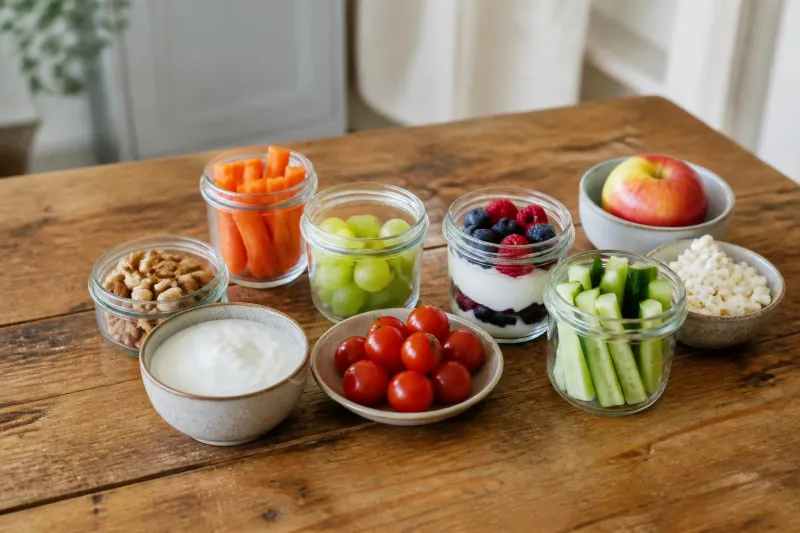
A healthier start can be as simple as adding one planned option to a routine that currently runs on chance. That might mean keeping a yoghurt and fruit at work, choosing a higher-fibre cereal bar after comparing labels, or making sure there is something ready to eat at home before the point where you are too hungry to think.
It also helps to drop the idea that foods are morally good or bad. Some foods are more useful in some situations. Some are less filling than they look. Some are convenient but expensive for what they provide. Some are enjoyable but easy to overbuy because the packet is larger than expected. Those are practical questions, not character judgements.
If you want more on this way of thinking, our guide to changing snack habits without turning them into rules sets out a similar approach.
Pick one change you can repeat this week
The most common mistake is trying to overhaul everything at once. New breakfast, packed lunch every day, no vending machine snacks, more cooking, better label reading, more water, fewer treats. It sounds committed, but it usually creates too many decisions at the same time.
A better starting point is one change you can repeat this week with minimal friction.
Good examples include:
- adding one planned afternoon snack on workdays
- checking labels on one product category you buy often, such as cereal bars, yoghurts or crackers
- keeping a simple backup option at work or in your bag
- putting ready-to-eat options where you can actually see them at home
- buying one extra item that stops the 5pm “there is nothing here” decision
The key word is repeat. A change only helps if it survives a normal Tuesday.
For example, if you often buy something random at a station because you missed lunch, your first change does not need to be “eat perfectly while travelling”. It could be “keep one shelf-stable backup snack in my bag and replace it every Friday”. If you regularly reach mid-afternoon and feel stuck between hunger and meetings, the change might be “put tomorrow’s snack next to my keys tonight”.
This is also where it helps to be honest about convenience. People often choose food that is nearest, visible and requires the fewest steps. That is not failure, it is ordinary behaviour. Use it. Put the option you want to remember at eye level. Keep a spoon at work if you buy yoghurt. Store unopened items where they will not get crushed or forgotten. If the routine depends on effort, it usually disappears first.
At Healthy Snacking, we write a lot about making snack choices workable in real life, not just theoretically sensible. Our piece on practical snacking at work may help if your week is shaped by desks, shifts, meetings or shared kitchens.
Use food labels without getting lost in them
Food labels are useful, but only if you use them for the right job. They are best for comparing similar foods, not for proving that one item is universally “healthy” and another is not.
The first thing to check is the basis of comparison. On UK labels, nutrition information is often shown both per 100g and per serving. The NHS guidance on reading food labels explains why this matters.
Use per 100g when you want a fair comparison between similar products. If two granolas, two flapjacks or two packs of hummus have different suggested portions, per 100g gives you a standard basis. It helps you compare fibre, sugar, salt or fat without the manufacturer choosing a convenient serving size for you.
Use per serving when the serving is realistic and relevant to how you actually eat the product. If a pot is clearly sold as one portion, per serving may be the more useful figure for real life. But it still pays to check the packet size. A “serving” can be smaller than what many people would normally eat, and some packets contain more than one serving even when they look like a single snack.
A few practical examples:
- If one cereal bar looks lower in sugar per serving, check whether its serving is simply smaller.
- If a soup shows moderate salt per serving, check how many servings are in the carton.
- If nuts, crackers or dried fruit look modest on the front of pack, the per 100g figures may still be high because these foods are concentrated. That does not make them bad choices, but it does affect comparison.
Front-of-pack claims need the same caution. A claim such as no added sugar tells you one specific thing only. It does not tell you the total sugar content, whether the product is filling, how much fibre it has, or how large the portion is likely to be. It can be relevant, but it is never the whole story.
The same goes for claims about fibre, protein or “natural” ingredients. They may be accurate within the rules, but they do not remove the need to read the rest of the label. If you want a clearer explanation of how claims work in practice, our guide to understanding food labels in everyday shopping is designed for exactly that job.
One more point for UK readers. Some food labelling rules are shared across Great Britain and the EU in broad structure, but product presentation can still vary by market and retailer, especially online or in imported goods. If you are comparing products bought in different places, always check the actual UK pack in your hand rather than assuming the website image or an EU version matches it exactly.
Make your routine easier at home, at work and while travelling
A lot of healthier eating is really about reducing last-minute decisions.
At home, that might mean putting ready-to-eat items where you will notice them first. Washed fruit hidden in the bottom drawer is less likely to be used than fruit in a bowl or a visible container in the fridge. Crackers, oatcakes or nuts kept in one known place are easier to use as part of a quick snack than items scattered across different cupboards. Leftovers that are properly cooled and chilled can become tomorrow’s easy option rather than tomorrow’s forgotten science project.
At work, think in layers:
- something ready to eat today
- one backup for days when plans change
- basic kit, such as a spoon, napkins or a container, if your choice depends on them
A backup option matters because many less-helpful snack decisions are really missing-lunch decisions or delayed-train decisions. The aim is not to carry a full pantry. It is to stop hunger from turning every choice into an emergency.
While travelling, convenience matters even more. Portable items can help, but so can planning around access. If you know you will only pass through a station with limited choice, decide earlier what to take. If your day includes a hotel room, long drive or shared vehicle, think about storage as well as preference.
Where chilled food is involved, follow the product instructions and basic storage guidance from the Food Standards Agency on chilling, freezing and defrosting food safely. In practice, that means not assuming a food will stay suitable indefinitely in a warm bag, and checking whether something needs to be kept refrigerated after opening. The packet instructions matter, especially for foods such as dairy products, prepared salads, dips and cooked leftovers.
A few routine fixes that often help:
- keep visible, easy options at the front of the fridge or cupboard
- portion loose items into containers if that makes them easier to take out
- replace finished backups as part of your weekly shop, not after you have already run out
- check “keep refrigerated”, “eat within” and freezing instructions before relying on a product for later in the week
- avoid buying only aspirational food that takes too many steps to eat
None of this is glamorous, but it is usually more effective than relying on willpower.
Build a snack habit that is practical rather than perfect
A practical snack habit sits at the overlap of convenience, enjoyment and useful information. If one of those is missing, the habit often falls apart.
Convenience matters because people eat what is available. Enjoyment matters because a snack you dislike is not a long-term solution. Label awareness matters because packaging can give a misleading impression if you never turn it over.
That does not mean every snack needs a checklist. It means having a rough toolkit. For example, you might rotate between:
- fruit with something more filling alongside it
- yoghurt or a yoghurt alternative, checking the packet for the details that matter to you
- crackers or oatcakes with a topping
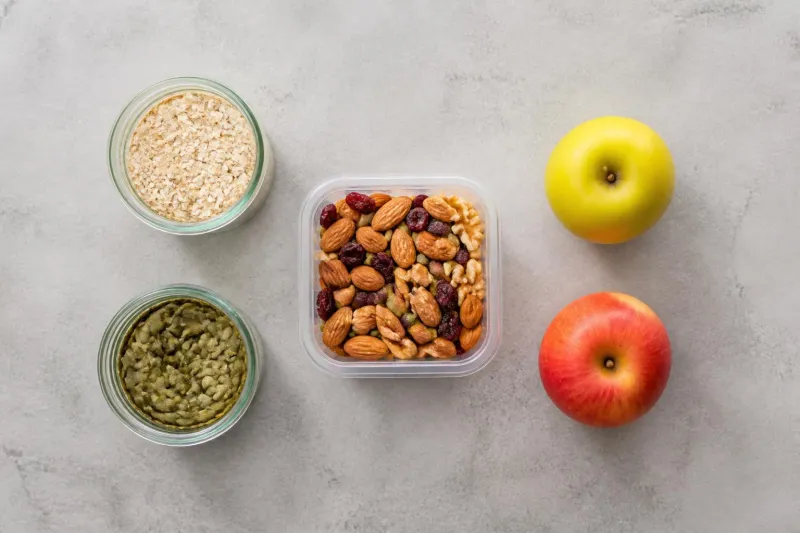
- nuts or seeds, if suitable for you and your setting
- a cereal bar that compares reasonably well with others in the same category
- leftovers that work cold and are stored according to the packet or food safety guidance
There is no prize for making snacks austere. Sometimes the practical option is the one you genuinely want to eat, because that is the one you will actually pack, buy or finish. A snack habit built entirely on self-denial usually breaks at the first stressful week.
This is also why lists of “healthy snacks” can be both useful and limited. They can give ideas, but they are not a complete diet plan and they do not tell you what suits your routine, appetite, budget, allergies, culture or preferences. Even foods with a generally positive reputation need context. For instance, nuts may fit well into an overall eating pattern for some people, but they are not automatically the right answer in every setting, and they are not suitable where allergy policies apply. We cover some of that nuance in our article on nuts in an overall eating pattern.
If you are trying to work out how to start eating healthy in a way that lasts, this is often the real skill, building a short list of options you can live with, not proving discipline through restriction.
Know when a label cannot answer the question
Labels are useful, but they have limits.
A nutrition panel can help you compare products. An ingredient list can tell you what is in the food. Allergen information can flag legally declared allergens. But a packet cannot answer every personal question about suitability.
That is especially important for allergies and intolerances. The Food Standards Agency consumer guidance on food allergy and intolerance is the right starting point here. If you need to avoid a specific ingredient or allergen, check the actual packet each time, because recipes and manufacturing details can change. Do not rely on memory, a general article, or a front-of-pack claim.
The same principle applies more broadly. A claim such as gluten free, high in protein or no added sugar may tell you one thing, but not everything else you need to know. Ingredient lists, allergen statements, storage instructions and packet size may matter just as much as the headline claim.
General guidance also cannot replace individual advice. The NHS Eatwell Guide is for the general population, and the NHS notes that some people may need more specific advice depending on their circumstances. That is outside what we do at Healthy Snacking. We are an editorial publication by Fleeta Limited, not a clinic, diet programme or personal advice service.
What we can do is help you ask better everyday questions:
- Am I comparing like with like?
- Am I reading per 100g or per serving, and does that change the picture?
- Is this packet likely to be eaten as one portion or several?
- Am I being influenced by one claim more than the full label?
- Have I checked the ingredients, allergens and storage instructions that actually matter here?
Those questions are often enough to make food choices calmer and more consistent, without turning eating into a project.
A healthier start does not need strict rules. It needs a workable definition, one repeatable change, and enough label awareness to see past the packaging. If you want to keep building from there, our editorial approach to evidence, labels and uncertainty explains how we handle these topics across Healthy Snacking.