Food labels that keep your fridge and desk drawer organised
Storage labels help you track what a food is, when it was opened and how it should be used.
On this page
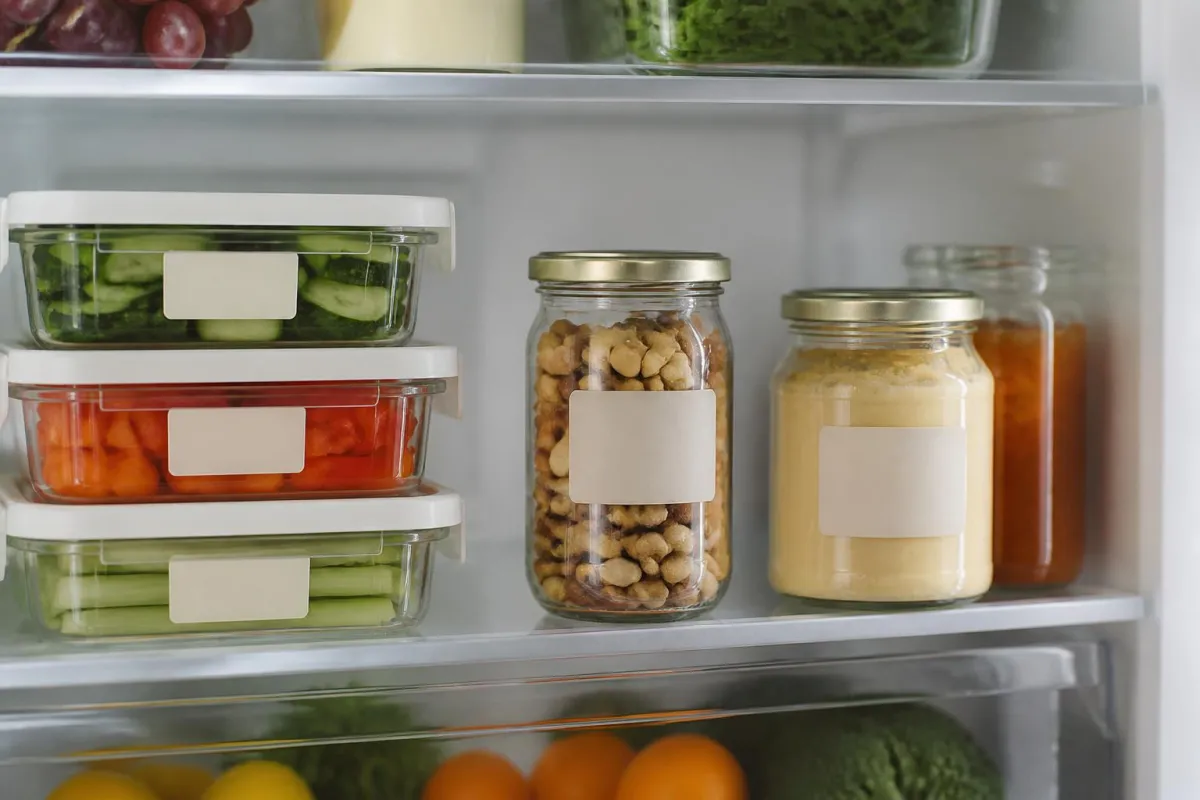
If you decant food into clear tubs, jars or lunch pots, the label on the original pack often disappears at the exact moment you still need it. A simple labelling habit helps with three ordinary jobs, knowing what something is, knowing when you opened it, and avoiding confusion over how long it should stay in the fridge or freezer.
For most adults, the best food storage labels are not long or elaborate. A short note with the food name, the date opened or cooked, and any useful storage instruction is usually enough. The key point is that your own label should support the original packaging, not replace it. Manufacturer instructions, ingredients and date marks still matter, especially for chilled food, frozen food and anything that could affect someone with an allergy.
What food storage labels are actually for
In real kitchens, labels are less about making shelves look tidy and more about stopping avoidable mix-ups.
At home, that might mean telling plain yoghurt from Greek-style yoghurt once both are in similar tubs, or knowing whether a leftover pasta sauce was made yesterday or four days ago. In a shared house, it can mean avoiding the familiar problem of three near-identical containers in the fridge and nobody knowing which one is theirs. At work, it often means the desk drawer version of the same issue, opened crackers, mixed nuts, teabags, dried fruit or cereal bars moved out of their outer box and then separated from the packet details.
Good storage labels do three practical things.
First, they identify the food. That sounds obvious, but it matters most when foods look similar. A tub of couscous can look much like bulgur wheat. A jar of one spice blend can be mistaken for another. A homemade flapjack and an oat bar from a multipack may look interchangeable once wrapped for later.
Second, they track timing. The useful question is not only when the product was bought, but when it was opened, cooked or frozen. Many foods have instructions such as "once opened, keep refrigerated and use within..." or "eat within..." a stated period. If you throw away the packet and rely on memory, those instructions are easily lost.
Third, they reduce mix-ups about storage and use. A label can remind you that a dip needs refrigeration after opening, that cooked rice was frozen on a specific date, or that a snack tub contains a food someone in the office avoids for allergy reasons.
This is where food storage labels earn their keep. They are not a substitute for food safety guidance, and they are not a nutrition project. They are a small organisational tool that helps you use the information you already have.
Which details are worth writing on a container
Most containers do not need a full rewrite of the packet. If you try to copy every line, you will stop doing it. We find a short, repeatable set of details works better.
Start with the name of the food. Be specific enough that another adult could recognise it without opening the lid. "Tomato soup" is better than "soup". "Peanut satay sauce" is better than "sauce". "Wholemeal wraps" is better than "wraps" if you keep more than one type at home.
Then add the date that matters most for that item. Usually that is one of these:
- Opened on
- Cooked on
- Frozen on
- Packed for lunch on
For many cupboard snacks, "opened on" is enough. For leftovers, "cooked on" is more useful. For batch cooking or bread frozen in portions, "frozen on" matters most.
If the packet gives a specific instruction after opening, copy that too, but keep it short. For example:
- Keep refrigerated after opening
- Use within 3 days of opening
- Store in a cool, dry place
- Do not refreeze once defrosted
If there is a date mark on the original pack that still matters, keep that visible if you can, or write it down clearly. In the UK, "use by" and "best before" do not mean the same thing. A use-by date is about safety and should be followed for perishable food. A best-before date is about quality rather than safety, though the food still needs to have been stored according to the instructions. Where a rule is discussed across Europe, note that UK date marking and food information rules are now set under UK law, even where they remain similar to EU practice.
For some foods, ingredients or flavour also deserve a note. This is especially useful if you decant similar products into matching jars. "Muesli with almonds" is more useful than "muesli". "Chilli hummus" is more useful than "hummus".
What usually does not need to go on the storage label is the full nutrition panel. If you want to compare products, the packet is the better source, and the basis matters. The NHS notes that per 100g and per serving are different comparison bases, so copying a single calorie or sugar figure onto a tub without context can mislead rather than help (NHS guidance on reading food labels).
How to use packet information without misreading it
The easiest mistake is copying information from the front of pack and assuming it tells the whole story.
A claim such as no added sugar may be relevant, but it does not tell you everything about the food, and it does not belong on every storage label. Nor does "high protein" or "source of fibre" unless you have a specific reason to note it. Those are packet claims, not usually storage instructions.
If you do copy nutrition information for convenience, make sure you copy the basis as well. "12g sugar" means very little on its own. Is that per 100g, per serving, or for the whole pack? The difference matters. The NHS specifically advises using nutrition information carefully because a portion and 100g are not the same basis for comparison (NHS food labels guidance). We cover that in more detail in our guide to comparing labels on a per 100g and per serving basis.
This comes up often with repacked snacks. You buy a multipack, split it into a desk drawer tub, and write one or two figures on the lid. Later, nobody remembers whether those figures came from one biscuit, one bar, a suggested serving, or 100g. That is why the original packet still matters.
A practical approach is this:
- If you decant food, keep the packet until the food is used up when possible.
- If the packet is bulky, cut out or photograph the part with the product name, ingredients, allergens, date mark and storage instructions.
- If you write nutrition details on a container, include the unit and basis, such as "per serving" or "per 100g".
This is also useful when front-of-pack wording sounds simpler than it is. For example, no added sugar does not mean sugar-free, and it does not tell you whether the product contains naturally occurring sugars from ingredients such as fruit or milk. If that distinction is relevant to you, our explainer on what no added sugar and low sugar claims actually mean sets out the difference.
Dates, chilling and freezing without guesswork
A homemade label is helpful, but it should not overrule the packet.
For chilled food, the manufacturer may give instructions such as "keep refrigerated", "store below 5C", or "once opened, consume within 2 days". Those instructions are there for a reason. The Food Standards Agency advises following storage instructions on labels and keeping chilled food appropriately cold as part of safer food storage (Food Standards Agency guidance on chilling, freezing and defrosting food safely).
That matters because your own system cannot tell you what the manufacturer already knows about the product. Two dips may look similar in the fridge, but one may last longer after opening than the other. A cooked meat product, a fresh sauce and a hard cheese do not all behave the same way once opened.
Use-by dates need particular care. If a food carries a use-by date, your label should help you keep track of it, not create a new homemade deadline that stretches beyond it. If you move the food into another container, write the use-by date on the new container or keep the original label attached if possible.
Freezing adds another layer. Some foods can be frozen before the use-by date if the packet says this is suitable, but the date matters. If you freeze food, write "frozen on" and what it is. If the packet says use within a certain time after defrosting, keep that instruction with it. If the packet says do not refreeze once defrosted, follow that rather than relying on memory.
For leftovers and home-cooked food, a simple date label is still useful, but it is not a guarantee. Your own note can tell you when something went into the fridge or freezer. It cannot by itself confirm whether it was cooled, stored and reheated properly. If you are in doubt, the cautious option is not to keep guessing.
In shared homes and office kitchens, fridge labels can also help with ownership and rotation. A small "opened 14 Oct" or "brought in Monday" note often does more than a colour-coded system that nobody sticks to after a week.
Allergens, shared kitchens and repacked snacks
This is the part people often underestimate.
When food is moved from its original pack into a jar, tub, sandwich bag or snack box, ingredient and allergen information can disappear completely. That may be mildly inconvenient in a single-person kitchen. In a shared household or workplace, it can be a serious problem.
The Food Standards Agency's consumer allergy guidance explains why ingredient information and allergen information matter, and why people should not infer suitability from a general label or from appearance alone (Food Standards Agency consumer allergy guidance). A biscuit containing nuts does not look obviously different from one without them. A savoury mix may contain milk, mustard, sesame or peanuts even if the individual pieces look familiar.
That means repacked snacks need more care than many people give them. If you portion trail mix into small tubs, or move crackers into a desk drawer container, it helps to keep a note of the product name and ingredients source. If you are taking food into a shared office, "oat bites" is not enough information for someone managing an allergy. Nor is "vegan", "dairy-free", or "gluten-free" a complete substitute for the actual ingredient and allergen details, and we should not tell readers that a food is safe for a particular person.
A practical compromise is to label foods in one of these ways:
- Product name plus keep the original wrapper or outer box nearby
- Product name plus a photo of the ingredients and allergen panel on your phone
- Product name plus a note such as "contains peanuts" or "contains milk", if that information is clear from the pack
In a household, this can also help with less formal but still important mix-ups, such as vegetarian and meat products stored in similar containers, or caffeinated and decaffeinated snacks and drinks kept side by side.
If you want a clearer grounding in what labels can and cannot tell you, our page on understanding the main parts of food labels is a useful companion to any home labelling system.
A simple labelling system most adults will keep using
The best system is the one you will still be using in a month.
For most people, that means keeping it light. You do not need a label printer, matching fonts or a spreadsheet for the snack cupboard. A roll of masking tape and a pen are enough for many households. Reusable wipe-clean labels can work well for jars and freezer tubs if you actually remember to update them.
A practical low-effort system looks like this.
For the fridge: Write the food name and the opened or cooked date. Add any key instruction copied from the packet, such as "use within 3 days" or "keep refrigerated". For leftovers, include a short description that distinguishes one meal from another.
For the freezer: Write the food name and frozen date clearly. Portion names help, such as "chilli, 1 portion" or "sliced bread, 4 slices". If the original pack had a useful instruction for defrosting or post-defrost use, keep that with the food if possible.
For the cupboard: Label decanted staples and snacks with the name and, where useful, the best-before date from the packet. This matters more for foods you buy infrequently, foods in identical jars, and items that can go stale after opening.
For desk drawers and work snacks: Use the shortest useful version. Usually that is product name plus opened date. If the snack has notable allergen information that could matter in a shared space, keep the wrapper or write a brief note rather than relying on memory.
For shared kitchens: Add a name or initials if ownership matters. That is not a food safety issue in itself, but it does stop the "mystery tub" problem that leads to waste.
The aim is organisation, not perfection. Food does not become morally better because it has a neat label, and a snack does not need a nutrition summary written on the lid to be a sensible choice. The NHS Eatwell Guide also makes the broader point that dietary balance is considered over time, not demanded from every individual snack or meal (NHS Eatwell Guide).
If you want to make this easier, choose one rule per storage area and keep it consistent. For example:
- Fridge tubs get name plus date
- Freezer items get name plus frozen date
- Decanted snacks keep the original packet until finished
That is enough structure to reduce waste and confusion without turning your kitchen into an admin task.
At Healthy Snacking, published by Fleeta Limited, we prefer systems that help people use food labels accurately and realistically. A good label on a container should answer the next practical question you are likely to have. What is it, when was it opened, and do I still need the original packet for the rest? If your system does that, it is doing its job.