How to read no added sugar orange juice labels
"no added sugar" means sugar has not been added, not that the drink contains no sugar
On this page
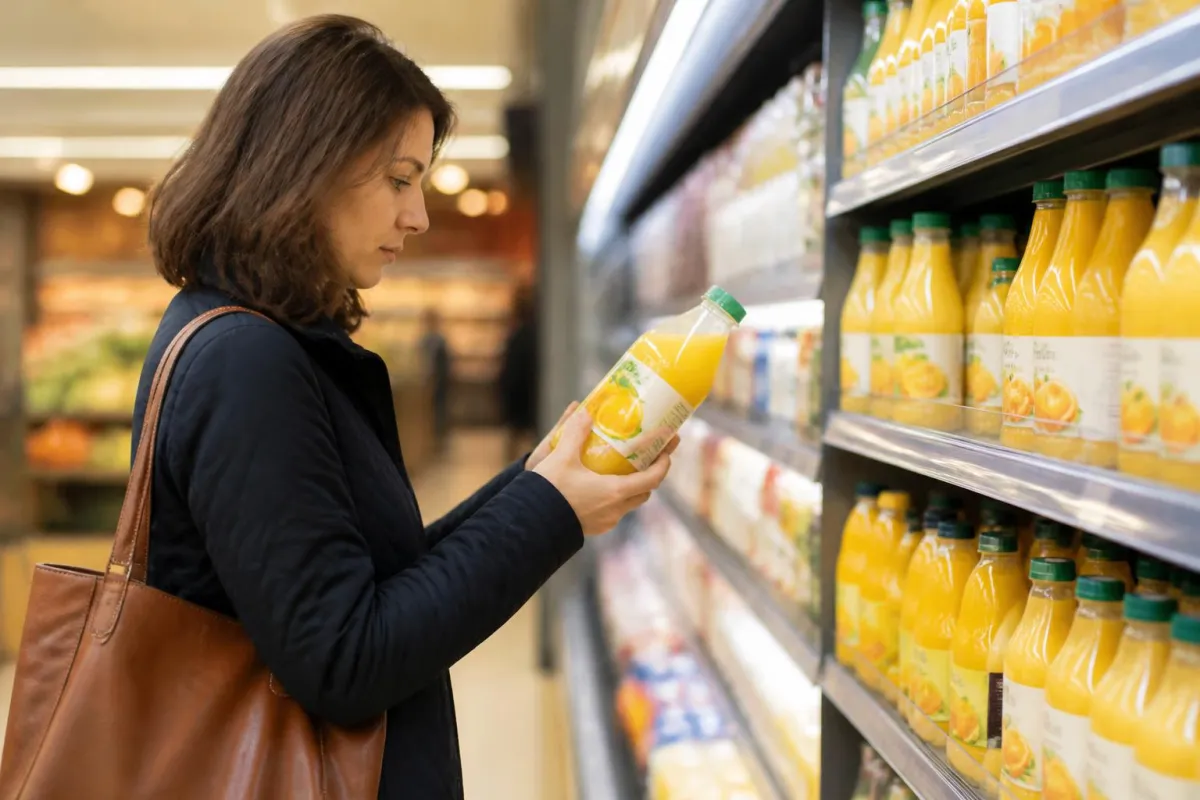
Reading a label for orange juice starts with one simple point. If a carton says no added sugar, that tells us something specific about what has not been put into the product. It does not tell us that the drink contains no sugar at all. Orange juice naturally contains sugars from the fruit, so the total sugar on the nutrition table can still be substantial even when the front of pack says no added sugar.
That is why we read past the headline claim. To compare one orange juice with another properly, we need to check the nutrition table, the ingredients list, whether it is from concentrate, the actual serving size used on pack, and the storage instructions. Used that way, the label gives a much clearer picture than the phrase no added sugar on its own.
What no added sugar means on an orange juice label
On a UK label, no added sugar is a narrower claim than many people assume. In ordinary shopping language, it means sugars have not been added during manufacture. It does not mean sugar free, and it does not mean the product is low in sugar.
That distinction matters especially with juice. Oranges naturally contain sugars, and those sugars remain in the juice. So a carton of no added sugar orange juice can still show a notable sugar figure in the nutrition table. There is no contradiction there. The claim is about added sugars, not all sugars.
This is also why we advise reading no added sugar alongside the rest of the label, not as a verdict on the whole drink. If you want a short companion explanation of the claim itself, our guide on what no added sugar tells you on a UK food label covers the wording in more detail.
Where rules differ, it helps to be precise. In Great Britain, food information rules are retained UK law. In the EU, parallel rules apply under EU legislation. The practical meaning shoppers see on pack is often very similar, but businesses still have to follow the rules that apply in the market where the product is sold. For a UK reader choosing juice in a British supermarket, the useful point is this: no added sugar is not the same claim as low sugar, and it does not remove naturally occurring sugars from orange juice.
It also does not tell us anything definite about sweetness from other ingredients unless we inspect the full label. If a product is not simply orange juice, but an orange juice drink or blend, the ingredients list becomes even more important. Front of pack wording can be brief. The back of pack usually tells us what the product actually is.
How to compare orange juice properly
The most reliable way to compare orange juice is to keep your units straight. Use per 100g to compare one product with another on a like for like basis. Use per serving to estimate what you might actually drink. Do not switch between the two halfway through a comparison.
The NHS makes this point clearly in its guidance on food labels, noting that a portion and 100g are different comparison bases, and that the nutrition information helps us compare foods and drinks NHS food labels guidance.
For orange juice, the nutrition panel may be given per 100ml rather than per 100g, because it is a drink. Some packs still use per 100g in general label discussions, and the same principle applies. The key is consistency. If one carton gives values per 100ml and another does the same, compare those figures first. If the pack also gives values per serving, treat that as a separate layer of information.
Here is the practical method we use.
First, compare the sugar and energy figures on the same basis, ideally per 100ml or the equivalent standard basis shown on each pack. That tells us how concentrated the drink is relative to another juice.
Second, look at the serving size the manufacturer has chosen. One brand may call 150ml a serving. Another may use 200ml or a full bottle. If we compare per serving figures without noticing that difference, we can end up thinking one juice is very different from another when the serving sizes are doing much of the work.
Third, check the pack size and think about your actual glass. A small breakfast glass, a large tumbler, a reusable bottle and a desk mug can all hold very different amounts. If a carton is one litre and your usual glass is generous, the amount you actually pour may be well above the serving used in the nutrition table. That does not make the label misleading, but it does mean the per serving line may not match your real habit.
This matters in ordinary life. At home, someone may pour a modest glass with breakfast. At work, the same person may fill a larger cup because that is what is available in the kitchen. While travelling, a single serve bottle can become the default amount simply because it is pre-portioned. The label can help with all of those situations, but only if we notice what unit we are reading.
A useful cross-check is to ask two separate questions.
- How does this juice compare with another juice on a standard basis?
- How much do I usually drink at one time?
The first question is answered by per 100g or per 100ml style comparisons. The second is answered by the serving line only if the serving resembles your real pour. If it does not, do the comparison mentally using the amount you actually drink.
What to check beyond the front of pack
The front of pack gives a quick signal. The back and side panels usually tell us far more.
Start with the ingredients list. If the product is straightforward orange juice, the list may be very short. If it is a juice drink, blend or mixed beverage, the ingredient order helps us see what proportion is juice and what else has been included. We should not assume that a bright orange carton is pure juice without checking.
Next, look for wording such as from concentrate or not from concentrate. Neither phrase is a moral ranking. They describe how the juice was produced or prepared. Some shoppers have strong preferences, but the label wording is there to identify the product accurately, not to tell us which one suits every person or every use. If you are comparing value, taste expectations or storage convenience, that wording may matter. If you are comparing sugar figures, the nutrition table matters more than assumptions about the phrase itself.
Then read the nutrition table carefully. Check the basis used, often per 100ml and per serving. Look at energy, sugars and any other values relevant to your comparison. If one carton uses a serving size that seems unusually small or large, do not let that dominate your judgement. Return to the standard basis.
Storage instructions are also worth checking. Orange juice may need refrigeration before opening, after opening, or both, depending on the product. Some shelf stable cartons can be stored in a cupboard until opened, while chilled products need refrigeration from purchase. The Food Standards Agency advises consumers to follow product storage instructions and keep chilled foods appropriately cold Food Standards Agency food storage guidance. For a household or office fridge, that is practical information, not small print to ignore. It affects waste, convenience and how quickly the carton should be used once opened.
Allergen information matters too, even where orange juice sounds simple. The Food Standards Agency consumer guidance explains why ingredient and allergen information should be checked directly, rather than inferred from a general claim or a familiar product type Food Standards Agency consumer allergy guidance. We should not assume personal suitability from no added sugar, from fruit imagery, or from previous versions of the same brand. Recipes and manufacturing information can change.
In practice, the front of pack claim is only one line of the story. The ingredient list tells us what it is. The nutrition table tells us what it contains in measurable terms. The storage instructions tell us how to keep it. The allergen information tells us what needs checking for personal safety.
Where orange juice fits in everyday eating
Orange juice is one item in a wider pattern of eating and drinking, not a stand-alone test of whether someone is doing things properly. At Healthy Snacking, that broader view matters because labels are easiest to use when we stop expecting one product claim to settle every question.
For many adults, orange juice appears in routine situations rather than special ones. Breakfast at home, a packed lunch for work, a meeting room fridge, a train station meal deal, a hotel breakfast machine, or a carton kept in the office kitchen are all ordinary examples. In those settings, the useful question is rarely “Is this a perfect food?” It is usually “What am I choosing here, and how does it fit with the rest of the day?”
The NHS Eatwell Guide frames balance over a day or week rather than demanding that every individual item do everything at once NHS Eatwell Guide. That is a helpful mindset for reading juice labels. A glass of orange juice does not need to carry claims it cannot support, and it does not need to be treated as the whole diet in liquid form.
At home, some people keep juice for occasional breakfasts. Others use it more regularly because it is easy to store and quick to serve. In workplaces, juice may be available in a communal fridge, bought with lunch, or poured at events where options are limited. While travelling, a small bottle may be chosen because it is sealed, portable and familiar. None of those contexts is automatically better or worse. They simply change what label details matter most.
For example, pack size may matter more in a household trying to reduce waste. Storage instructions may matter more in a workplace kitchen where cartons are opened and shared. Per serving figures may matter more for single bottles bought on the go, because the whole container is likely to be consumed at once.
If you regularly compare juice with other drinks, it can also help to separate different aims. Sometimes you are comparing sugar figures. Sometimes you are comparing convenience, shelf life after opening, or whether the carton fits in a bag or office fridge. Sometimes you are simply deciding whether the wording on the front matches the product inside. Labels can support those decisions, but they cannot make them for us.
Common label traps and uncertain assumptions
The most common trap is assuming that no added sugar means low sugar. It does not. For orange juice, naturally occurring sugars can still make the total sugar figure fairly high. If that distinction is the main thing you want to understand, we have a separate guide on no added sugar and low sugar label claims.
A second trap is assuming it must be lower in energy than another juice. Sometimes products differ, sometimes they do not, and the claim itself does not guarantee the outcome. Check the nutrition table rather than inferring it from the headline.
A third trap is assuming it is better value. Value depends on more than one claim. You may be comparing juice content, whether it is from concentrate, pack size, chilled versus ambient storage, and how much is likely to be wasted after opening. A larger carton can look cheaper in one sense and still be poorer value for a small household if part of it is not used in time.
A fourth trap is assuming personal suitability. A no added sugar orange juice label does not tell us whether a product suits a particular medical need, allergy, intolerance or dietary plan. That kind of judgement depends on the full label and, where relevant, appropriate professional advice. We do not treat front of pack claims as a substitute for that.
A fifth trap is overconfidence when the label detail is limited. Sometimes a product image online shows only the front of pack. Sometimes a café fridge gives us little more than the bottle front. Sometimes a workplace multipack outer case is discarded before anyone reads the full information. In those situations, it is sensible to recognise what we do not know. If the ingredients, allergen details or full nutrition table are not visible, we should avoid filling in the gaps with assumptions.
Another easy mistake is comparing orange juice with a different type of drink and forgetting that the product categories are not identical. A juice, a juice drink, a squash, and a flavoured water can all sit in the same shop fixture while being labelled on very different bases. The front of pack phrase no added sugar may appear across several categories, but it does not make them nutritionally equivalent.
Finally, watch for serving-size theatre. A per serving line can be useful, but only if the serving is realistic for how the product is actually consumed. If a bottle is likely to be drunk in one go, a tiny serving definition may not help much. If a family carton is usually shared, a single large serving may not reflect real use either. The label is not wrong for giving a serving, but we still need to interpret it.
If you want another example of how this works in a different drink category, our piece on reading no added sugar cranberry juice labels shows how similar wording can still require category-specific checking.
The practical takeaway is simple. Read no added sugar as one narrow claim, not a complete verdict. Compare like with like, using per 100g or the equivalent standard basis first. Then check the serving size, ingredients, nutrition table, storage instructions and allergen information. That approach is slower than trusting the front of pack, but it is usually the quickest route to an informed choice.