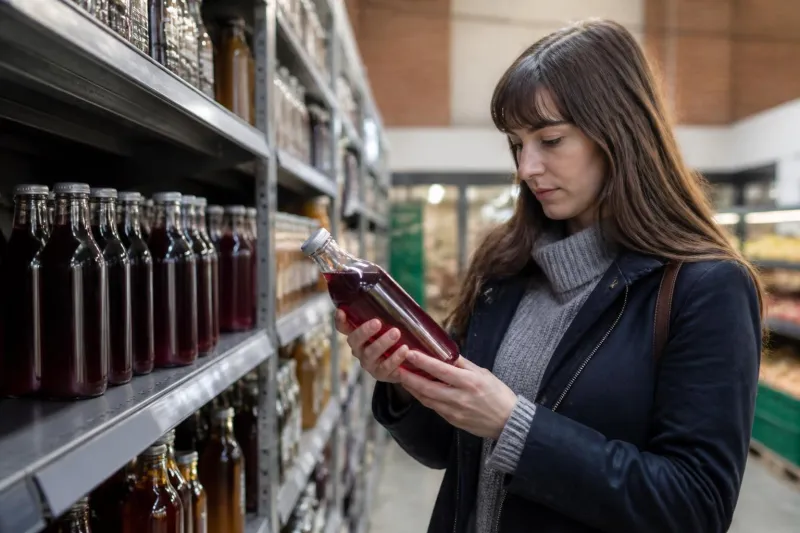
How to read jelly labels without guessing
no added sugar does not mean sugar-free
On this page
Reading a jelly label gets much easier once you stop treating one claim as the whole story. If a pack says No Added Sugar jelly, that tells you something specific about added sugars in the recipe, but it does not tell you everything about total sugars, energy, portion size, storage, or whether the product suits your own preferences.
The quickest way to avoid guessing is to read the label in a set order. Start with the product name, then the ingredients, then the nutrition table, then the portion information. That helps you see what the claim means in context, rather than assuming it means sugar-free, low sugar, or automatically lower in calories.
What no added sugar jelly actually means
On a UK food label, the claim no added sugar has a defined use. In plain terms, it means the product has not had sugars added to it as an ingredient, and it must not contain another ingredient used for its sweetening properties instead of sugar. That is the core meaning readers should keep in mind.
What it does not mean is just as important.
A No Added Sugar jelly is not automatically sugar-free. If the recipe contains ingredients that naturally contain sugars, those sugars can still be present in the finished product. For jelly, that might come from fruit, fruit juice, fruit purée or similar ingredients, depending on the recipe.
It is also not automatically low in energy. People often assume that taking added sugar out of a product must make it low-calorie, but labels do not work that way. A jelly may still contain energy from other ingredients, and the amount you actually eat matters too. The claim tells you about one aspect of formulation, not the whole nutritional picture.
It also does not tell you whether the product is sweetened with sweeteners. Some jellies use sweeteners instead of sugar. That may affect the taste, ingredients list and nutrition table, but the presence of sweeteners does not, by itself, make a product better or worse. It simply means you need to read beyond the front of pack.
This is one reason we often suggest reading similar claims side by side. If you want a broader explanation of how the wording differs from other claims, our guide to No added sugar and low sugar label claims sets out the distinction in plain English.
Which part of the label matters most first
A sensible reading order saves time and cuts down on assumptions.
First, check the product name. Is it actually jelly, jelly crystals, a ready-to-eat jelly pot, or a fruit dessert that uses jelly-like wording? The product name tells you what category you are looking at. That matters because preparation, ingredients and portion sizes can vary a lot between an instant mix and a chilled pot.
Second, read the ingredients list. This is where you see what is doing the work in the recipe. Look for fruit juice, fruit juice from concentrate, purée, gelling agents, acids, flavourings, colours and sweeteners. Ingredients are listed in descending order by weight at the time of manufacture, so the order gives useful context.
Third, move to the nutrition table. The NHS advises using nutrition information to compare foods, and it is important to notice whether you are looking at values per 100g or per portion, because those are different comparison bases NHS food labels guidance. On jelly, the lines people usually look at first are energy and sugars, but it can also help to note fibre if fruit ingredients are present, and salt if you are comparing across dessert products more generally.
Fourth, check the portion information. This is where many misunderstandings happen. A pack may state nutrition per serving, but the serving may be smaller than what you would actually eat, or the pack may contain more than one serving. If it is a prepared jelly mix, the stated values may depend on making it up exactly as directed.
Finally, look at storage and allergy information before buying or packing it for later. For a snack that seems simple, jelly can still come with instructions that matter.
If you want another example of reading this claim in context rather than in isolation, our piece on what no added sugar tells you on a UK food label covers the same principle across other products.
Why per 100g and per serving can tell different stories
This is the part of the label that makes two similar products look more different than they really are.
The NHS guidance on food labels is straightforward here. Use per 100g figures to compare products fairly, because pack sizes and serving sizes vary. Per serving can still be useful, but only after you understand what one serving means and whether it matches what you are likely to eat NHS food labels guidance.
For jelly, this matters in a few common ways.
A ready-to-eat pot might look low in sugars per serving because the pot is small. Another product might look higher per serving simply because the stated serving is larger. If you compare only the per serving line, you may be comparing different amounts of food.
A jelly crystal product can be even trickier. The label may show values for the prepared jelly rather than the dry crystals. If one brand gives nutrition for the made-up product and another gives it for the dry mix as sold, a quick glance can mislead you. You need to read the wording around the table carefully.
Per 100g helps level this out. It gives you a standard basis for comparison, whether one pack contains a single pot, four small pots or a sachet that makes a bowlful. Once you have used per 100g to compare like with like, then per serving helps you judge how that product fits into your own day.
That second step matters because portion sizes are not neutral facts of nature. They are manufacturer-declared serving suggestions. Sometimes they are practical. Sometimes they are optimistic. If a pot contains one serving, that is simple enough. If a tub says it contains two servings but you know you usually finish it in one go, then the per serving line is not the best guide to what you will consume.
The most useful habit is this: compare products per 100g first, then sense-check the actual amount you are likely to eat. That gives you a cleaner reading than relying on front-of-pack impressions.
What ingredients can still be doing the sweetening
When a jelly says no added sugar, readers often want to know what is making it taste sweet instead. There is no single answer, and the label patterns vary.
One common pattern is fruit ingredients. You might see fruit juice, fruit juice from concentrate, fruit purée or pieces of fruit. These can contribute naturally occurring sugars and flavour. Their presence does not automatically make the product high in sugar, and it does not automatically make it low in sugar either. You still need the nutrition table.
Another common pattern is sweeteners. The ingredients list may name specific sweeteners, and the pack may also state that it contains sweeteners. This can explain why a jelly tastes sweet while the sugars line remains relatively modest. Again, that is descriptive, not a value judgement. Some people prefer products with sweeteners, some prefer products without them, and some simply want to know what they are buying.
You may also see concentrates in the ingredient list. Concentrates can add flavour and naturally occurring sugars depending on what they are and how much is used. The label claim does not tell you the full role of those ingredients on its own.
There are also products where the sweetness comes from a combination of fruit ingredients and sweeteners. In those cases, the front of pack can sound simple while the recipe itself is more mixed. That is exactly why the ingredients list matters.
What you should avoid is assuming that one ingredient pattern automatically means a healthier or less healthy choice. A label is a source of facts about composition, not a moral ranking system. For practical reading, the better question is, what is sweetening this product, how much sugar does the nutrition table show, and what amount am I likely to eat?
If you want to practise this skill on another spreadable fruit product where similar assumptions often appear, our guide to how to read no added sugar jam without guesswork is a useful comparison.
How to fit jelly into everyday snacking without overthinking it
For most adults, jelly is easiest to manage as just one snack or dessert option among many. It does not need to carry the burden of being a perfect food, and it does not need to be ruled in or out by one claim.
The NHS Eatwell Guide is helpful here because it frames balance across the day or week, not as something every single snack must achieve on its own NHS Eatwell Guide. That is a practical way to think about jelly at home, at work or while travelling.
At home, that might mean keeping a few chilled jelly pots for times when you want something easy and portioned. It might also mean making up a larger jelly and serving some with other foods you already enjoy, depending on appetite, convenience and what else you are eating that day.
At work, a ready-to-eat pot may be useful because there is no prep and the portion is clear. If you rely on workplace fridges, check whether the product needs to stay chilled and whether the pack can be resealed. Those are ordinary label questions, but they matter more in real life than broad claims do.
While travelling, the practical points become even more important. Is the jelly shelf-stable before opening, or does it need refrigeration? Is it likely to split, leak or get crushed in a bag? If you are comparing a jelly pot with another snack, the best choice may simply be the one that stores safely and fits your day.
There is also no need to turn one label claim into a daily rule. Some people like the taste and texture of No Added Sugar jelly. Others prefer a different snack entirely. Reading the label properly lets you choose on purpose, without pretending the product is something it is not.
Checks that matter for storage and allergies
Storage instructions are easy to skip, but they are there for a reason. Some jelly products are sold chilled and need to stay chilled. Others are shelf-stable until opened. Some mixes need refrigeration after preparation. Follow the packet instructions, especially once the product has been opened or made up. The Food Standards Agency guidance on chilling and storage is a useful reminder that correct storage helps manage food safety, and product instructions should be followed Food Standards Agency food storage guidance.
For prepared jelly mixes, read the method as well as the storage line. The final product may only keep for a limited period in the fridge, and that can differ from the shelf life of the unopened sachet or block. If you are taking jelly to work or on a journey, think about how long it will be out of the fridge, not just how it was stored at home.
Allergy checks matter too. Do not rely on the product type, flavour, or a familiar brand look. Read the ingredients list and allergen information every time, because recipes can change and similar-looking products can differ. The Food Standards Agency consumer guidance is clear that people should use the ingredient list and allergen information rather than assumptions about what a food usually contains Food Standards Agency consumer allergy guidance.
That point is especially relevant for jelly products that include fruit ingredients, flavourings, colourings or sweeteners, or that are made in facilities handling other allergens. A general claim such as no added sugar does not tell you anything reliable about allergy suitability.
If you want the shortest possible version of this whole article, it is this. Read the product name first. Then read the ingredients. Then compare the nutrition table per 100g before looking at per serving. Then check storage and allergen information. That order tells you far more than the front-of-pack claim ever can, and it lets you choose jelly without guessing.