How to read no added sugar cranberry juice labels
no added sugar means sugars were not added as ingredients, not that the drink is sugar-free.
On this page
- What no added sugar means on cranberry juice
- How to compare bottles without mixing up the numbers
- What the ingredients list can tell you
- Pure juice
- Diluted juice or juice drink
- Blend
- Concentrate or squash-style product
- What this claim does not tell you about the drink
- Practical checks for home, work and travel
- 1. Check what the drink actually is
- 2. Compare sugars on the same basis
- 3. Read the ingredients for additions that matter to you
- 4. Check allergen and ingredient information in full
- 5. Follow storage instructions
- 6. Match the pack format to the situation
- 7. Recheck when buying a different version
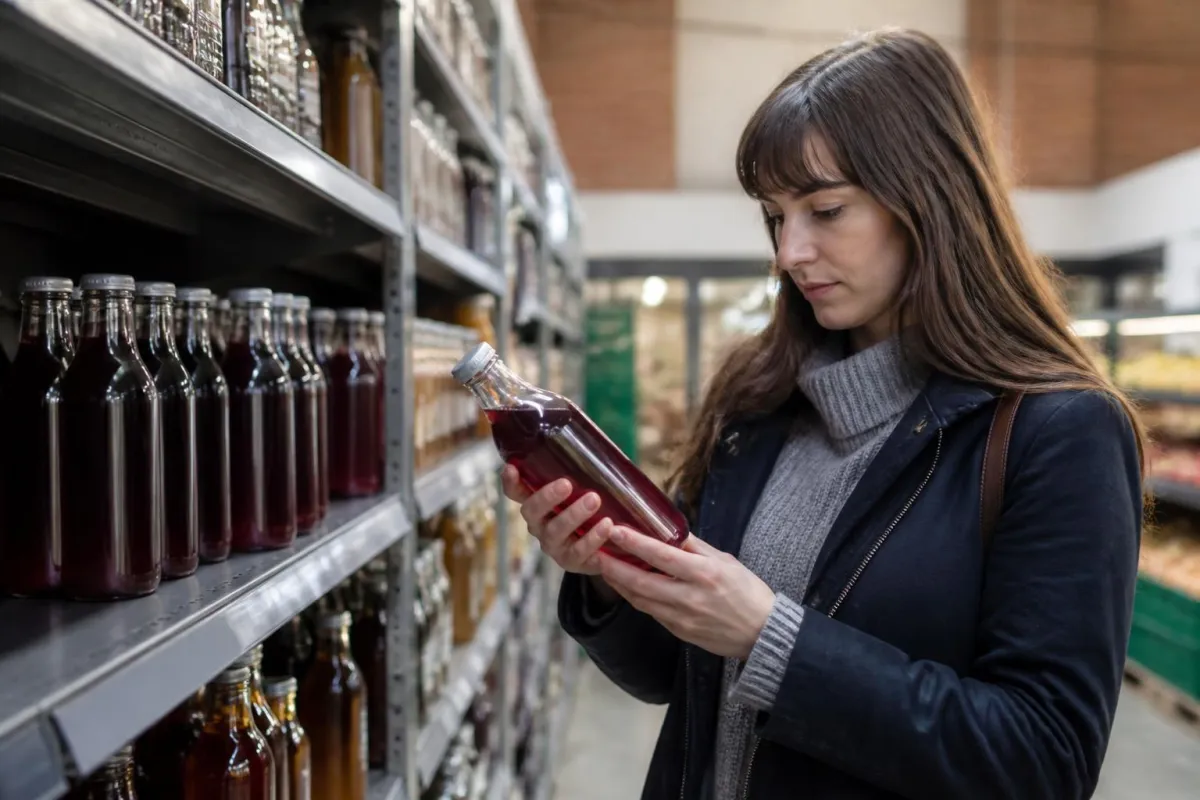
Reading a cranberry drink label gets easier once you separate three things, the front of pack claim, the ingredients list, and the nutrition table. If a bottle says no added sugar, that tells us something specific about what has not been added during manufacture. It does not tell us that the drink contains no sugar at all, and it does not settle whether one bottle is more suitable than another.
For cranberry juice with no added sugar, the most reliable approach is simple. Check what the drink actually is, compare the sugars on the same basis, usually per 100g, and then read the storage and allergen information before you put it in the fridge, your desk drawer, or your travel bag. That routine works far better than relying on the front label alone.
What no added sugar means on cranberry juice
On cranberry drinks, no added sugar means sugar has not been added as an ingredient. It does not mean the drink is sugar-free. Fruit juice naturally contains sugars from the fruit itself, so a bottle can carry a no added sugar claim and still show sugars in the nutrition table.
That distinction matters because cranberry products vary a lot. Some are pure juice. Some are juice drinks made with water and flavourings. Some are blends with sweeter fruit juices such as apple or grape. All of those can look similar at first glance, and more than one type may use a no added sugar claim.
So when we read cranberry juice no added sugar on a label, we should treat it as one useful clue, not the final answer. The claim tells us that sugar has not been added, but it does not tell us:
- whether the drink is 100 per cent juice
- whether it has been diluted
- whether it is blended with other fruit juices
- how much naturally occurring sugar it contains
- how large the stated serving is
It is also not the same as “unsweetened” in the casual way shoppers sometimes use that word. A drink may taste sharp because cranberries are naturally tart, but taste is not the legal basis of the claim. The label wording and the ingredients list matter more than our assumptions.
If you want a broader explanation of how this claim differs from others on pack, our guide to no added sugar and low sugar label claims sets out the distinction clearly.
For UK readers, this is also a point where it helps to avoid mixing up UK practice with wider EU discussions online. You may see general European explanations of nutrition and health claims, but the bottle in your hand is the one that counts. Read the wording on the actual UK product sold here, and use the ingredients and nutrition panel to confirm what the front claim really means.
How to compare bottles without mixing up the numbers
The easiest mistake with cranberry drinks is comparing one bottle per serving and another per 100g. The NHS treats those as different bases, and they are not interchangeable for comparison purposes NHS guidance on reading food labels.
If you are deciding between two bottles, start with per 100g. That gives you a standard basis across products, even when bottle sizes and serving suggestions differ.
A quick routine looks like this:
- Find the nutrition table.
- Look for sugars per 100g.
- Compare that figure across bottles.
- Only then look at per serving, if you want to know what the brand counts as one portion of that drink.
Why per 100g first? Because serving sizes can be surprisingly different. One cranberry drink may define a serving as a small glass. Another may use a larger amount. A concentrated drink may assume dilution before drinking, while a ready-to-drink bottle may not. If we compare only per serving, we can end up comparing different volumes and drawing the wrong conclusion.
For drinks, labels may also use millilitres in practice, but the principle is the same. The key point from the NHS is that per 100g and per serving are different ways of presenting information, and we need to compare like with like.
Here is the kind of confusion we see often:
- Bottle A looks lower because its per serving sugars are lower.
- Bottle B looks higher because its serving is larger.
- But when both are checked per 100g, Bottle B may actually be lower.
That is why the standard basis matters.
After that, per serving becomes useful for real life. It helps if you want to know what you would drink in one glass at home, what fits in a lunch bag, or what you are likely to finish in the car or on a train. Just keep the order right. Compare products per 100g first, then use per serving for your own context.
This is especially important with cranberry drinks because they are sold in several forms:
- pure juice in smaller amounts
- ready-to-drink juice drinks
- diluted products
- mixed juice blends
- concentrate intended to be mixed with water
These can all sit near each other on a shelf, but they are not nutritionally identical products. The standard comparison base helps us keep them straight.
What the ingredients list can tell you
The ingredients list usually tells us more than the front label. If you want to know what kind of cranberry drink you are buying, this is where to look.
Start with the first few ingredients. Ingredients are listed in descending order by weight at the time they are used. That means the top of the list gives us the clearest picture of what the product mostly consists of.
Look for these broad patterns:
Pure juice
If the label shows cranberry juice, or cranberry juice from concentrate, with little else besides perhaps permitted processing-related ingredients, you are likely looking at a juice product rather than a juice drink. Cranberries are naturally tart, so pure cranberry juice can be intense.
Diluted juice or juice drink
If water appears prominently and the product includes juice alongside other ingredients, it may be a juice drink rather than pure juice. This matters because the front claim no added sugar can still appear, but the drink itself is a different type of product.
Blend
If apple, grape or other fruit juices appear alongside cranberry, you are looking at a blend. That can change the flavour profile and the sugars shown in the nutrition table, even when no sugar has been added separately.
Concentrate or squash-style product
If the bottle is meant to be diluted before drinking, the label should make that clear. In that case, both the ingredients and the nutrition information need extra care, because some values may relate to the prepared drink and others to the concentrate. Check the wording closely.
This is why the ingredients list matters more than the front claim on its own. Two drinks can both say no added sugar and still be very different products. One may be straight juice. Another may be mostly water with fruit juice. Another may be a blend where the cranberry is only part of the fruit content.
The list can also show other additions that matter to some readers, such as sweeteners, flavourings, preservatives, or added vitamins. None of those automatically make a product better or worse. They simply tell us more about what it is.
If you have read our pieces on other products with the same kind of claim, the method is similar. The same label-reading habit applies in our guide to what no added sugar squash really tells you on the label and in our article on how to read no added sugar jam without guesswork.
What this claim does not tell you about the drink
No added sugar is a narrow claim. It says something about formulation, not everything about the drink.
It does not tell us whether the drink is balanced in the context of the rest of the day. The NHS Eatwell Guide places foods and drinks within an overall pattern, considered across a day or week, rather than expecting every single item to do every job at once NHS Eatwell Guide.
It also does not tell us:
- whether the portion you pour is larger than the labelled serving
- whether the drink fits your own routine at breakfast, at work, or while travelling
- whether another version would suit you better because it is less concentrated or easier to store
- whether the product is appropriate for your own medical or dietary needs
That last point is important. General label reading can help us compare bottles, but it does not replace individual advice. A front of pack claim is not a personal suitability statement.
This is one reason we avoid reading too much into positive-sounding wording. “No added sugar” can sound like a full verdict on the drink, when in reality it is one piece of information among several. A bottle can meet that claim and still vary widely in juice content, acidity, sweetness from fruit, portion size, and how it fits into someone’s day.
For everyday use, a more practical question is often, “What exactly is this drink, and how much of it am I likely to have?” That keeps the focus on real use rather than label halo effects.
At Healthy Snacking, we find this is often the most useful reset for readers. Food labels are there to inform choice, not to divide foods into morally good and bad categories. A cranberry drink with no added sugar may be the right pick for one situation and not for another. The label can guide us, but it cannot make the whole decision on its own.
Practical checks for home, work and travel
A short routine makes cranberry drink labels much easier to handle in real life. Whether you are stocking the fridge at home, keeping a bottle at work, or carrying one while travelling, these checks cover most of what matters.
1. Check what the drink actually is
Before anything else, read the product description and ingredients list. Is it pure juice, a juice drink, a blend, or a concentrate to dilute? Do not assume from the colour of the liquid or the size of the bottle.
2. Compare sugars on the same basis
Use per 100g first when comparing bottles. Then look at per serving if you want to understand the brand’s suggested portion. Keep those two bases separate, as the NHS advises.
3. Read the ingredients for additions that matter to you
This might include other fruit juices, sweeteners, flavourings, preservatives, or fortification. None of these should be guessed from the front label.
4. Check allergen and ingredient information in full
For anyone managing allergies or intolerances in a household, the front claim is never enough. The Food Standards Agency advises consumers to use the ingredient list and allergen information, and not to rely on assumptions based on familiar packaging or product type Food Standards Agency allergy guidance.
Even if cranberry itself is not the concern, blends and flavoured drinks can include other ingredients that matter. Recipes can also change, so a bottle you bought before is worth checking again.
5. Follow storage instructions
Storage matters more than many people expect, especially once a bottle is opened. Some cranberry drinks need refrigeration after opening. Others may have specific use-within guidance. The Food Standards Agency’s food storage advice is clear on the importance of chilling and following product instructions where relevant Food Standards Agency storage guidance.
At home, that means reading the label before the bottle gets pushed to the back of the fridge. At work, it means not assuming an opened bottle can sit on a desk all day if the label says refrigerate after opening. While travelling, it means thinking ahead about whether you need a shelf-stable unopened carton, a chilled bottle for immediate use, or a small pack you can finish at once.
6. Match the pack format to the situation
This is not a nutrition rule, just a practical one.
- At home, a larger bottle may be convenient if everyone will use it and you can store it properly after opening.
- At work, a smaller container may be easier if fridge space is limited.
- For travel, single-use or compact packs can reduce the chance of carrying around an opened bottle longer than intended.
7. Recheck when buying a different version
Brands often sell several cranberry products under similar names. One may be a juice blend, another a lighter juice drink, another a concentrate. The front branding can look almost identical. Recheck the ingredients and nutrition panel each time you switch format or flavour.
That routine sounds basic, but it prevents most of the common mix-ups. It also keeps the focus where it belongs, on the actual bottle in front of us.
When we read labels this way, cranberry juice with no added sugar becomes much easier to assess. We stop asking the front label to do too much. Instead, we use it as a starting point, then confirm the details in the ingredients list, compare values on a proper like-for-like basis, and follow the practical instructions that affect everyday use.
That is usually enough to make a clear, calm choice, whether the bottle is for breakfast at home, a shared office fridge, or a bag packed for the train.