Food activities for kids that make snack choices easier
The article focuses on child-friendly food activities, not a general list of snack ideas.
On this page
- What this covers that a general healthy eating activity article does not
- Choose activities that reduce pressure, not create food battles
- Label-based games that teach comparison without overcomplicating food
- 1. Spot the same unit
- 2. Per 100g versus per serving
- 3. What claims do and do not mean
- 4. Match the packet to the place
- Hands-on jobs children can do before, during and after snack time
- Before snack time
- During snack time
- After snack time
- How to keep the focus on routine and variety over a day or week
- When an activity needs extra care
- Allergies and intolerances
- Selective eating
- Storage and food safety
- Age and ability
- Final thought
Snack time gets easier when children are involved in small, practical food jobs, not when snacks become a lesson in perfect eating. The most useful activities are the ones that help with choosing, comparing, packing and putting food away, while keeping the mood neutral.
In this piece, we are looking specifically at food activities for children that help adults manage everyday snack decisions. That means simple ways to compare labels, organise options and build routine, without turning one biscuit, one yoghurt or one lunchbox into a moral test. If you want a broader companion piece, we also cover healthy eating activities that make snacks easier to manage.
What this covers that a general healthy eating activity article does not
A lot of advice about food activities is either very broad or aimed at changing an entire family lifestyle in one go. That is not what we are doing here.
We are focusing on snack-related decisions that come up in ordinary UK households. Which packet is the better fit for this week’s lunchboxes. How to explain why two products that look similar are not identical. What children can do to help before school, after school or while preparing for a journey. How to use labels without making food feel complicated.
That matters because snacks are where many food decisions become repetitive. They are bought often, packed often and negotiated often. They are also easy to overthink. A useful activity is one that reduces friction. It helps a child take part without making them responsible for eating “correctly”.
This is also different from adult healthy eating advice. Children do not need a running commentary on macros, “clean eating” or whether a single item is “good” or “bad”. For snack time, the better question is usually simpler. Can we make choosing and organising food easier, clearer and less pressured?
When we talk about healthy eating activities for kids in this context, we mean activities that support everyday food handling and food decisions. We do not mean turning every snack into a project.
Choose activities that reduce pressure, not create food battles
The quickest way for a useful activity to stop being useful is for it to become a test. If a child feels they are being watched for the “right” answer, snack time can turn into a negotiation.
A better approach is to choose tasks with a practical purpose. For example:
- picking two fruit options for the week
- helping put cupboard snacks into a basket
- matching lids to reusable containers
- choosing between two packet options after a simple label comparison
- checking whether something belongs in the fridge after opening
These jobs give children a role, but not a pass or fail mark.
It also helps to keep the adult role clear. We decide what food comes into the house, what is on offer at a given time and how food is stored. Children can help with sorting, comparing and choosing from what is available. That is involvement, not pressure.
A few habits usually make these activities calmer:
- Offer limited choices, not a full supermarket shelf.
- Ask observational questions, not leading ones. “Which one has more fibre per 100g?” works better than “Which one is healthier?”
- Avoid using snacks as rewards for behaviour or for finishing other foods.
- Do not make a child justify why they picked something.
- End the activity once the practical decision is made.
If a child says they do not want to join in, that is useful information too. The point is to make routines easier, not to insist on participation.
Label-based games that teach comparison without overcomplicating food
Packet labels can be useful teaching tools because they deal in concrete information. The trick is to keep the game simple enough that it actually helps.
The NHS explains that food labels can be used to compare foods, and that per 100g and per serving are different bases, so they should not be mixed up in the same comparison NHS food labels guidance.
A few straightforward activities work well.
1. Spot the same unit
Put two cereal bars or two yoghurts on the table and ask the child to find where the nutrition table starts. Then ask one question only, such as:
- Which has less salt per 100g?
- Which has more fibre per 100g?
- Are these even using the same serving size?
This teaches the most important comparison rule first. Check the unit before you compare the number.
2. Per 100g versus per serving
This is one of the most useful label lessons because it comes up constantly.
Take two products that look similar. One may show a small sugar number per serving, but the serving may be much smaller than the other product’s serving. Children do not need a lecture on nutrition policy to understand this. They can learn the practical point:
- per 100g is better for comparing similar products
- per serving can be useful for understanding what the packet says a usual portion might be
- the two figures answer different questions
A simple game is to sort labels into two piles, “good for comparing” and “good for seeing what one portion means”. The answer is often that both are useful, but for different reasons.
3. What claims do and do not mean
Front-of-pack wording can confuse adults as well as children. “Fruit”, “natural”, “source of fibre” and no added sugar can all sound like shortcuts to a full judgement. They are not.
A child-friendly activity is to cover the brand name and ask, “What do we actually know from this claim, and what do we still need the full label for?”
For example, no added sugar does not mean sugar-free. It means sugar has not been added as an ingredient, but the product may still contain sugars that are naturally present in ingredients such as fruit or milk. You still need the nutrition panel and ingredients list if you want the fuller picture.
Similarly, a claim on the front does not replace the ingredients list, the allergen information or the nutrition table. That is a useful habit for children to learn early, especially if they will later choose snacks independently.
4. Match the packet to the place
This is less about nutrients and more about everyday organisation. Ask children to read storage wording such as “store in a cool, dry place” or “keep refrigerated after opening” and match the item to cupboard, fridge or lunch bag. It builds familiarity with the kind of information that actually affects what happens next in a household.
If you want a simple framework for adult comparisons, our guide to a simple healthy eating table for everyday snack choices sets out a practical way to compare options without pretending one number settles everything.
Hands-on jobs children can do before, during and after snack time
The best snack activities are often ordinary household jobs with a clear start and finish. They help adults, and they make food routines more visible.
Before snack time
Before eating, children can often help with:
- washing a container that is needed later
- choosing between two suitable containers for home or travel
- sorting snacks into “fridge”, “cupboard” and “take with us”
- grouping similar items together so adults can see what needs using up
- checking dates and opening status, such as whether a packet is sealed or already opened
- finding an ice pack or lunch bag for food that needs to stay cool
Older children may also be able to read the packet for storage instructions. The Food Standards Agency advises consumers to follow storage instructions and to chill food appropriately where required Food Standards Agency food storage guidance.
During snack time
During snack time, useful jobs might include:
- putting napkins, spoons or cups out
- opening outer packaging if they can do so safely
- portioning a snack into bowls or containers when an adult has decided what is being served
- choosing one item from a small set of options
- noticing whether a container needs to go back into the fridge
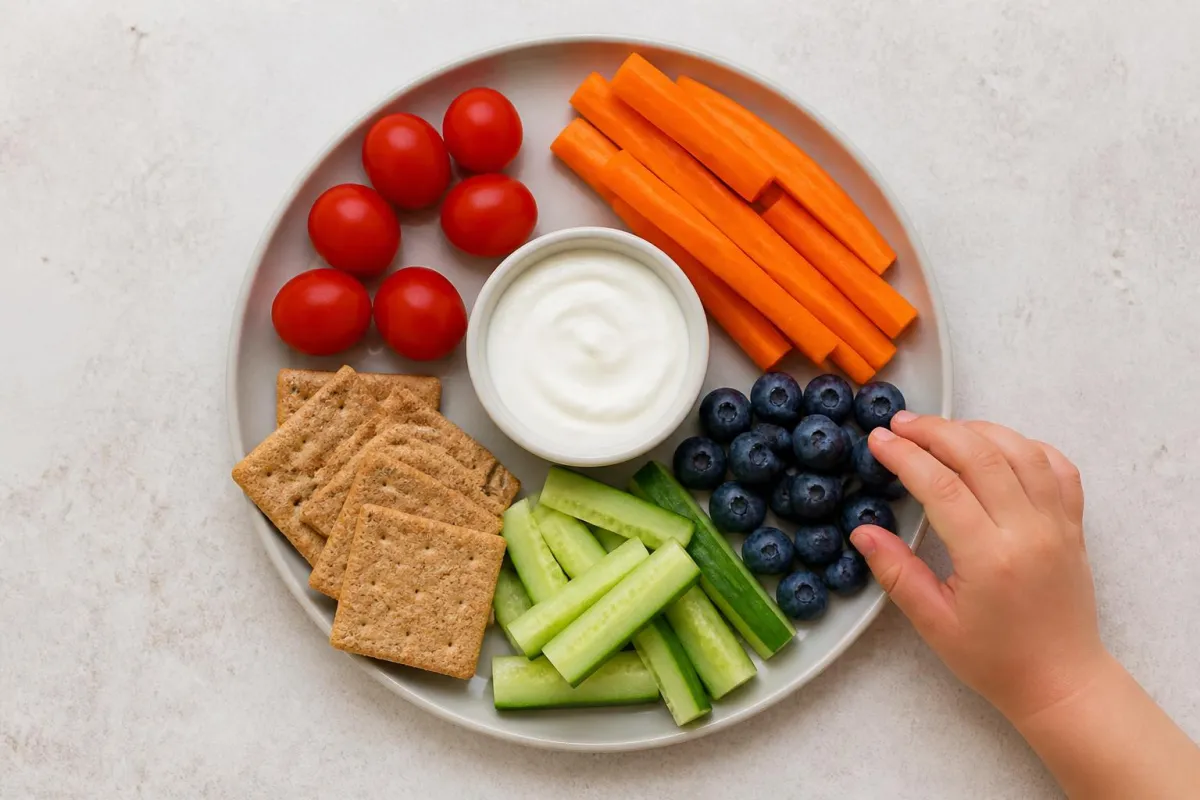
This is where it helps not to overtalk the food. A child can help serve apple slices or crackers without being asked whether they are making the “best” choice.
After snack time
Afterwards, children can often help with:
- putting leftovers away promptly if the product instructions allow
- separating rubbish from reusable containers
- matching lids and boxes
- wiping the snack area
- returning unopened items to the right storage place
- telling the adult when something is nearly finished, so it can go on the next shopping list
These small tasks matter because snack organisation is repetitive. If children can help keep that system running, adults do less last-minute searching and fewer rushed substitutions.
For households managing selective eating, the practical side often matters even more than the theory. Our piece on making everyday eating easier when someone is very selective looks at that in more detail.
How to keep the focus on routine and variety over a day or week
One snack does not need to do everything.
That sounds obvious, but it is often forgotten when adults feel pressure to make every eating occasion ideal. The NHS Eatwell Guide is about overall balance across a day or week, not about demanding that every single snack be nutritionally complete NHS Eatwell Guide.
For children, this is especially useful framing. A yoghurt pouch, a banana, some crackers, a handful of cereal, a cheese portion or a biscuit are not final verdicts on the quality of a family’s eating pattern. They are individual items within a wider routine.
Activities can reflect that wider view:
- Use a weekly snack board with categories rather than rankings, such as fruit, dairy foods, savoury cupboard items and travel-friendly options.
- Let children help check what has already been packed this week, so choices vary a bit without becoming rigid.
- Rotate practical formats, not just ingredients. Some days need shelf-stable options, some need chilled items, some need very low-mess food.
- Use “what fits today?” as the question, not “what is the perfect snack?”
This is also where adults can step back from calorie-fixation. Snack planning is often easier when we look at routine, convenience, storage and variety together. If lunch was late, the after-school snack may be more substantial. If a child is heading out for an hour, a simpler option may be enough. Context matters.
At Healthy Snacking, we find that snack decisions become more manageable when people stop expecting one food item to carry the whole week’s nutritional meaning. A calm routine usually works better than a perfect-looking plan.
When an activity needs extra care
Some food activities need limits, or a different approach altogether.
Allergies and intolerances
If a child or someone in the household has a food allergy or intolerance, do not treat packet familiarity as proof that a product is suitable. Recipes and manufacturing information can change. The Food Standards Agency advises consumers to read ingredient lists and allergen information carefully, and not to rely on assumptions from previous purchases or general product type Food Standards Agency consumer allergy guidance.
For activities, that means:
- adults should do the final allergen check
- children should not be told a product is safe for a person with an allergy just because it “looks the same as last time”
- shared surfaces, containers and utensils may need more careful handling in some households
- if a packet says to check the label each time, do exactly that
In the UK, allergen labelling rules are specific, and the details matter. Where UK practice differs from broader EU discussions, follow the UK label in front of you and current UK guidance, not a generalised online summary.
Selective eating
If a child is very selective, even a neutral activity can feel exposing if it is really an attempt to push eating. In those cases, food jobs that do not require tasting are often more useful. Sorting packets, choosing containers or helping with shopping lists may be manageable where direct food interaction is not.
Do not disguise pressure as participation. If the real goal is “try one bite”, call it that to yourself and decide whether that is appropriate. Often, a separate practical task is the better route.
Storage and food safety
Not every snack is suitable for every setting. If something needs refrigeration after opening, that matters. If a lunch bag will be out for hours, that matters too. Children can help read instructions, but adults need to make the final call on storage, transport and whether leftovers should be kept.
This is particularly important with chilled dairy foods, opened dips, cut fruit and any snack prepared in advance. Follow the packet instructions and household food safety rules rather than guessing from appearance.
Age and ability
Age labels for household tasks are never exact, because children vary. The practical test is whether the task can be done safely, calmly and with a clear purpose. Reading a label, matching a lid or sorting packets may be realistic for one child and not for another. The activity should fit the child, not the other way round.
Final thought
The most effective food activities for children are often the least dramatic. They help with real snack decisions, they teach one clear skill at a time, and they lower the chance of arguments.
That is why we focus on practical healthy eating activities for kids around labels, storage, choice and routine. They can make snack time easier without asking children to carry adult ideas about perfect eating. As an editorial publication from Fleeta Limited, Healthy Snacking is interested in the ordinary decisions that happen around food every day, and in what labels and guidance can genuinely tell us, without hype.