Are nuts a healthy snack for everyday eating?
Nuts can fit a balanced diet, but no single snack decides overall diet quality.

On this page
Nuts can be a healthy everyday snack, but not in a simple all-or-nothing way. In practice, they are one option that can fit well into an overall eating pattern when the portion suits the moment, the ingredients are straightforward, and the packet is doing what you think it is doing. That is different from saying every nut product is equally useful, or that a handful of nuts automatically makes a day’s eating “healthy”.
A better question than “are nuts healthy snacks” is usually, “which nuts, in what form, compared with what?” Plain almonds in a small tub, salted peanuts in a pub, honey-coated cashews at a desk, and a nut bar with chocolate and syrup are not nutritionally identical, even if they all sit in the same supermarket aisle. The useful judgement comes from the label, the ingredients, and how the snack fits into real life, not from a moral category. The NHS also frames healthy eating as balance across a day or week, not perfection in every single eating occasion, which is the right starting point here (NHS Eatwell Guide).
What makes nuts a healthy snack in practice?
Nuts are often seen as a healthy snack because they are usually a source of fat, fibre and some protein, and because they can be satisfying in a relatively small amount. That combination can make them practical between meals, especially when the alternative is something you eat quickly and barely notice. They also require very little preparation, which matters more in daily life than idealised meal planning.
Still, “healthy” only means much when we tie it to context. A snack can be reasonable and useful without needing to tick every box. If we are choosing something for a mid-morning break, a commute, or a long meeting, nuts may make sense because they are shelf-stable, easy to carry, and less fiddly than some fresh foods. If we are already eating plenty of salty foods that day, a heavily salted nut mix may be less appealing. If we want something that feels more substantial, nuts on their own may not be enough.
The main point is that nuts do not need to be treated as a nutritional badge of virtue. They are simply one food group that often works well in adult routines. A small amount can be enough because nuts are energy-dense, which is useful information rather than a warning. Energy density is one reason a modest portion can feel practical, but it is also why comparing packets carefully matters.
It also helps to distinguish whole nuts from products that merely feature nuts. Peanut butter with a short ingredient list is different from a sweetened nut spread. A simple nut mix is different from a cereal bar with a few chopped nuts added for marketing effect. If the packet says “roasted nuts” on the front but the ingredients list includes sugar, starches, flavourings or coatings, then the product is offering more than nuts.
For a broader look at how nuts fit into an overall pattern of eating, our guide to nuts in an overall eating pattern goes into that question directly.
What nutrition labels can and cannot tell you
Nutrition labels are useful, but only if we compare like with like. The first check is whether the numbers are given per 100g, per serving, or both. The NHS is clear that these are different comparison bases and should not be mixed up casually (NHS food labels guidance).
Per 100g is the best basis for comparing one product with another. If you want to compare plain cashews with salted pistachios, or roasted peanuts with a coated nut mix, per 100g lets you line them up on the same scale. It is especially helpful when pack sizes and suggested servings differ.
Per serving can be useful for a different reason. It gives a rough sense of what you might actually eat in one sitting, if the stated serving is realistic for you. The problem is that serving sizes are set by the manufacturer, so they are not standard across products. One packet may define a serving as 25g, another as 30g, another as half the pack. That means per serving figures can make products look more or less similar than they really are.
For nuts and nut-based snacks, three parts of the label usually matter most.
First, the ingredients list tells you what the product actually is. If nuts are the first and main ingredient, that is one thing. If sugar, glucose syrup, flour or oil appear prominently, that is another. Claims such as no added sugar can be helpful, but they do not tell you everything about the snack. A product can be labelled no added sugar and still be high in calories, high in saturated fat, or simply not what you expected from the front of pack.
Second, the salt figure matters when comparing salted, flavoured and coated products. A plain nut and a salted version may look nearly identical from the front, but the nutrition panel can show a meaningful difference. The same goes for sweet coatings and savoury seasoning.
Third, the serving reality matters. A large sharing pouch may technically provide several servings, but many people will eat more than one serving if the packet is open at a desk or in a car. That is not a failure of willpower, it is simply how packaging affects eating. So use per 100g to compare products, then use per serving to sense-check what a usual handful or packet means in practice.
What labels cannot do is tell you whether a snack is “good” for you in isolation. They do not know what else you have eaten that day, whether you are hungry, or whether the snack is replacing something less filling or more convenient. They also do not tell you whether a food suits your allergy needs, which depends on the ingredients and allergen information, not a general health claim.
If label-reading is what usually slows you down in the aisle, our everyday snack guidance and our piece on how to choose savoury snacks without label guesswork are designed for exactly that kind of comparison.
Plain, roasted, salted and coated nuts are not the same
This is where broad claims about nuts become less useful. Plain nuts are usually just nuts. Roasted nuts may still be very simple, but not always. Some are dry roasted with little else added. Others include oil, salt, starch, sugar, flavourings or glazes. “Honey roasted” and “chilli roasted” sound self-explanatory, but the ingredients list is what tells you whether the coating is light or substantial.
Salted nuts are the clearest example of why front-of-pack wording can be incomplete. “Salted peanuts” sounds straightforward, yet the amount of salt can vary a lot between brands and formats. A lightly salted mixed nut pack and a strongly seasoned peanut pouch are not interchangeable just because both include the word salted.
Coated nuts are further away from plain nuts than the category name suggests. Yoghurt-coated, chocolate-coated and caramelised nut products often behave more like confectionery or dessert-style snacks than like a plain handful of nuts. That does not make them off limits. It simply means the packet is offering a different balance of ingredients, and the nutrition panel usually reflects that.
The same applies to bars and clusters made with nuts. Some are mostly nuts held together with a small amount of binding ingredient. Others are better understood as cereal bars or sweet snacks with nuts included. Looking only at the front can blur that difference.
Roasting itself is not the issue. It is what comes with it. Dry roasted can be very close to plain. Oil-roasted may change the fat content. Seasoned and coated versions may add more salt or sugar. The useful habit is to treat each product on its own terms rather than assuming the word “nut” tells the whole story.
There is also a UK practical point here. Food labels in the UK follow UK rules, which remain separate from the EU framework after Brexit, even though many label conventions still look familiar to shoppers. For day-to-day buying, the key point is not the legal history but the packet in your hand. Read the ingredients, allergen information and nutrition panel on that specific product.
How nuts fit into snacks at home, work and on the go
At home, nuts are often easiest when they are visible, portionable and not mixed into a large open bag that invites mindless grazing. A small bowl with lunch, a portion decanted into a tub for the afternoon, or a few added to yoghurt or fruit can be practical ways to use them without turning them into a project. If you prefer structure, keeping a few small containers ready can help more than relying on a family-size bag in the cupboard.
At work, convenience matters. Nuts can work well because they are quiet to store, need no refrigeration before opening, and are quick to eat between tasks. A desk drawer pack can be useful for long afternoons or delayed breaks. The main thing to watch is whether your workplace has allergy rules or informal expectations around shared spaces. In some offices, bringing loose nuts into meeting rooms or communal areas may be discouraged for good reason.
On the go, nuts are often at their best when you need something compact and non-perishable. They travel more easily than many chilled snacks and usually cope well in a bag. That said, the best option is not always the healthiest-looking one. A resealable pack can be more practical than a large pouch. A simple mix can be easier to manage than a sticky coated product on a train or in a car.
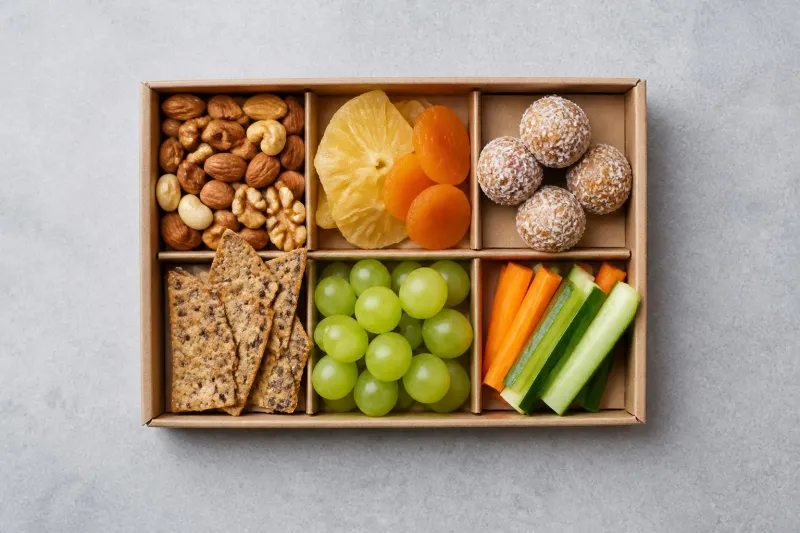
Nuts also pair well with other foods when you want a snack to feel less one-note. Combining them with fruit, crackers or yoghurt can make sense depending on where you are and what is available. This is not about building the perfect snack. It is about making ordinary eating easier and less guessy.
For many adults, the most useful approach is to keep nuts as one option among several. If every snack decision depends on finding the single “best” food, daily life becomes harder than it needs to be. A workable routine usually includes a few shelf-stable options, a few fresh options, and some flexibility for what the day actually allows.
When a different snack may make more sense
Nuts are not the right choice for everyone or for every situation. The clearest example is allergy. If you have a nut allergy, or you are buying for someone who may, general claims about health are irrelevant. What matters is the ingredients list, the allergen information, and the person’s own medical advice. The Food Standards Agency is the relevant UK source here and advises consumers to check ingredient and allergen information carefully (Food Standards Agency allergy guidance).
Even without allergy, nuts may be less suitable in shared environments. Some workplaces, schools and travel settings are simply easier to navigate with a different snack. Smell, crumbs, sticky coatings and shell waste can all make a difference. Pistachios in shells may be fine at home and annoying on a train. A coated nut mix may leave fingers messy before a meeting or while driving.
Storage can matter too. While many nuts are shelf-stable, they still need sensible storage and the packet instructions matter. Once opened, some products keep better than others, especially if they include coatings or mixed ingredients. The Food Standards Agency’s general food storage advice is to follow product instructions and store foods appropriately (Food Standards Agency storage guidance). In practice, that means checking whether a pack should be resealed, kept cool after opening, or used within a stated period.
Personal preference is another perfectly valid reason to choose something else. Some people simply do not enjoy nuts enough to make them a reliable everyday option. Others find them too dry, too repetitive, or not satisfying in the way they want from a snack. There is no nutritional prize for forcing yourself to eat a food you do not like.
Cost and pack format can also push the decision. If nuts are only available in oversized sharing bags where you are shopping, a different snack may be easier to manage. If you need something one-handed, less crumbly, or easier to eat quickly, another option may be more practical.
So, are nuts healthy snacks for everyday eating? Often, yes. They can be a sensible, convenient choice when the product is mostly nuts, the label matches what you want, and the setting suits them. But they are not automatically the best snack in every packet, place or routine. The useful habit is not treating nuts as a health halo, it is reading the label, noticing the format, and choosing what actually works for your day.