How to stock a varied snack cupboard without food rules
Compare labels on the same basis: per 100g is not per serving.

On this page
- What “varied” means when you are not following snack rules
- Three cupboard setups compared for home, work and travel
- 1. The category-based cupboard
- 2. The routine-based cupboard
- 3. The mixed convenience cupboard
- How to compare packets without getting misled by the label
- A practical example of a flexible adult snack cupboard
- Shelf zone, everyday home use
- Drawer zone, workplace packing
- Bag zone, travel and commuting
- What still needs checking after you have organised the cupboard
- 1. Allergens
- 2. Ingredients
- 3. Storage instructions
A varied snack cupboard does not need rules about “allowed” and “forbidden” foods. For most adults, it is more useful to organise for range, convenience and clear labelling, so you can pick something that suits the moment at home, at work or on the move. Variety can mean different textures, flavours, levels of practicality and types of food, without expecting every single snack to be perfectly balanced on its own.
At Healthy Snacking, we find that the most workable approach is to plan for real situations. Keep some things that are quick and easy, some that travel well, and some that are there because you actually enjoy them. If you are thinking about planning a varied adult snack cupboard without diet rules, the key is not perfection. It is being able to see what you have, compare packets properly, and avoid building a cupboard around hype, guilt or vague health claims.
What “varied” means when you are not following snack rules
When people say they want more variety, they often mean one of three things.
First, they want more than one type of snack, so they are not relying on the same few packets every week. Second, they want options that fit different settings, such as a desk drawer, a kitchen shelf, a work bag or a train journey. Third, they want a mix that feels less rigid, so choosing a biscuit one day and a packet of nuts another does not feel like breaking a rule.
That is a practical definition of variety for an adult cupboard. It is not a target number of brands, colours or food groups. It is a cupboard that gives you genuine choice.
The NHS Eatwell Guide is useful here because it places overall balance in the context of a day or a week, not every single eating occasion NHS Eatwell Guide. That matters for snacks. A single snack does not have to “do everything”. You do not need every packet to contain the same mix of ingredients, and you do not need to turn each choice into a test of whether you have eaten “well enough”.
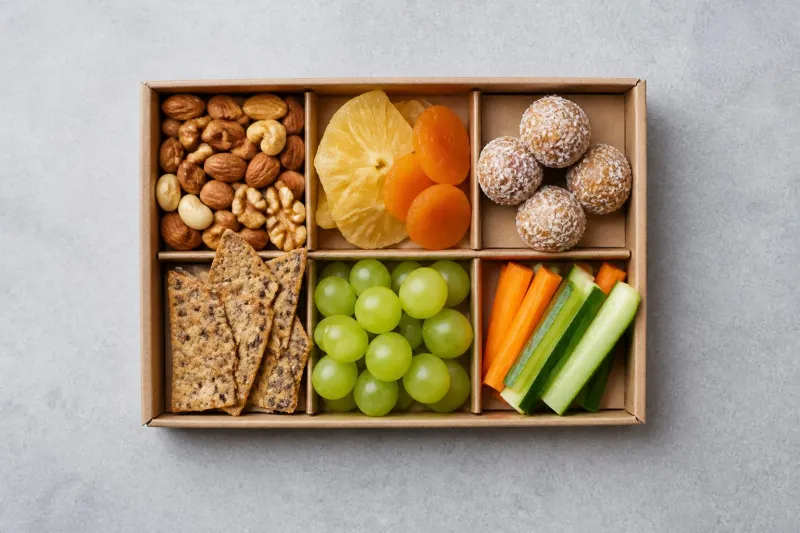
In practice, a varied adult snack cupboard might include:
- some items that are mostly there for convenience
- some that are more filling for longer meetings or delayed journeys
- some sweet options
- some savoury options
- some crisp or crunchy textures
- some softer or easier-to-eat options
- some foods in single packets
- some foods you portion out yourself
None of that makes one snack morally better than another. It simply reduces the chance that your only option is whatever happens to be left at the back of the cupboard.
If you share food with other adults, variety also means acknowledging different routines and preferences. A cupboard used by one person working from home can be narrower than a shared office shelf. If you are stocking a workplace space, our guide to stocking a shared office kitchen without food rules covers the practical side of shared use without turning it into a policy document.
Three cupboard setups compared for home, work and travel
There is no single best cupboard system. The right setup depends on how much space you have, how often you restock, and whether your main problem is boredom, poor visibility or grabbing whatever is easiest. Three setups work especially well.
1. The category-based cupboard
This setup groups snacks by type. For example:
- nuts, seeds and trail mixes
- crackers, crispbreads and rice cakes
- crisps and savoury snacks
- cereal bars and flapjacks
- dried fruit and fruit-based packets
- biscuits and sweet snacks
Who it suits:
- people who like visual order
- households with enough shelf space to separate types
- adults who want to compare similar products side by side
Trade-offs:
- it can make one category dominate if you overbuy it
- some snacks fit more than one category
- it does not automatically help with work packing or travel
The main advantage is visibility. If all savoury packets are together, you can see quickly whether you have only highly portable options left, or whether there is a better mix. It also makes label comparison easier because similar products sit next to each other.
2. The routine-based cupboard
This setup groups snacks by situation rather than by food type. For example:
- workday desk snacks
- quick home snacks between meals
- bag-ready travel snacks
- longer-journey backups
- “open at home” packets that do not travel neatly
Who it suits:
- people whose snacking depends heavily on schedule
- commuters
- adults who often forget to pack food for work or travel
Trade-offs:
- it can hide repetition, because similar products may be stored in different zones
- comparing labels across categories takes more effort
- shared households may find it less intuitive
This is often the most practical system if your issue is not what to buy, but where your snacks disappear to. If work snacks always get eaten at home, or travel snacks are scattered across cupboards and bags, routine-based storage solves a real problem.
For workplace-specific planning, our page on practical snacking at work goes further into packing and storage habits.
3. The mixed convenience cupboard
This setup combines the two. You keep broad categories, but create one or two special convenience zones, such as:
- a “take today” basket near the door
- a desk-drawer refill box
- a travel pouch for shelf-stable packets
Who it suits:
- most adults
- smaller homes where one cupboard has to do several jobs
- people who want flexibility without too much sorting
Trade-offs:
- it needs occasional resetting
- some packets will migrate between zones
- if you do not label baskets or containers, it can become messy quickly
For many people, this is the easiest answer to planning a varied adult snack cupboard without diet rules. It gives enough structure to keep options visible, but not so much structure that every packet needs a perfect home.
How to compare packets without getting misled by the label
A varied cupboard is only useful if you can compare what is in it clearly. The most common mistake is comparing one packet on a per serving basis and another on a per 100g basis. Those are not interchangeable.
The NHS guidance on food labels explains that nutrition information can be shown both per 100g and per serving, and that they are different comparison bases NHS food labels.
Here is the practical rule.
Use per 100g when you want to compare similar products fairly across brands or packet sizes. This removes the problem of one manufacturer choosing a small serving and another choosing a large one.
Use per serving when you want to understand what you are likely to eat from that actual packet, if the serving is realistic and clearly defined.
For example:
- If you are comparing two savoury snack mixes, per 100g is the cleaner starting point.
- If you are comparing two individually wrapped bars that are each meant to be eaten as one unit, per serving may also be useful, because the serving is the packet itself.
- If a large sharing bag gives very small serving sizes, per serving can make the numbers look lower without reflecting what many adults actually eat.
That does not mean per serving is misleading by default. It means you need to check whether the serving size is plausible for the way the packet is sold and used.
Claims on the front of pack need the same caution. A phrase like no added sugar can be relevant, but it does not tell you everything about the product. It means sugar has not been added as an ingredient, but it does not mean the food contains no sugar, and it does not replace the rest of the label. Ingredients, nutrition table and portion context still matter. We cover the packet-reading side of this in our guide to comparing no added sugar snacks without guesswork.
A few useful habits help:
- compare like with like, such as crackers with crackers, not crackers with cereal bars
- look at the basis first, per 100g or per serving
- check the serving size in grams, not just the headline number
- read the ingredients list if you want to know what is actually in the packet
- treat front-of-pack claims as prompts to look closer, not conclusions
If you want a more detailed walkthrough for savoury packets, our article on comparing savoury lunch snacks without label mix-ups focuses on exactly that problem.
A practical example of a flexible adult snack cupboard
Here is one example of a cupboard layout that works across everyday use, workplace packing and travel. It is not a prescribed plan. It is simply a way of separating “use now”, “pack later” and “take with you” so the cupboard stays varied without becoming chaotic.
Shelf zone, everyday home use
Top shelf, slower-use back-up items:
- unopened multipacks of crackers, oatcakes or crispbreads
- spare nuts or seed mixes
- unopened biscuits
- dried fruit packets
- shelf-stable cartons or pots only if the packet says cupboard storage is suitable before opening
Middle shelf, visible everyday options:
- one open sweet option
- one open savoury option
- one crunchy plain base, such as crackers or crispbreads
- one or two individually packed grab-and-go items
Lower shelf, quick-access basket:
- the next few items likely to be packed for work
- anything nearing its best before date that you want to use soon
- duplicates removed from bulk boxes, so you can see what is actually available
This shelf structure avoids one common problem, which is having plenty of food but no visible snack you can take quickly.
Drawer zone, workplace packing
Use one drawer or lidded box for packing, not for long-term bulk storage. Keep it stocked with items that are easy to put into a bag without extra preparation.
For example:
- individually wrapped bars or biscuits
- small savoury packets
- napkins or tissues
- a clip or band for resealing opened packets if you portion things out at home
- a short written list on the inside lid saying what needs replacing
The point of this zone is routine support. If you leave for work in a hurry, you do not want to search three shelves and a tin. You want one place that answers the question, “What can I take today?”
Bag zone, travel and commuting
Keep a separate bag or pouch for shelf-stable snacks that can stay packed until needed, within the product guidance.
This might include:
- one sweet packet
- one savoury packet
- one more substantial back-up item for delays
- a spoon or napkin if relevant
- a note to check dates and packet condition before each trip
Do not assume a snack is suitable for warm bags, cars or long storage just because it seems dry or sealed. Packet-specific instructions matter. Some foods are straightforward cupboard items until opened. Others need cooler handling, have shorter once-opened use periods, or are more fragile than they look.
A flexible cupboard works best when these zones are small enough to maintain. If every zone becomes a storage dump, you lose the benefit. We prefer a light structure, enough to make decisions easier, not enough to create a new set of food rules.
What still needs checking after you have organised the cupboard
Organisation helps, but it does not replace packet checks. Once the cupboard is tidy, there are still three things to look at every time you buy, open or pack food.
1. Allergens
The Food Standards Agency consumer guidance is clear that ingredient and allergen information matters, and personal suitability should not be inferred from a general impression of the product Food Standards Agency allergy guidance.
That means you should not assume:
- a familiar brand has kept the same recipe
- a plain-looking product is free from a particular allergen
- a “free from” style front-of-pack cue is enough without checking the actual wording on the packet
In the UK, allergen labelling rules apply in specific ways, and packet wording is what matters in practice to the buyer standing in the kitchen or shop. If you are buying for other adults, especially in a shared home or office, check the current packet each time rather than relying on memory.
2. Ingredients
Ingredients matter for more than allergies. They tell you what the product actually is, which is often more useful than the marketing on the front.
This is especially relevant when:
- two products sound similar but are made quite differently
- a front claim such as no added sugar draws attention away from the rest of the packet
- a snack is marketed as fruit-based, protein-based or wholegrain-based, but the ingredient order gives better context
We do not need to turn this into a purity test. The point is clarity. If you want a varied cupboard, it helps to know whether your apparent range is genuinely varied or just five versions of the same format with different branding.
3. Storage instructions
The Food Standards Agency guidance on chilling, freezing and defrosting food is broader than snacks alone, but the practical message is simple. Appropriate storage matters, and product instructions should be followed Food Standards Agency storage guidance.
For snack cupboards, that means checking things such as:
- store in a cool, dry place
- refrigerate after opening
- consume within a stated period once opened
- keep sealed or reseal after use
- whether a product is suitable for freezing, if that is relevant
This matters more than many people think. A packet that is fine on the shelf when unopened may need different handling after opening. A snack packed for travel may not cope well with heat or long delays. A workplace drawer may be too warm for some items in summer. Assumptions based on “it’s only a snack” are less reliable than the instructions on the product in front of you.
The same applies where UK practice differs from broader EU assumptions. Readers often come across mixed advice online, but the packet sold here, and the UK guidance that applies here, should take priority for day-to-day decisions.
A varied cupboard without food rules is not an unplanned cupboard. It is simply one organised around real life rather than restriction. If you can see what you have, compare labels on the right basis, and check allergens, ingredients and storage properly, you do not need a rigid system to keep snacks practical and varied.
If you want to understand how we handle evidence, uncertainty and label interpretation across the site, our editorial approach to practical food information explains the standards we use at Healthy Snacking, published by Fleeta Limited.