Why healthier eating matters in everyday snack choices
Healthy eating is about overall patterns, not making every snack perfect.

On this page
Healthier eating matters in everyday snack choices because snacks are part of the eating pattern most of us actually live with. They fill the gap between meals, travel with us to work, and often get chosen quickly. That makes them a practical place to think about the importance of eating healthy food, not as a test of willpower, but as one part of how we eat across the day and week.
At Healthy Snacking, we find that people are often less helped by grand promises than by clear basics. A single biscuit, yoghurt, cereal bar or handful of nuts does not settle whether someone eats well overall. What matters more is knowing how to place snacks into a broader pattern, how to read a packet properly, and when a healthy-sounding message is useful and when it is not.
What healthier eating is actually for
Healthier eating is not mainly about proving that every choice is perfect. In UK public guidance, the NHS Eatwell Guide is useful because it frames eating as an overall pattern. It shows the broad balance of foods that make up a diet, and it makes clear that this balance applies over a day or a week, not item by item or snack by snack (NHS Eatwell Guide).
That matters in ordinary life. Most adults do not eat from a textbook. We eat around work hours, commuting, family routines, budgets, convenience and appetite. So the practical purpose of healthier eating is to support everyday functioning with a pattern that is varied, manageable and realistic enough to keep going.
For snacks, that usually means asking ordinary questions rather than moral ones. Does this fit with what else I have eaten today? Is it something filling enough for the gap I need to cover? Am I comparing similar products properly? Am I relying on the front of the pack, or have I looked at the full information?
The importance of eating healthy food becomes clearer when we stop treating "healthy" as a label for individual virtue and start treating it as a way of organising regular eating. Some snacks bring more fibre, protein or fruit and veg into the day. Some are mainly there because they are convenient, enjoyable or easy to share. Both can exist in the same week. The point is not to make every item carry the whole burden of the diet.
This is also where restrictive thinking often gets in the way. If healthier eating is defined as never having a less balanced option, people tend to swing between over-control and giving up. A more useful approach is to let the overall pattern do the work. We have covered that in more detail in our guide to starting to eat healthier without strict food rules.
Why one snack does not define your diet
A common worry is that one snack can make a diet healthy or unhealthy. It cannot. The NHS approach is explicit that balance is considered over time, rather than demanded from each separate food choice (NHS Eatwell Guide). If breakfast and lunch were light, a more substantial afternoon snack may make sense. If dinner will be later than usual, a snack with more staying power may be useful. If you have already had several sweet foods that day, you might simply want something different next time.
Thinking this way reduces unnecessary guilt and improves decision-making. Instead of asking, "Is this snack allowed?", it is more useful to ask, "What role is this snack playing?" A banana and yoghurt before a long meeting do a different job from crisps shared on a train, or toast late at night. Context matters.
This does not mean all snacks are nutritionally interchangeable. Some are easier to fit regularly into a balanced pattern than others. But that is different from saying one packet settles the quality of your whole diet. The bigger picture still matters more.
A practical example helps. Suppose you compare two afternoon options at work. One is a pastry grabbed with coffee because lunch was rushed. The other is crackers with hummus brought from home. The second may be easier to repeat as part of a routine, but that does not make the pastry a dietary disaster. It simply means that, over a week, repeated choices that offer more useful nutrition and satiety often make the pattern easier to manage.
This is one reason we prefer talking about eating patterns rather than "good" and "bad" foods. Once food is moralised, people stop noticing the actual factors that matter, such as frequency, context, portion size, storage, and what the rest of the day looks like.
How labels make healthy choices easier
Food labels are one of the most practical tools for everyday decisions, especially when two products look similar from the front of the pack. The NHS advises using the nutrition information to compare foods, and it is important to understand the difference between per 100g and per serving (NHS food labels).
The per 100g column is useful because it gives a standard basis for comparison. If two cereal bars have different sizes, or two yoghurts come in different pots, per 100g lets you compare like with like. It is especially helpful for checking nutrients such as fat, saturated fat, sugars and salt across similar products.
Per serving can also be useful, but only if you understand what the manufacturer means by a serving. A per serving figure depends on the portion the company has chosen to present. That may be one bar, half a pack, a measured bowl, or another amount that does not match what you would actually eat. So per serving is practical for estimating what goes into your day, but it is not always the best basis for comparing one product with another.
The packet in your hand matters because pack sizes vary, and so do serving assumptions. A bag that looks like one snack may list values for half the bag. A yoghurt sold as an individual pot may be straightforward, while a pouch or sharing pack may not be. This is why we recommend checking both the standard comparison basis and the actual amount you are likely to eat. Our page on per 100g versus per serving comparisons goes into this in more detail.
Ingredients lists also matter. They tell you what is in the product in descending order by weight at the time of manufacture. That does not turn every shopper into a nutrition analyst, but it helps you see whether a front message reflects the product as a whole.
In the UK, front-of-pack nutrition labelling is common, but not every product presents information in exactly the same way. Where rules differ between the UK and the EU more generally, packaging and presentation can vary, especially across imported foods. That is another reason to rely on the full packet rather than assumptions based on style, branding or a single claim.
For readers who want a straightforward refresher, we have a separate guide to understanding food labels.
What claims can and cannot tell you
Front-of-pack claims can be helpful, but they are limited. A phrase like no added sugar tells you something specific, not everything you need to know. It means sugar has not been added as an ingredient, but it does not mean the product contains no sugar, and it does not tell you the full nutritional picture on its own. You still need the nutrition panel and ingredients list. The NHS guidance on labels is useful here because it focuses on comparison and context, not marketing shortcuts (NHS food labels).
This is where interpretation matters. A fruit puree pouch labelled no added sugar may still be high in sugars naturally present in the ingredients. A breakfast cereal with a fibre claim may still be high in salt or sugars compared with another cereal. A product described as baked rather than fried may still not tell you much until you compare the numbers.
So what can claims do well? They can point you towards a feature worth checking. If a snack says high fibre, source of protein, or no added sugar, that may be a prompt to turn the pack over and see whether it suits what you are looking for.
What can they not do? They cannot replace reading the label. They also cannot tell you whether a food is suitable for your own circumstances, whether that is appetite, routine, dietary preference or allergy.
This is one area where certainty is often overstated online. General messaging can simplify things too far. We prefer a narrower and more reliable conclusion. A claim can be relevant. It is not the whole answer. We cover one common example in our article on what no added sugar tells you on a UK food label.
Making healthier eating workable at home, work and on the move
A workable routine matters more than a burst of enthusiasm. If snacks are only available when you are already hungry, rushed and away from home, convenience will usually drive the choice. That is not a personal failure. It is logistics.
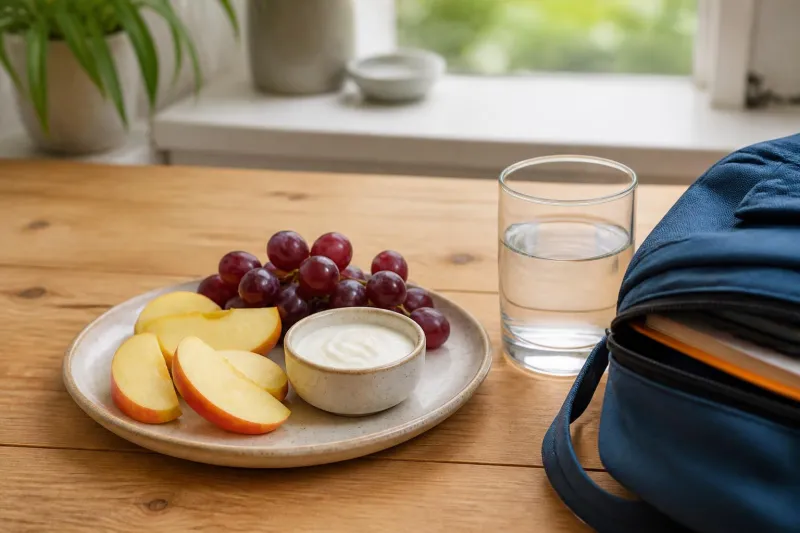
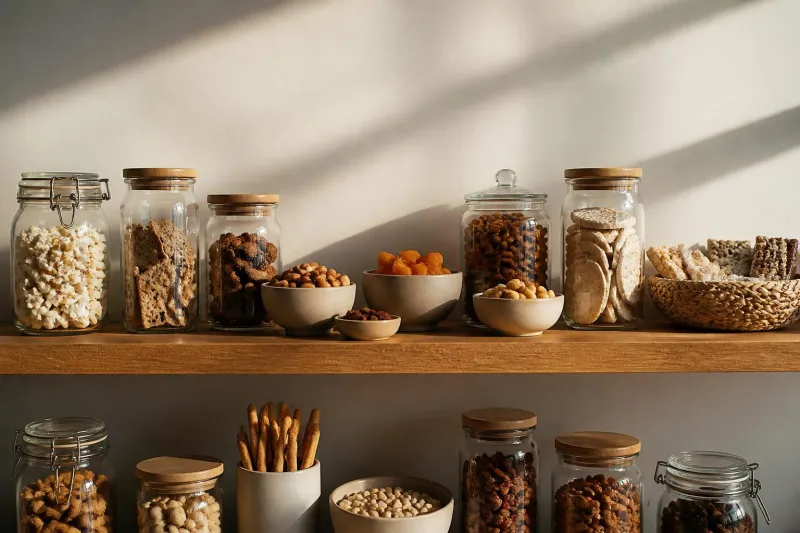
At home, it helps to keep a small set of everyday options visible and easy to use. That might mean fruit where you can see it, yoghurt or cooked items stored at the right temperature, crackers decanted into a container for easier portioning, or a shelf with lunchbox items that can be picked up quickly. None of this needs to be elaborate. The point is to reduce friction.
At work, the same principle applies. Desk snacks tend to be whatever survives in a drawer, so think about storage first. Items that need chilling should only be taken in if you can keep them chilled appropriately. The Food Standards Agency gives practical guidance on chilling, freezing and defrosting food safely, including the importance of following product instructions and keeping foods properly cold where required (Food Standards Agency food storage guidance). For workplace lunches and snacks, that means checking whether a product says keep refrigerated, whether it can be eaten on the go without temperature control, and whether the packet gives a use-by instruction that matters.
On the move, predictability helps. If you know a journey day usually leads to grabbing whatever is nearest, pack one or two options in advance. That could be as simple as a sandwich, fruit, nuts, oatcakes, or a labelled packaged snack you already know how to read and store. The aim is not to avoid all spontaneous choices. It is to avoid having no choice except the most convenient one.
Planning also helps with variety. If every snack is sweet because sweet options are easiest to find, try building in savoury alternatives. If every workday snack comes from a vending machine, consider keeping a backup option in your bag. If you often miss lunch and then overbuy at 4 pm, the useful change may be meal timing rather than the snack itself.
This is also a good place to be realistic about effort. A snack routine that depends on daily prep, multiple containers and perfect memory often collapses within a week. A routine that uses ordinary cupboards, a fridge, a bag pocket and a quick label check is much more likely to survive normal life.
Where caution matters more than a healthy-sounding label
There are situations where general healthy eating messages are not enough. Allergens are the clearest example. A snack can sound wholesome, minimally processed, natural, plant-based or high protein, and still be unsuitable for someone with an allergy or intolerance. The Food Standards Agency consumer guidance is clear that people need to check the ingredient list and allergen information, and not rely on assumptions from general wording or appearance (Food Standards Agency consumer allergy guidance).
This matters in several common situations. Recipe changes happen. Multipacks and single units can differ. Imported products may present information differently. A flavour in the same brand range may contain a different allergen from the one you bought last time. "Free from" style expectations should never be inferred from branding, colour, product type or a vague wellness claim.
The same caution applies to ingredient preferences more broadly. If you avoid sweeteners, caffeine, gelatine, certain oils or particular flavourings, the packet is more reliable than the front message. A healthy-sounding label does not tell you everything.
We also need to be careful with advice that drifts into personal medical territory. The NHS Eatwell Guide is for the general population and recognises that some people may need individual advice for specific medical needs (NHS Eatwell Guide). That is why we keep our guidance practical and general. We can explain how labels work and what public guidance says. We cannot tell an individual that a product is suitable for their condition, allergy or treatment plan.
So the safest everyday rule is a simple one. If the detail matters, read the actual packet. If the consequences of getting it wrong are significant, do not rely on a broad health message, a social media summary, or what the product "looks like". Check the ingredients, allergen statement, storage instructions and any relevant advice you already have from an appropriate professional.
The importance of eating healthy food is real, but it is best understood in this grounded way. Everyday snack choices matter because they are repeated often, not because each one carries a moral verdict. A balanced eating pattern, careful label reading, sensible storage and a bit of planning will take most people further than strict rules or front-of-pack hype.