Healthy eating in the UK without turning snacks into rules
Healthy eating in the UK is about overall pattern, not one perfect snack.
On this page
Healthy eating in the UK does not require turning every biscuit, yoghurt pot or handful of nuts into a moral test. In everyday life, it usually means looking at your overall pattern of eating, using labels well enough to compare options, and making your routine a bit easier to manage. That is much closer to how most people actually eat than trying to make every snack perfect.
At Healthy Snacking, we find that many readers are not asking for a strict plan. They want a fair way to judge ordinary foods in ordinary settings, at home, at work, on trains, or between meetings. The useful middle ground is to know the broad UK guidance, understand what a packet is really telling you, and stop before healthy eating becomes a set of exhausting rules.
What healthy eating in the UK usually means in everyday life
In the UK, broad public guidance on eating patterns is just that, broad guidance. The NHS Eatwell Guide is designed to show the balance of foods across a day or week, not to demand that every snack on its own looks like a mini balanced meal NHS Eatwell Guide. That point matters, because people often start judging a single cereal bar or packet of crackers as if it must prove their whole diet is "good" or "bad".
A more realistic reading is this. The general direction of travel matters more than whether every eating occasion is textbook. If your overall routine includes a reasonable mix of foods, some fruit and vegetables, some higher fibre choices, regular drinks, and not too many foods that are easy to overdo without noticing, you are already working within the spirit of UK guidance.
That leaves room for personal interpretation. One person may want a filling afternoon snack that helps them get through a late commute. Another may just want something tidy and easy to keep in a desk drawer. A third may need food that travels well and does not need a fridge. Those are practical differences, not failures.
This is also where healthy eating in the UK can get distorted by social media. Broad guidance becomes a private rulebook. People start asking whether one flapjack, one supermarket sandwich, or one late-night toast habit "counts" as healthy. Usually, that is the wrong question. The better question is whether that choice fits your broader routine and whether there is an easy adjustment that would suit you better next time.
For snacks, a few principles are often enough:
- Think about the role of the snack. Is it convenience, hunger, enjoyment, or bridging a long gap?
- Compare like with like. A yoghurt is not directly competing with a bag of crisps unless that is genuinely the choice in front of you.
- Notice patterns. One sweet snack is different from relying on several every day because nothing else is available.
- Avoid all-or-nothing thinking. A snack can be useful, enjoyable, and imperfect at the same time.
If you want a practical framework rather than a strict plan, our guide to a simple table for everyday snack choices can help you sort options without overcomplicating them.
How to judge a snack when the packet gives you mixed signals
Food packets often mix useful facts with marketing language. The practical way through is to separate three things: the nutrition table, the ingredients list, and the front-of-pack claims.
Start with the nutrition information. In the UK, one of the most common points of confusion is the difference between per 100g and per serving. These are not interchangeable. The NHS specifically notes that a portion and 100g are different bases for comparison, and both can be useful depending on what you are trying to compare NHS food labels.
Use per 100g when:
- you are comparing similar products of different sizes
- one brand uses a tiny serving and another uses a larger one
- you want a standard basis that is harder to manipulate
Use per serving when:
- the serving is realistic and clearly stated
- you know you usually eat about that amount
- the product is naturally portioned, such as a single pot or bar
A common problem is that the packet presents a modest-looking per serving figure, but the serving is smaller than what many adults would actually eat. For example, a bag may technically contain two servings even though most people would finish it in one go. In that case, per 100g gives you the cleaner comparison, and the pack size tells you what your likely intake would be in real life.
Then look at what the label includes. For everyday snack comparisons, people usually focus on:
- energy
- fat and saturates
- sugars
- salt
- fibre, if shown
- protein, if relevant to how filling the food may be
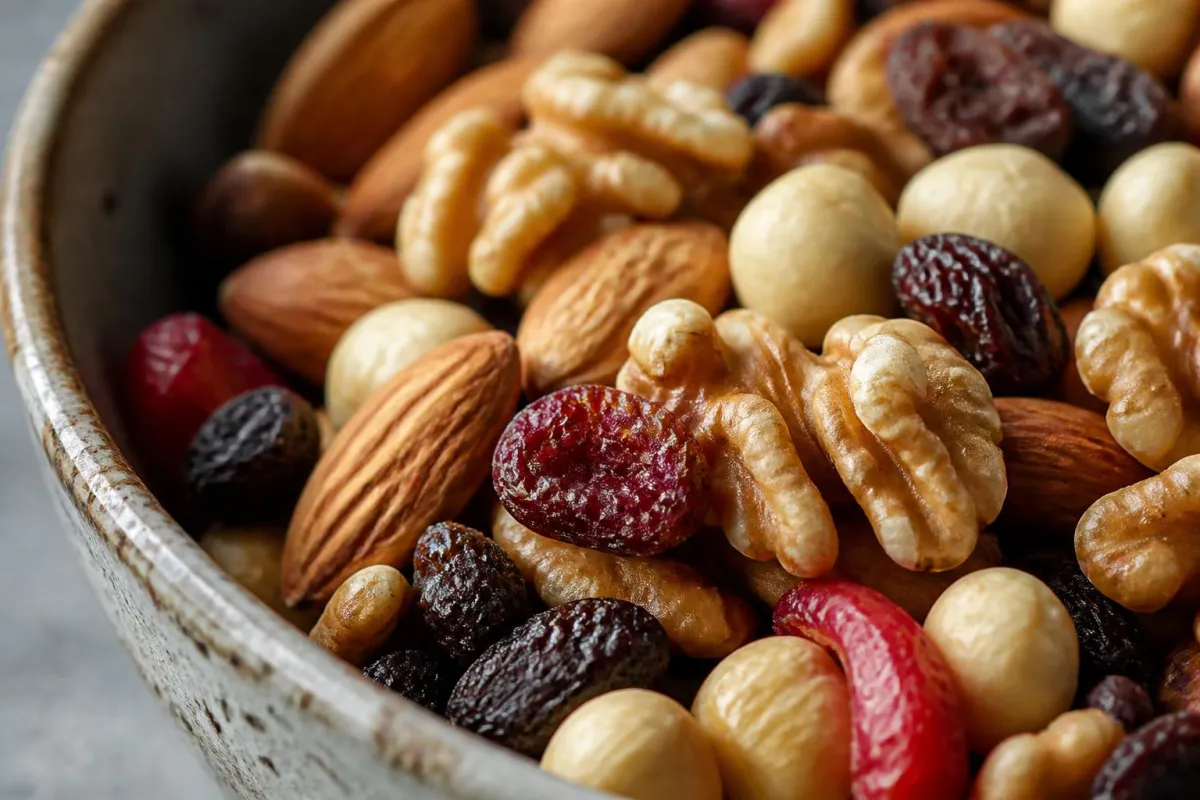
None of these numbers should be treated as a moral score. They are just pieces of information. A food can be higher in one thing and still be useful in context. Nuts are a good example, because they are energy-dense but can still make sense in an overall pattern. We cover that in more detail in our look at nuts in an overall eating pattern.
Ingredients matter too, but not in the simplistic way people sometimes assume. A short ingredients list is not automatically better, and a long one is not automatically suspicious. What matters more is whether the product is broadly what you think it is, and whether the ingredients help explain the nutrition values. If a fruit bar is mostly concentrated fruit pastes and syrups, the sugars figure should not come as a surprise. If a savoury snack is heavily seasoned, the salt figure may be more important than the health halo on the front.
For anyone managing allergies or intolerances, ingredients and allergen information are not optional details. The Food Standards Agency advises consumers to check ingredient and allergen information carefully rather than inferring suitability from general claims Food Standards Agency consumer allergy guidance. That is especially important when a product looks similar to one you have bought before, because recipes can change.
Where label claims help and where they can mislead
Front-of-pack claims can be useful shorthand, but they are not the full story. A phrase like no added sugar tells you one specific thing, not everything you need to know about the product.
In UK labelling, no added sugar means sugars have not been added during manufacture in the way the claim allows for. It does not mean the food contains no sugar at all. A product made largely from fruit purée or fruit juice concentrate may still contain a lot of naturally present sugars. So the claim can be true and still leave a misleading impression if you stop reading there.
The same basic caution applies to other positive-sounding phrases. "Source of fibre", "high protein", "baked not fried", or "made with wholegrains" may all tell you something real, but only something partial. They do not cancel out the rest of the label. A high-protein snack can still be high in salt. A wholegrain product can still be heavily sweetened. A baked snack can still be easy to eat mindlessly in large amounts.
This is one area where UK readers can get mixed messages from packaging design. The legal framework for claims has been shaped by retained EU rules, but what matters in practice is the label actually sold in the UK and the way it presents information to you. If there is any tension between a bold front claim and the nutrition panel, trust the full panel.
Traffic-light labelling can help when it appears, because it gives a quick view of fat, saturates, sugars and salt. But it is not mandatory on every product in the same way, and not every category uses it consistently. That means you cannot rely on traffic lights always being there. When they are missing, go back to the table and compare on the same basis, ideally per 100g for similar products.
The easiest way to think about claims is this:
- A claim can be accurate and still incomplete.
- A claim can help you shortlist products, but not choose between them on its own.
- A claim should never replace checking the actual nutrition and ingredients.
If you are interested in how public messaging affects everyday choices, our piece on how healthy eating campaigns shape snack decisions looks at why some label phrases carry more weight than they deserve.
Making healthier eating easier at home, at work and while travelling
People often assume healthy eating is mainly about willpower. In practice, routine and storage do a lot of the work. If the easier option is the one you are happy to eat, you do not need to negotiate with yourself every afternoon.
At home, the useful question is not "what is the healthiest snack possible?" but "what will actually be visible, available, and easy to eat when I am busy?" That might mean keeping a few cupboard options that do not need preparation, plus a few fridge items you genuinely like enough to reach for. It can also mean making peace with repetition. Many adults are better off with a small set of reliable choices than with a constant search for novelty.
Useful home habits include:
- storing ready-to-eat items where you can see them
- keeping packets sealed properly and checking use-by or best-before information
- chilling foods that need refrigeration, following the pack instructions
- freezing suitable items if you regularly buy more than you use
For storage and chilling, the Food Standards Agency guidance is the sensible baseline. Appropriate chilling, freezing and defrosting help manage food safety, and product instructions still matter Food Standards Agency food storage guidance.
At work, the main obstacle is usually not knowledge but friction. If your options are a vending machine at 4pm or nothing, convenience will win. A workable approach is to keep one or two shelf-stable backups in a drawer or bag, plus something more perishable if you have access to a fridge. The point is not to build an ideal menu. It is to reduce the number of times you end up choosing purely on desperation.
While travelling, durability matters. Foods that cope with being carried, opened, resealed, or eaten quickly are often more useful than foods that look better on paper but are awkward in real life. A snack that survives a train journey and gets eaten is more practical than one that leaks, spoils, or needs cutlery you do not have.
This is also where people sometimes benefit from planning in pairs rather than singles. Instead of hunting for one perfect snack, combine two ordinary things that cover different jobs. For example, something more filling with something fresh, or something dry with a drink. That tends to work better than trying to make one packet solve every nutritional question.
If you want more ideas on making routine do the heavy lifting, we have covered healthy eating activities that make snacks easier to manage.
What to prioritise when you do not want to overthink food
When time is short, it helps to have an order of checks. Not a strict rulebook, just a sequence that gets you to a decent decision quickly.
First, ask what the food is for. Are you genuinely hungry, filling a long gap, or just looking for something easy while working or travelling? That tells you whether you need something more substantial or whether a small, enjoyable option is enough.
Second, if you are comparing similar products, check the nutrition table on a like-for-like basis. For most packaged comparisons, per 100g is the clearest starting point. If the product is a genuine single portion, per serving may be the more realistic figure. If those two views tell different stories, that is your cue to slow down and check the actual pack size.
Third, read the ingredients and allergen information if relevant to you. Do not assume a familiar-looking product is unchanged. Do not assume a claim on the front answers an allergy question. The Food Standards Agency guidance is clear that consumers should rely on the provided allergen and ingredient information, not guesswork.
Fourth, think about storage and timing. Will this still be in good condition when you eat it? Does it need chilling? Can it sit in a work bag all day? A theoretically better choice that spoils, gets crushed, or turns into a mess is not really the easier choice.
Fifth, stop before perfectionism takes over. If one option is clearly more suitable for your situation, that is usually enough. You do not need to identify the single best snack in the country every time you are in a station shop or office kitchen.
A simple mental shortlist often works:
- compare like with like
- watch the difference between per 100g and per serving
- treat claims as clues, not verdicts
- check ingredients and allergen information when it matters
- choose something that fits your day and can be stored properly
- move on
That last step matters more than it sounds. Healthy eating in the UK is often made harder by over-analysis. People spend so long trying to optimise one snack that they lose sight of the overall pattern. Broadly sensible choices, repeated often enough, usually matter more than squeezing every decision through a perfect standard.
At Healthy Snacking, that is the approach we come back to. Use the UK guidance for direction, use labels for comparison, and use routine to make ordinary eating easier. Snacks do not need to become rules before they become manageable.