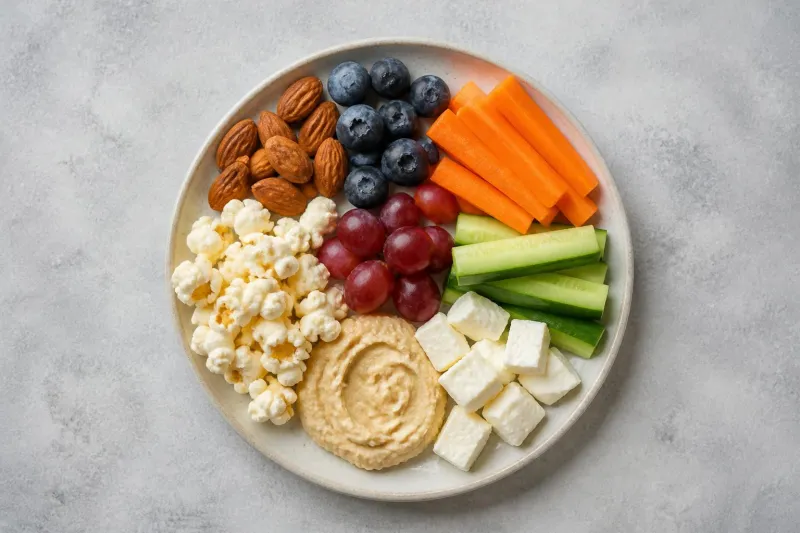
Healthy eating activities that make snacks easier to manage
A useful healthy eating activity should make everyday choices clearer, not stricter.
On this page
A useful healthy eating activity is any small, repeatable task that helps us make clearer snack choices in ordinary life. For adults in the UK, that usually means understanding a label, comparing two similar products on the same basis, or setting up the week so we are not choosing in a rush every time we are hungry.
The point is not to build a perfect system or to make every snack identical. It is to reduce guesswork. If an activity helps us notice what we are buying, what we already have at home, and what a packet is actually telling us, it is doing its job.
What counts as a healthy eating activity for adults
In practice, a healthy eating activity is less about “being good” and more about making decisions easier. For adults, that can include checking a front-of-pack traffic light panel before buying, comparing cereal bars per 100g rather than by marketing claims, writing a simple snack list for workdays, or putting travel-friendly options in a bag the night before.
That matters because adult eating patterns are rarely neat. Snacks happen between meetings, on train platforms, in the car, after a late finish, or while clearing the kitchen. A useful activity has to work in those conditions. If it only works when we have lots of time, a fully stocked fridge, and the patience to analyse everything, it is not very practical.
The NHS makes an important distinction here. Balance is judged across what we eat over time, not by demanding that every single item does everything at once (NHS Eatwell Guide). That is why sensible snack management is usually about routine choices, not perfection. We do not need a moral ranking of foods. We need clearer ways to compare, organise and remember.
A healthy eating activity for adults should usually do one or more of these things:
- improve understanding of what a label means
- help us compare like with like
- reduce last-minute decisions
- make it easier to keep suitable options available
- fit around normal home, work and travel routines
That can be very simple. One person may keep a short list of snacks that travel well. Another may spend ten minutes after the weekly shop separating cupboard items into “take to work” and “leave at home”. Someone else may use a simple table for everyday snack choices to think through what they tend to reach for at different times of day. None of that requires rigid rules.
What does not help is turning snacks into a test of willpower. If an activity creates confusion, shame, or endless checking without better decisions, it is not a strong activity just because it sounds disciplined.
Label-reading activities that help in real life
Reading labels is one of the most useful healthy eating activities because it helps us work with information that is already on the packet. The key is knowing what to compare and what not to assume.
A good starting point is the front of pack. In the UK, many products use colour-coded traffic lights for fat, saturates, sugars and salt, often shown both per serving and as a percentage of a reference intake. This can help us scan quickly, especially when choosing between similar items. The NHS advises using nutrition information to compare foods, while remembering that a portion and 100g are different bases (NHS food labels).
That difference matters. A packet may look lower in something per serving simply because the serving size is small. Another product may look higher only because its stated serving is more realistic. So one of the most practical label-reading activities is this:
- Pick two similar products.
- Ignore the front-of-pack claim for a moment.
- Compare the nutrition table per 100g first.
- Then check what the packet calls per serving.
- Decide whether that serving reflects how you would actually eat it.
Using per 100g gives us a standard basis. It is especially useful for comparing products in the same category, such as flapjacks, crackers, yoghurt pots, popcorn, or nut mixes. Using per serving tells us what the manufacturer says a portion is, but that may or may not match real life. Both figures are useful, but they answer different questions.
For example, if two cereal bars are close in weight, per serving may be enough for a quick choice. If one bar is much larger than the other, per 100g gives a fairer comparison. The same applies to drinks, where bottle sizes can make “one serving” look tidier than it feels in practice.
Another useful activity is checking ingredient lists alongside nutrition panels. Front-of-pack claims can be true and still incomplete. A product labelled no added sugar may contain sugars that are naturally present in fruit, milk, or juice ingredients. That does not make the claim misleading by itself, but it does mean the claim is not the whole picture. We should still check the nutrition table and ingredients list rather than treating no added sugar as a shortcut for overall suitability.
The same caution applies to terms such as “source of fibre”, “high protein”, or “baked not fried”. These may tell us something real, but they do not remove the need to compare the full label. A healthy eating activity that improves real-life decisions is one that slows us down just enough to compare properly, not one that trains us to trust whichever phrase is printed largest.
A practical routine for labels could look like this:
- use the front of pack for a quick first scan
- use per 100g to compare similar products fairly
- use per serving to understand how the packet frames a portion
- check ingredients if a claim seems to be doing too much work
- keep the comparison within category, because yoghurt is not directly comparable with crackers in any simple way
This approach also helps us avoid calorie fixation. We do not need to reduce everything to one number. Salt, sugars, fibre, fat profile, ingredients, and how filling or convenient something is can all matter in context. The aim is not to find a mathematically perfect snack. It is to understand what we are choosing.
Planning activities for home, work and travel
Planning helps because many snack decisions are made when time and attention are low. The most useful activities are the ones that remove friction without becoming rigid.
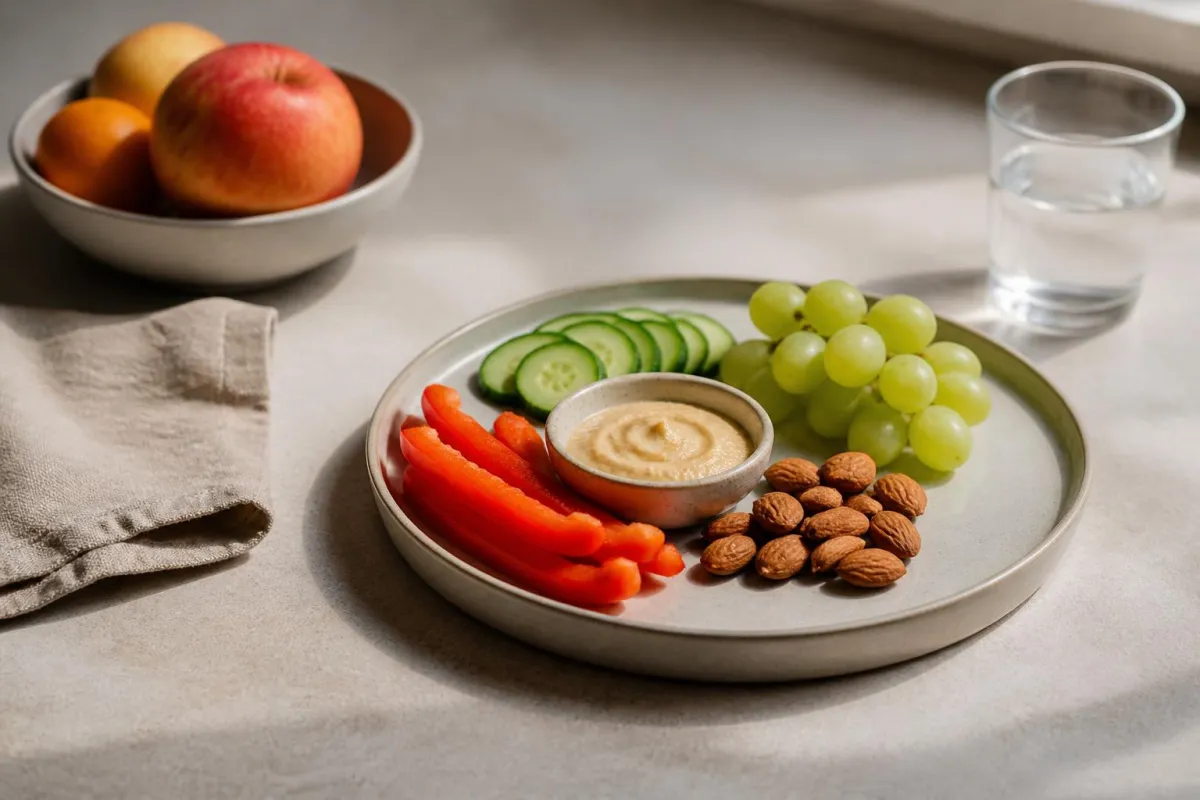
At home, one of the best planning habits is to organise by use, not by food group theory. If the snacks most likely to be taken out of the house are scattered across cupboards, fridge drawers and shopping bags, we are more likely to forget them and buy something else later. A simple home activity is to create one visible area for everyday snack options, then restock it after the weekly shop. That can include cupboard items and a note on the fridge for chilled items that need to be picked up before leaving.
Another helpful activity is to build a repeatable shopping list rather than making fresh decisions every week. That list does not need to be long. It can simply cover a few categories that suit our routine, such as something crunchy, something that travels well, and something that needs chilling. We have written more about building a shopping list that makes everyday eating easier if that is the part people struggle with most.
For work, planning is usually about avoiding the 3 pm gap between intention and availability. A useful activity is to prepare a small weekday set-up on Sunday evening or the night before the working week starts. That might mean:
- putting shelf-stable items in a desk drawer or work bag
- checking what can stay at work and what needs bringing in daily
- noting whether there is a fridge, and whether items are likely to be forgotten there
- keeping a backup option for days when meetings overrun
This is not meal prep in the social media sense. It is basic organisation. The activity is successful if it means we do not have to decide everything at the vending machine.
Travel needs a slightly different approach. Trains, motorway services, airports and long days out all create odd timing. Here, the best planning activities focus on portability, mess, temperature and delay. It helps to ask four questions before leaving:
- Can this sit in a bag for several hours?
- Does it need chilling?
- Will I actually want to eat it on the move?
- If plans change, does it still make sense later?
That last point is often missed. A snack that only works at exactly 11 am is less practical than one that can cover a delayed lunch or an extra leg of a journey.
None of this has to become a rigid system. If planning starts to feel like policing, it is worth scaling it back. The purpose is to reduce avoidable last-minute choices, not to eliminate flexibility. Some days will still involve buying food out. A healthy eating activity should make those days easier to handle, not make them feel like failure.
If readers want a broader look at how habits change in everyday life, our piece on what usually changes when you start eating better may be useful as a companion.
How to judge whether an activity is actually useful
Not every food-related task deserves to be called helpful. Some activities create effort without improving understanding. Others turn into guilt rituals, where we spend more time monitoring than learning.
A genuinely useful activity usually has three qualities.
First, it improves understanding. After doing it a few times, we should be clearer about what a label means, how products differ, or what tends to work for our own routine. If we are still confused by basic terms and cannot explain what we compared, the activity may be too complicated or poorly focused.
Second, it improves comparison. It should help us compare like with like. Looking at per 100g instead of jumping between random serving sizes is a strong example. So is comparing two similar snacks within the same category instead of trying to rank all foods on one scale.
Third, it improves organisation. A useful activity makes the next decision easier. If we spend ten minutes sorting snacks for the week and then actually use them, that is useful. If we create a colour-coded spreadsheet and never look at it again, it probably is not.
There are also warning signs that an activity is not helping:
- it makes us more anxious but not more informed
- it depends on perfect consistency
- it treats one claim as enough evidence
- it creates rules we cannot apply in ordinary life
- it encourages guilt when plans change
- it takes longer than the problem it is meant to solve
One simple test is to ask, “Did this help me understand, compare, or organise?” If the answer is no, we may be doing an activity because it feels virtuous rather than because it works.
This is also where public messaging can complicate things. Campaigns can raise awareness, but they can also flatten detail into slogans. We have looked at how healthy eating campaigns shape everyday snack choices, including why broad messages do not always answer practical label questions.
Limits, uncertainty and when labels do not answer everything
Labels are useful, but they do not settle every question. They help with comparison and basic information. They do not remove uncertainty, and they do not tell us everything about suitability for a particular person or situation.
The first limit is balance. A label can tell us about the product in front of us. It cannot tell us whether our day or week is balanced overall. That is why NHS guidance looks at eating patterns more broadly, rather than treating every snack as a complete judgement on its own (NHS Eatwell Guide).
The second limit is allergy and intolerance. A front-of-pack message, a traffic light panel, or a general “healthy” reputation does not make a food suitable for someone with an allergy. Ingredient lists and allergen information matter, and people need to check the actual packaging each time because products can change. The Food Standards Agency’s consumer guidance is the relevant starting point here (Food Standards Agency consumer allergy guidance). We should not infer personal suitability from a general label or from a category description.
The third limit is storage and food safety. A snack that seems convenient may not be suitable for carrying around all day if it needs chilling. Labels and pack instructions matter here too. The Food Standards Agency gives practical guidance on chilling, freezing and defrosting food safely, and the packet instructions should be followed where relevant (Food Standards Agency food storage guidance). This is one area where “healthy” and “safe to keep in a bag until evening” are separate questions.
There is also a UK-specific point worth noting. Food labelling rules in Great Britain and in the EU are closely related in many everyday respects, so readers will often see familiar formats on products, especially those sold across markets. But details can differ by product and by where it is sold. If a packet presents information in an unusual way, the safest approach is still the practical one, check the basis of comparison, read the ingredients, and do not assume one market’s convention answers everything for another.
Finally, labels do not tell us whether a snack will suit our appetite, schedule, preferences, or household routine. They are information tools, not complete decision-makers. A healthy eating activity is most useful when it respects that limit. It helps us ask better questions, compare more clearly, and organise ordinary life a bit better.
That is the approach we use at Healthy Snacking, an editorial publication by Fleeta Limited. We focus on everyday snack choices, label reading, and what evidence can and cannot show. For most adults, the most effective activities are not dramatic. They are small, repeatable habits that make the next snack decision less rushed and more informed.