How to read no added sugar on peanut butter labels
no added sugar does not mean sugar-free
On this page
A peanut butter label that says no added sugar tells you one specific thing, not everything you need to know about the jar. It means sugar has not been added as an ingredient. It does not mean the product contains no sugar at all, and it does not tell you on its own whether the peanut butter also contains added oil, salt, sweeteners, or other ingredients.
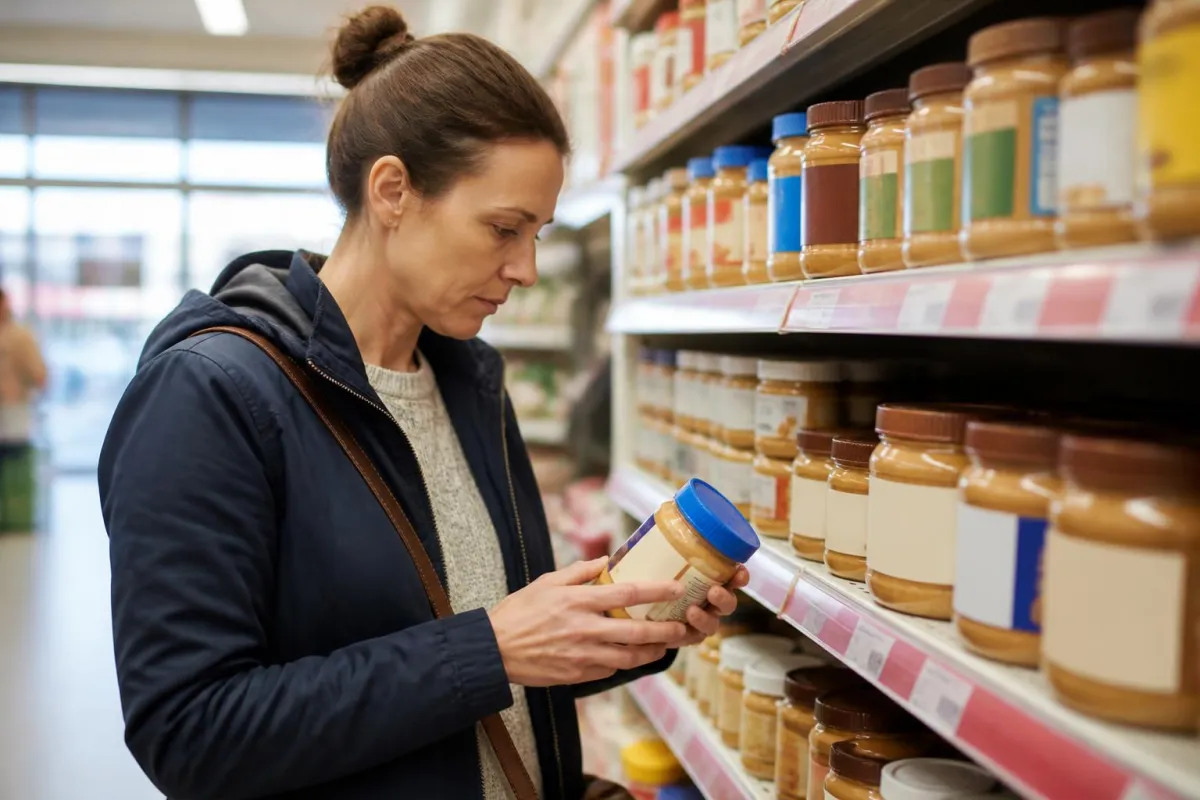
When we read peanut butter no added sugar claims at Healthy Snacking, we treat them as a starting point. The useful checks are the ingredients list, the nutrition table, the allergen information, and the storage instructions. That gives you a much clearer picture than the front of pack wording by itself.
What no added sugar means on a peanut butter label
On a peanut butter jar, no added sugar means the manufacturer has not added sugar to the product. In practice, that usually means no table sugar, syrup, honey, glucose syrup, or similar sweetening ingredient has been included in the recipe. It is a claim about what has not been added.
What it does not mean is sugar-free. Peanuts naturally contain a small amount of sugar, so a peanut butter made entirely from peanuts can still show sugars in the nutrition table. That is normal. The sugars figure on the back is not proof that the front claim is false.
It also does not describe the whole product. A jar can be no added sugar and still include salt, palm oil, rapeseed oil, stabilisers, or other ingredients. Another jar can be no added sugar and contain only peanuts. Those are both possible, which is why the claim is useful but incomplete.
This is also where wording matters. No added sugar is not the same as low sugar, reduced sugar, or unsweetened. Those phrases are often treated as if they mean the same thing in conversation, but on labels they point to different ideas. If you want the broader picture on that distinction, we explain it in our guide to the difference between no added sugar and low sugar claims.
For UK readers, front of pack claims are used within a specific labelling framework, but your practical reading method is still the same. Start with the claim, then verify it against the ingredients and nutrition information. If a rule is discussed more generally across the EU, the wording and framework can differ after Brexit, so it is better to rely on the actual UK label in your hand than on broad assumptions about what a term must mean everywhere.
Check the ingredients list before the front of pack claim
If you only do one thing with a peanut butter label, read the ingredients list.
Ingredients are listed in descending order by weight at the time of manufacture. For a simple peanut butter, you may see something as short as:
Peanuts
Or:
Peanuts, salt
That tells you a lot straight away. It means the jar is mostly, or entirely, peanuts, with perhaps a small amount of salt.
Other jars may list more ingredients, such as vegetable oils or palm oil. These can be added for texture, spreadability, or to reduce separation. Some people do not mind that. Others prefer a shorter ingredients list. The key point is that no added sugar does not rule oils in or out.
Sweetening ingredients are worth checking for directly, especially if the front wording is busy or uses several claims. Look for ingredients such as sugar, brown sugar, honey, maple syrup, molasses, glucose syrup, fructose, date syrup, or fruit juice concentrates. If any of those appear, the product should not be understood as having no added sugar in the ordinary sense. If the wording and the ingredients seem to conflict, trust the full label and leave that jar for a second look.
You may also see emulsifiers or stabilisers. Again, that is not automatically a problem. It simply tells you the product is not just ground peanuts. Whether that matters depends on what you are trying to buy.
The ingredients list is also where allergens matter most. Peanuts must be declared as an allergen. Some jars may also carry advisory wording about other nuts, sesame, milk, or other allergens if there is a cross contamination risk in the factory. The Food Standards Agency advises consumers to use the ingredients list and allergen information carefully, rather than relying on assumptions about what a product usually contains Food Standards Agency consumer allergy guidance.
If you want another example of how this approach works across everyday foods, our guide to reading no added sugar cereal labels properly uses the same label-first method.
Compare jars on the same basis
Once you have checked the ingredients, compare jars on the same basis. For peanut butter, per 100g is usually the clearest way to do that.
Why per 100g? Because every jar has to present nutrition information on a standard basis, and that lets you compare like with like. One brand may call a serving 15g, another 20g, another a tablespoon, and another may not emphasise a serving at all. If you compare only per serving, the numbers can look different partly because the serving sizes are different, not because the products are dramatically different.
The NHS explains that per 100g and per serving are different comparison bases, and that using nutrition information to compare foods works best when you keep the basis consistent NHS food labels.
With peanut butter, this matters because the product is dense. A small change in serving size can make the label look lighter or heavier than another jar even when the recipes are fairly similar. Per 100g cuts through that.
That does not mean per serving is useless. If you already know how you use peanut butter, on toast at home, in porridge at work, or as part of a snack while travelling, per serving can help you understand what that amount contributes in practice. Just do not use it to compare jars unless the serving sizes are genuinely the same.
A sensible sequence is:
- Compare ingredients first.
- Compare nutrition per 100g.
- Use per serving only to picture your usual use.
That approach is especially helpful with peanut butter no added sugar products, because the front claim can make jars look more similar than they are. Two jars may both avoid added sugar but differ noticeably in salt, fibre, or the presence of added oils.
What the nutrition table can and cannot tell you
The nutrition table helps, but it does not hand you a final verdict. It is one tool.
Start with sugars. In a no added sugar peanut butter, the sugars figure usually reflects the naturally occurring sugars in peanuts. A low sugars number does not automatically make one jar superior, and a slightly higher one does not automatically make another poor. Check whether the ingredients explain the difference.
Next, look at fat and saturates. Peanut butter is naturally high in fat because peanuts are. That is not surprising and it is not a sign that the product has somehow failed a test. What matters more is understanding what kind of product you are comparing. If one jar contains only peanuts and another includes added palm oil, the saturates figure may help explain part of that difference. But the number still needs context from the ingredients list.
Fibre and protein can also be useful, especially when comparing a very simple peanut butter with one that is more processed. Peanut butter often provides both, but amounts can vary. Again, use the figures to describe the product, not to turn one line into a moral judgement.
Salt is often where labels vary more clearly. Some peanut butters contain no added salt, some a little, and some enough for the difference to be noticeable on the label. If you are choosing between jars that otherwise look similar, the salt figure may be one of the more practical comparison points.
What the table cannot tell you is whether a food is good or bad in the abstract. At Healthy Snacking, we do not treat one nutrient as a verdict on the whole jar. A peanut butter can be high in fat because peanuts are high in fat. It can contain some sugar without any sugar being added. It can contain salt and still be a straightforward product. Labels describe foods. They do not issue moral grades.
That is also consistent with broader NHS guidance. The NHS Eatwell Guide looks at dietary balance across the day or week, rather than demanding that every single food item do everything at once NHS Eatwell Guide.
So when you read the table, ask practical questions:
- Is the sugars figure consistent with the ingredients?
- Is the salt level higher or lower than the other jars I am comparing?
- Does the fat profile seem to reflect just peanuts, or peanuts plus added oils?
- Am I comparing per 100g rather than being distracted by different serving sizes?
That is usually enough to make a sensible choice.
If this style of label reading is useful, we apply the same method in our article on how to read no added sugar on bread labels, where the front claim also tells only part of the story.
Allergens, storage and everyday use
Beyond nutrition, there are three practical checks that matter with peanut butter, allergens, storage, and how you actually use the jar.
First, allergens. Peanut butter contains peanuts, so the primary allergen is obvious, but the label can still contain important extra information. Some products are made in facilities that also handle tree nuts, sesame, milk, or other allergens. If you or someone in your household needs to avoid a particular ingredient, check both the ingredients list and any allergen statement every time. Packaging and factory arrangements can change. The Food Standards Agency guidance is clear that people should use the label information provided and not assume a familiar product is unchanged Food Standards Agency consumer allergy guidance.
Second, storage. Peanut butter is shelf stable when unopened, but you should still follow the product instructions. Some natural peanut butters separate, with oil rising to the top. That is usually a texture issue, not a sign that sugar has been added or omitted. Stirring may be expected. Once opened, the label may advise storing in a cool, dry place and using within a certain period. The Food Standards Agency’s storage guidance is broader than peanut butter alone, but the basic point applies, follow the product instructions and store foods appropriately Food Standards Agency food storage guidance.
Third, everyday use. Think about what you need the jar to do. A very runny, all-peanut product may be ideal for stirring into porridge or yoghurt, while a more stable texture may be easier for sandwiches at work or travel snacks. That is not a nutrition judgement. It is just practical use. The same applies to salted versus unsalted versions. Label reading works best when it connects to how you actually eat.
It also helps to remember that no added sugar claims can distract from the simple question, what is this made from, and does it suit my household? That is the main question whether you are reading a peanut butter jar, a loaf, or a jar of jam. We explored that same issue in our piece on reading no added sugar jam without guesswork.
A straightforward way to read a peanut butter label is this:
- Front of pack, note the no added sugar claim.
- Ingredients list, check whether it is just peanuts or peanuts plus salt, oils, or other ingredients.
- Nutrition table, compare per 100g, especially sugars, salt, fat, saturates, fibre, and protein.
- Allergens, check for any ingredient or advisory statement relevant to you.
- Storage, follow the jar’s instructions once opened.
That is usually enough to cut through the marketing and understand what you are buying. For peanut butter no added sugar products, the useful habit is not to treat the claim as meaningless, but not to treat it as the whole story either. It tells you one thing. The rest of the label tells you the rest.