How to choose high-protein snacks without label confusion
Protein claims are easier to judge when you compare the same label basis, such as per 100g or per serving.
On this page
Choosing a higher-protein snack is usually simpler than the front of the pack makes it look. Start by checking how much protein it provides on the same basis as the foods you are comparing, usually per 100g or per serving. Then look at the rest of the picture, including sugar, salt, energy, fibre, ingredients, storage needs and whether the snack is actually practical for your day.
That matters because protein on its own does not tell you whether a snack is useful, filling, convenient or a good fit for your routine. At Healthy Snacking, published by Fleeta Limited, we focus on the ordinary decisions people make in kitchens, offices, cars and train stations, where label wording can sound confident but the small print does the real work.
What counts as a healthy high-protein snack
In everyday household terms, a high-protein snack is simply a snack that gives a noticeable amount of protein for the amount you actually eat. That could be a pot of Greek-style yoghurt, a pack of roasted chickpeas, cottage cheese with crackers, edamame, a small tub of skyr, a boiled egg with tomatoes, or a nut and seed mix. It does not have to be a sports product, a shake or a bar.
The harder word is healthy. We would use it practically, not as a moral badge. A healthy snack is one that fits reasonably well into your wider eating pattern, is suitable for the situation you are in, and does not rely on one headline nutrient to distract from everything else. The NHS Eatwell Guide is useful here because it treats balance across the day or week, not as a test every single snack has to pass on its own.
So when people look for healthy high protein snacks, the useful question is not “does this contain protein?” It is more like this:
- Does it provide a meaningful amount of protein for the portion I will actually eat?
- Is the sugar, salt and energy level in line with what I want from a snack?
- Does it have some fibre, if that would help this part of my day?
- Will it keep well enough for where I am taking it?
- Will I actually eat it, or will it sit in a drawer until it expires?
Protein can help a snack feel more substantial, especially when it is paired with fibre or a food that takes some chewing. But a protein number alone does not settle the question. A sweetened dessert pot with added protein may still be mostly useful to compare as a dessert-style snack. A savoury snack marketed for protein may still be high in salt. A nut mix may not carry a front-of-pack protein claim at all, yet still be a practical option in the right context.
That is why we prefer “higher protein” as a comparison idea in everyday use. It keeps the focus on what you are choosing between, not on a badge on the front of the packet.
How to compare labels without mixing up the numbers
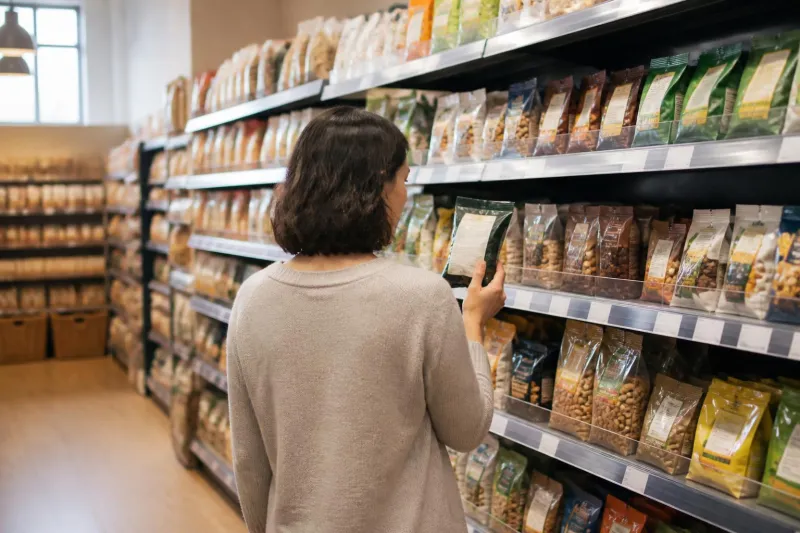
This is where most confusion starts. One product shouts about protein per pack. Another lists nutrition per 100g. A third uses a serving size that is smaller than the pack many people will actually eat. If you compare those numbers directly, you can easily reach the wrong conclusion.
In the UK, the nutrition panel usually gives values per 100g or per 100ml, and often also per serving. The NHS explains that these are different comparison bases and should not be mixed up when comparing foods per 100g.
A practical way to compare snacks is:
- Use per 100g first, when the foods are similar.
- Use per serving second, to check what you would realistically consume.
- Make sure the serving is a real one, not just a manufacturer’s neat fraction.
For example, if you are comparing two yoghurt pots of similar size, per serving may be enough because you are likely to eat the whole pot. If you are comparing nuts, crackers, jerky and a chilled dairy pot, per 100g is often the fairest starting point because pack sizes and serving ideas vary so much.
Here is how that works in practice.
If Snack A has 20g of protein per 100g and Snack B has 12g per 100g, Snack A is more protein-dense. But if the actual pot of Snack B is much larger, the amount you eat may still give you more total protein. That is why both figures matter.
Do the same with sugar, salt and energy:
- Protein, compare on one basis only at a time.
- Sugar, compare on the same basis as protein.
- Salt, especially important in savoury snacks.
- Energy, useful for context, not as a moral score.
If one snack gives 18g protein per 100g and another gives 15g per 100g, that is a modest difference. If the second has much less salt, more fibre, a simpler ingredient list, or is easier to keep at work, it may still be the more useful choice for you.
Be careful with serving sizes. A packet may list nutrition for half the pack, but many adults will eat the full pack in one sitting. Bars and single pots are straightforward. Resealable bags and multipacks are not. If a lentil crisp bag says per serving but the bag contains two servings, check both the serving number and the whole-pack amount before deciding what it really offers.
This also matters for products making protein claims. In the UK, “source of protein” and “high protein” have specific conditions attached under retained nutrition claims rules, rather than meaning whatever a brand wants them to mean. We explain the distinction in our guide to protein claim wording on labels. If you want to compare a few products quickly, our piece on snacks that are easier to compare on the label can help.
One country point is worth noting. Since Brexit, UK food law is not simply identical to the EU framework in every detail, even where many nutrition labelling concepts remain familiar. If a product is sold in Great Britain and imported from elsewhere, the layout or wording may look slightly different, but the same comparison principle still applies. Match like with like, and do not compare per 100g on one pack with per serving on another.
What else matters besides protein
Protein is only one part of whether a snack works well.
Fibre is often the first missing piece. Many higher-protein snacks, especially dairy-based ones, provide little or no fibre. That does not make them bad choices, but it may mean they are more useful when paired with fruit, vegetables, oats, wholegrain crackers or pulses. If fibre matters in the comparison you are making, it is worth knowing what label claims mean. We cover that in our guide to fibre claim wording on labels.
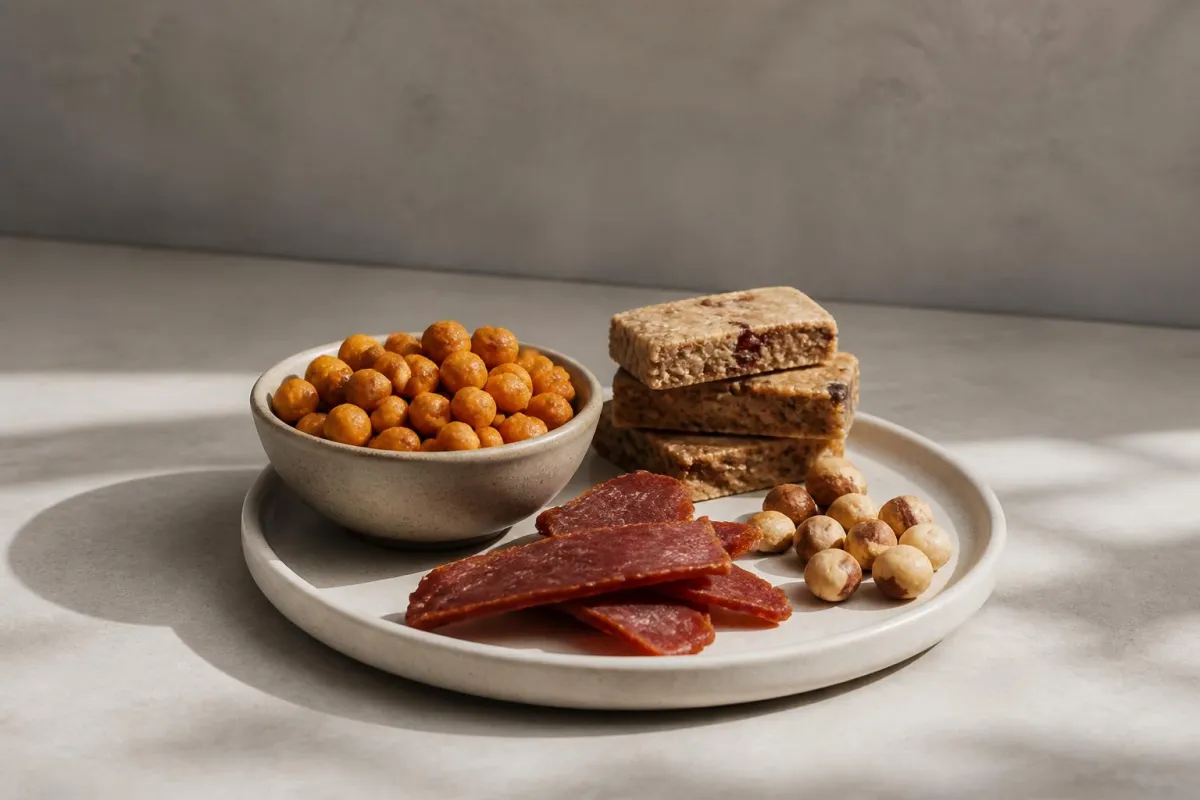
Salt can change the picture quickly in savoury snacks. Jerky, meat snacks, cheese portions, flavoured roasted pulses and protein crisps can all look similar on the front yet differ a lot in salt. If you are comparing savoury options for regular use at work, salt is often one of the clearest reasons to choose one over another.
Ingredients matter too, but not in a simplistic “short list good, long list bad” way. A longer ingredient list may simply reflect a flavoured yoghurt, a fortified bar or a baked snack with several components. What matters more is whether the ingredients make sense for what the product is, and whether sweeteners, flavourings, protein isolates or syrups are doing most of the work. That is not automatically a reason to reject a product. It is just part of understanding what you are buying.
Level of processing is another context issue. Some minimally processed foods, such as plain yoghurt, nuts, roasted broad beans or boiled eggs, can be straightforward ways to get protein. More processed snacks, such as bars or puffs, may still be convenient and perfectly usable in some settings. The useful question is not whether a food can be placed in a neat category, but whether it is giving you what you want from that snack occasion.
Convenience matters more than many label guides admit. A chilled snack that spoils because your office fridge is full is less useful than a shelf-stable one with slightly less protein. A snack that needs a spoon may not suit a train journey. A glass jar of cottage cheese may be nutritionally fine but awkward in a work bag.
How filling a snack feels matters as well, although labels cannot tell you this precisely. Texture, water content, fibre, fat, portion size and how quickly you eat all play a part. Two snacks with the same protein figure may not feel equally substantial. That is normal. Labels help with comparison, but they do not predict your experience exactly.
Everyday snack patterns for home, work and travel
Most people do better with a few repeatable patterns than with a long list of perfect snack ideas.
At home, chilled foods are easier to use. That opens up options such as yoghurt, skyr, cottage cheese, kefir drinks, eggs, hummus, or leftovers that are small enough to count as a snack rather than a meal. If you want a snack to feel more complete, pairing protein with fruit, vegetables or a wholegrain item is often more practical than hunting for a single product that does everything.
For work, it helps to split snacks into two groups, shelf-stable and chilled.
Shelf-stable options can include:
- nuts and seeds
- roasted chickpeas or broad beans
- crispbreads with a protein topping added at work
- shelf-stable milk drinks, where the label suits your needs
- tinned fish with crackers, if that is realistic in your workplace
Chilled work options can include:
- yoghurt pots
- skyr or quark-style pots
- cheese with fruit or tomatoes
- edamame
- boiled eggs
The point is not to turn this into a rulebook. It is to reduce the chance that the only available option at 4 pm is whatever is nearest the till. Our everyday snack guidance goes into this kind of routine planning in more detail.
For travel, storage and mess matter almost as much as nutrition. A snack that travels well, opens easily and does not need immediate refrigeration is often the more dependable choice. Nuts, roasted pulses, some bars, crispbreads, oatcakes, nut butter sachets and certain long-life dairy products can all work, but the labels still need checking product by product. We have a separate guide to shelf-stable snacks that travel well and read clearly on labels.
One useful pattern is to keep one or two “default” options in each place you regularly need them. That might mean a yoghurt and fruit at home, roasted pulses in a desk drawer, and nuts or a clearly labelled bar in a travel bag. Not because those are the only sensible foods, but because routine removes some of the pressure to decode packaging in a hurry.
When claims and front-of-pack wording need a closer look
Front-of-pack wording is there to catch your eye, not to replace the full label.
Take no added sugar. That phrase has a specific meaning, but it does not mean sugar-free, low sugar, or low energy. A snack with no added sugar can still contain sugars naturally present in fruit or milk, and it may still be sweet. If you are comparing products, check the nutrition panel and ingredients list rather than assuming what the phrase means.
The same applies to high in protein. A product may meet the claim conditions and still differ a great deal from another product making the same claim. One may be a yoghurt pot, another a bar, another a savoury baked snack. The protein claim tells you something real, but not enough to choose between them on its own.
Other wording can create the same problem:
- baked not fried
- source of fibre
- low fat
- natural
- plant-based
- lightly salted
None of these phrases cancels the need to check the nutrition panel. Some tell you one narrow thing. Some are broader marketing language. Either way, the back or side of the pack is where the useful comparison happens.
This is especially important when a product combines several claims. A bar might be labelled high in protein, no added sugar and high fibre, yet still be small, expensive for what it is, or less filling than a simpler snack. Another product might make no bold claim at all but compare well once you look at the numbers.
Storage, allergens and other checks before you rely on a snack
A snack is only useful if you can store it properly and if it is suitable for you to eat.
Follow the pack instructions, especially for chilled products. The Food Standards Agency gives general guidance on chilling and storage, but the product’s own instructions come first where they are relevant Food Standards Agency food storage guidance. If a dairy snack says keep refrigerated, that matters. If a pack says consume within a certain time after opening, that matters too.
This is easy to overlook with higher-protein snacks because many of them are dairy, meat, fish or egg based, and those are not all equally forgiving if left in a warm bag. Even shelf-stable products may become less practical once opened.
Allergen checks are non-negotiable. Do not rely on memory, pack colour, brand familiarity or a general article like this one. The Food Standards Agency advises consumers to use the specific ingredient list and allergen information on the food they are buying Food Standards Agency consumer allergy guidance. Recipes and factories can change. A snack that was suitable for one person last month may not be suitable now.
This matters particularly with:
- nuts and peanuts
- milk and whey ingredients in protein products
- soya
- sesame
- egg
- gluten-containing cereals
- flavour coatings and seasonings on savoury snacks
If you are building a regular snack routine for home, work or travel, it is worth checking a few practical points before relying on any product:
- Is the nutrition panel clear and comparable?
- Is the whole-pack amount realistic for how you eat it?
- Does it need refrigeration?
- Can it survive your commute or workday?
- Are the allergens and ingredients suitable for you?
- Will you keep a backup option when chilled food is not practical?
That is usually enough to cut through most label confusion. Healthy high protein snacks are not a single category with one look, one ingredient list or one ideal number. They are a group of options that become more or less useful depending on how you compare them, where you need them, and what else you want the snack to do. When in doubt, compare like with like, use per 100g and per serving carefully, and let the full label carry more weight than the front-of-pack promise.