How to choose lower-carb snacks without label confusion
Lower carb is a comparison, not a regulated health category.
On this page
Choosing lower-carb snacks is mostly about comparison, not finding a strict category. In everyday shopping, a "lower-carb" snack is simply one that contains less carbohydrate than the alternatives you are considering, in the amount you are actually likely to eat. That could mean comparing two cereal bars, two yoghurt pots, or a small bag of nuts against a pack of crackers.
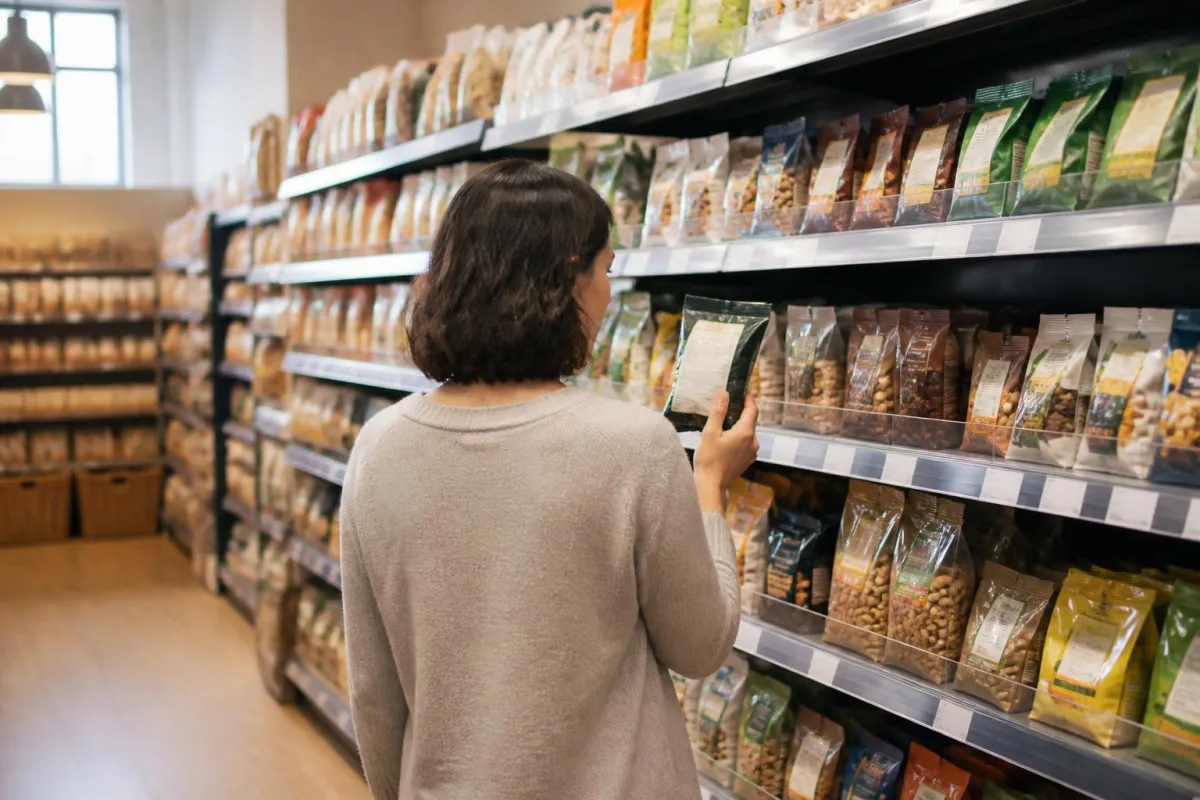
That is why label reading matters more than front-of-pack promises. For practical, everyday low carb healthy snacks, we need to look at the nutrition panel, check whether we are comparing per 100g or per serving, and keep the packet size in mind. The NHS notes that 100g and a portion are different comparison bases, and both can be useful depending on the question you are asking (NHS guide to reading food labels).
What people usually mean by a lower-carb snack
Most people are not using "lower-carb" as a legal or technical term. They usually mean a snack that is lighter on carbohydrate than another common option, such as crisps versus crackers, or yoghurt versus a flapjack. It is a relative idea.
That matters because there is no single cut-off that turns a food into a lower-carb snack for all purposes. A food can be lower in carbohydrate than one option and higher than another. A plain Greek-style yoghurt may be lower in carbohydrate than a sweetened yoghurt with granola, but higher than a boiled egg. A small handful of nuts may be lower than a cereal bar, but not lower than some cheese portions.
For everyday adult snacking, the sensible question is not "Is this officially low carb?" but "Compared with what I would otherwise eat, how much carbohydrate does this contain in the amount I am likely to have?" That keeps the focus on ordinary choices rather than diet rules.
It also helps to separate carbohydrate from value judgments. A snack being lower in carbohydrate does not automatically make it better, and a snack being higher in carbohydrate does not make it bad. Carbohydrate is one part of the label. Depending on the food, you may also care about fibre, protein, salt, ingredients, and how filling or practical it is. The NHS Eatwell Guide also frames balance across the day or week, rather than demanding that every individual snack achieve everything at once (NHS Eatwell Guide).
So when we talk about lower-carb snacks here, we mean snacks that tend to come out lower on the carbohydrate line of the label than common alternatives, without pretending that this is a formal category or a guarantee of suitability for every person.
How to compare labels without mixing up the numbers
The carbohydrate figure you need is usually listed in the nutrition table as "carbohydrate", often with a separate line underneath for "of which sugars". If you are comparing products, start with total carbohydrate, then use the sugars line and ingredients list for extra context.
The first trap is comparing one product per 100g with another per serving and assuming the numbers mean the same thing. They do not.
Per 100g is the cleanest way to compare products directly. It puts foods on the same basis, which is why the NHS recommends using it for like-for-like comparisons (NHS guide to reading food labels). If you are choosing between two brands of roasted chickpeas, two cracker packs, or two yoghurt pots of different sizes, per 100g helps you see which one is more carbohydrate-dense.
Per serving answers a different question. It tells you how much carbohydrate you may actually eat if you have the stated portion. That can be more useful when the whole pack is clearly one snack, such as a single yoghurt pot, a mini cheese pack, or a small nut pouch.
Problems start when serving sizes are unrealistic, vague, or easy to exceed. A large sharing bag may show a modest carbohydrate figure per serving, but that number depends on stopping at the manufacturer's chosen portion. If the packet contains three servings and you are likely to eat the lot, the relevant figure is the whole packet, not the neat-looking serving line.
Packet size can change the picture dramatically. A snack with a lower carbohydrate figure per 100g can still deliver more carbohydrate overall if the pack is much larger. The reverse is also true. A food that looks higher per 100g may result in less carbohydrate in practice because the unit sold is small and self-contained.
A simple way to compare is to ask three questions in order:
- What is the carbohydrate value per 100g?
- What is the carbohydrate value per serving?
- How much of this pack am I realistically going to eat?
If the serving is unclear, calculate from the pack. For example, if a 160g packet lists carbohydrate per 100g, multiply that figure by 1.6 to estimate the full pack. You do not need perfect arithmetic every time, just enough to avoid being misled by presentation.
It also helps to compare similar formats with similar formats. Yoghurt against yoghurt, nuts against nuts, crackers against crackers. If you compare completely different foods, both the per 100g and per serving figures can look odd because water content, density and normal eating patterns differ so much.
For readers who want a broader grounding in label comparison, our everyday snack guidance and study snacks that are easier to compare on the label go into the same issue from a practical shopping angle.
What claims like no added sugar do and do not tell you
Front-of-pack claims can be useful prompts, but they are not a shortcut past the nutrition panel.
Take no added sugar. In UK food labelling, that claim has a specific meaning. It tells you sugar has not been added as an ingredient in the way covered by the rules for that claim. It does not tell you that the food is low in carbohydrate. It does not tell you that it is low in sugar overall. It does not tell you how large the portion is. And it definitely does not tell you how it compares with another snack unless you check the numbers.
A fruit snack can say no added sugar and still contain substantial sugars naturally present in fruit, with a carbohydrate total to match. A yoghurt with no added sugar may still contain lactose from milk. A nut butter pouch with no added sugar may be relatively low in carbohydrate, but another pouch with the same claim could include dates or dried fruit and come out much higher.
The same caution applies to claims such as "natural", "high protein", "source of fibre" or "gluten free". Some of these claims have defined conditions. Others are looser marketing language. None of them replaces checking the label.
The ingredients list matters because it tells you where the carbohydrate is likely to be coming from. Oats, flours, rice, maize, dried fruit, syrups, honey and starches all affect the overall carbohydrate picture differently depending on the recipe. Looking at the ingredients list alongside the nutrition panel can explain why two products in the same category differ so much.
Allergen information matters too. A snack may look suitable from a carbohydrate point of view and still be unsuitable for someone because of ingredients or cross-contamination warnings. The Food Standards Agency advises consumers to check ingredient and allergen information carefully and not to infer personal suitability from general claims (Food Standards Agency consumer allergy guidance).
So the useful rule is straightforward. Treat front-of-pack claims as signposts, not verdicts. If the packet says no added sugar, turn it over and check the carbohydrate line, the sugars line, the ingredients list, and the actual packet size before deciding whether it fits what you mean by a lower-carb snack.
Which snack types often come out lower in carbohydrate
Some snack formats tend to be lower in carbohydrate on labels than others, although there are always exceptions.
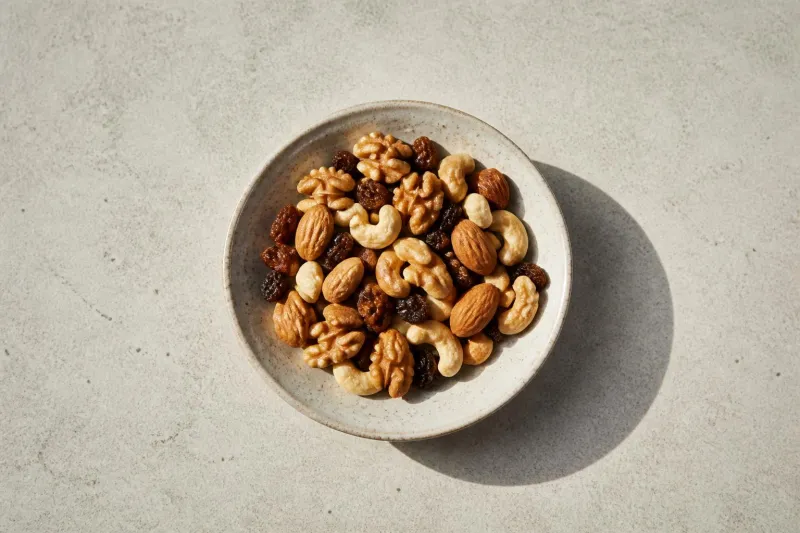
Nuts and seeds often come out lower than cereal-based snacks, especially compared with crackers, pretzels, flapjacks, cereal bars and baked snacks made mainly from grains. That does not make every nut or seed product identical. Coated, sweetened or clustered versions can be much higher than plain or simply salted ones. We cover the wider context in nuts in an overall eating pattern.
Cheese portions, plain cooked meats, eggs and some fish-based snack pots also tend to be lower in carbohydrate, because they are not built around grains or sugars. But sauces, glazes, crumbs and crackers included in the pack can change that quickly.
Plain yoghurt, especially unsweetened or less sweetened varieties, often compares favourably against desserts, layered yoghurts, granola-topped pots and many bars. Again, the difference is not the format alone but what has been added.
Vegetable-led snacks can vary. Raw crunchy vegetables are naturally lower in carbohydrate than many packaged snacks, but dips can move the numbers in different directions. Hummus, bean dips and lentil-based snacks may contain more carbohydrate than dairy-based dips or some seed-based options, though they may offer other qualities you care about. Crisps made from pulses or vegetables are not automatically low in carbohydrate simply because the front of the pack highlights the ingredient.
Cereal and grain-based snacks often land higher. Crackers, breadsticks, rice cakes, oat bars, popcorn clusters and many savoury baked bites are commonly more carbohydrate-heavy than nuts, cheese or egg-based options. That does not mean they are unsuitable, only that they are less likely to be what someone means by lower-carb.
Dried fruit is another format that often surprises people. Because water has been removed, the sugars and total carbohydrate are concentrated. A small portion may still be fine as an everyday snack choice, but it is rarely one of the lowest-carbohydrate options on the shelf.
Sweet snack bars are especially variable. Some are mainly dates, oats or syrups. Others rely more on nuts and seeds. Two bars that look similar on the front can differ sharply on the label. The same goes for savoury snacks. Lentil curls, pea crisps, corn snacks, pork crackling, cheese crisps and seeded crackers all sit in very different places once you compare them properly. Our guides to sweet snacks that satisfy without label guesswork and how to choose savoury snacks without label guesswork can help if you are narrowing down those categories.
The broad pattern is simple. Snacks built mainly from grains, flours, starches and dried fruit often come out higher in carbohydrate. Snacks built mainly from nuts, seeds, dairy, eggs, meat or fish often come out lower. But "often" is doing real work there. The label still decides the comparison.
How to make lower-carb choices at work, at home and while travelling
Good intentions matter less than what is easy to reach when you are busy, delayed or tired. If you want lower-carb options to be realistic, organise them around where you actually snack.
At home, keep a few straightforward options visible and easy to use. That might mean portioning nuts into small containers, keeping plain yoghurt where it is easy to spot, or storing cheese, boiled eggs or prepared vegetables at eye level in the fridge. If a snack needs chilling, freezing or a use-by check, follow the product instructions rather than relying on guesswork. The Food Standards Agency gives practical guidance on chilling and storage, and the key point for snack planning is simple: storage affects food safety, so the pack instructions matter (Food Standards Agency food storage guidance).
At work, the easiest win is often reducing dependence on whatever happens to be nearest at 3pm. Desk-stable options can help, but check the packet rather than assuming all "healthy" office snacks are lower in carbohydrate. Nut packs, seed mixes and some savoury protein-based snacks may fit better than cereal bars or biscuit packs, but sweet coatings and oversized bags can undo the difference. If you have access to a fridge, yoghurt, cheese, eggs and cut vegetables open up more options.
It is also worth thinking about the full eating occasion. If your snack usually comes with a drink, the carbohydrate total may be coming as much from the drink as the food. A lower-carb snack paired with a sugary coffee-shop drink may not work out the way you intended.
When travelling, convenience narrows the field. Service stations, train kiosks and airport shops often stock more bars, pastries, sandwiches and crisps than simpler refrigerated foods. In those situations, realism helps. You may not get the ideal choice, so compare what is actually available. A small pack of nuts, a plain yoghurt, a cheese snack pack, or a boiled egg pot may come out lower than most bakery items or cereal bars. If all you have is a vending machine, the best option may simply be the one with the lowest carbohydrate figure among a limited set.
For longer journeys, pack first and buy second. A small insulated lunch bag with a cool pack can make chilled snacks more practical for several hours, but only if the product's own storage instructions still make sense. For shelf-stable travel snacks, choose packets that are easy to finish or reseal, because packet size can quietly turn a lower-carb intention into a much larger intake than planned.
Finally, keep expectations realistic. Lower-carb snacking is not about building a perfect system or treating every packet as an exam. It is about making comparisons that are good enough to guide ordinary choices. If you understand per 100g, per serving, packet size and the limits of front-of-pack claims, you can usually sort the genuinely lower-carb options from the merely well-marketed ones.
That is the practical standard we use at Healthy Snacking. Clear labels, sensible comparisons, and no need to turn snack choice into a set of restrictive rules.