Sweet snacks that satisfy without label guesswork
A sweeter snack can fit into an overall balanced diet; the NHS frames balance over a day or week, not every single item.

On this page
- What counts as a sensible sweet snack
- How to compare sweet snacks on the label
- What no added sugar does and does not mean
- Practical sweet-snack patterns for home, work and travel
- Common label traps with dried fruit, bars and desserts
- When ingredients and allergen information matter more than the front of pack
Sweet snacks can fit perfectly well into an ordinary eating pattern without turning every choice into a test. For most adults, the useful question is not whether a snack is virtuous or naughty, but whether it is practical, satisfying, and clear enough on the label that you know what you are actually choosing.
That is especially true if you are looking for healthy snacks for a sweet tooth. The simplest approach is to compare like with like, keep an eye on the nutrition panel and ingredients list, and judge balance across the day or week rather than expecting one biscuit, yoghurt pot or handful of dried fruit to do every nutritional job on its own, as the NHS Eatwell Guide explains.
What counts as a sensible sweet snack
A sensible sweet snack is one that makes sense in context. It suits the moment, it is realistic for where you are, and it does not rely on wishful thinking about what is in the packet.
That will look different from one situation to another. At home, a sweet snack might be toast with nut butter and sliced fruit, or yoghurt with berries. At a desk, it might be a cereal bar plus a drink and something more filling alongside it. On a train, it may simply be a shelf-stable option that will not melt, leak or get crushed in a bag.
It also helps to drop the idea that every snack must be nutritionally complete. The NHS frames overall balance across a day or week, not as a standard that every single eating occasion must meet on its own. A sweet snack can be mostly about convenience and enjoyment, while another part of the day brings more fibre, protein or vegetables. That is a more realistic way to think about ordinary food than treating one mid-afternoon snack as a referendum on your whole diet.
This matters because people often overcorrect in one of two directions. Either they assume anything sweet must be a poor choice, or they expect a sweet snack to act like a meal replacement. Neither assumption is very helpful. A small flapjack, a fruit yoghurt, a pack of dried apricots and a chocolate-coated protein bar are all sweet, but they are not interchangeable. They differ in texture, ingredients, fibre, fat, salt, storage needs and how filling they are likely to feel in practice.
If you want a steadier routine, think in patterns rather than rules. Some people prefer a naturally sweet base with something more substantial added, such as fruit with nuts, or yoghurt with oats. Others prefer a clearly portioned packaged item because it is easier to keep at work or take on a journey. Both can be sensible. The point is not to moralise the snack, but to understand what it is doing for you.
For more everyday comparisons, our everyday snack guidance and our guide to lower-sugar snacks without label guesswork go into the same practical approach.
How to compare sweet snacks on the label
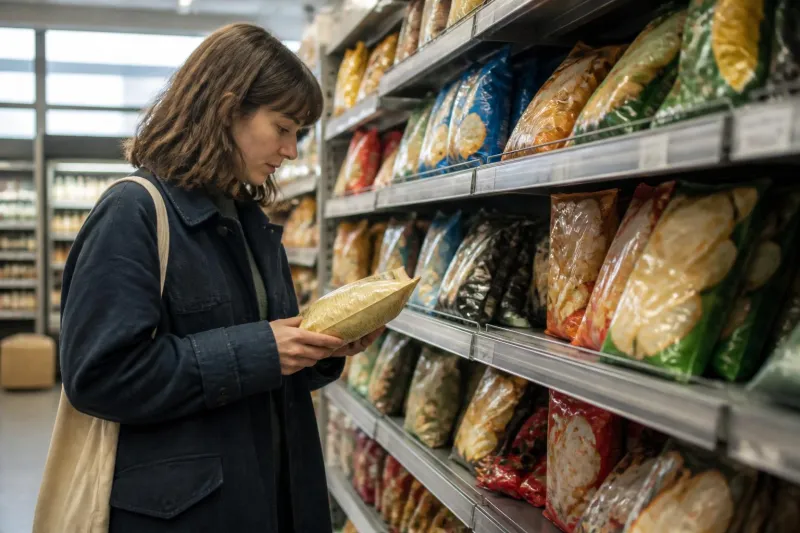
If two sweet snacks look similar from the front of pack, the nutrition panel is where the useful comparison starts. In the UK, labels commonly show values both per 100g and per serving. The NHS is clear that these are different bases and should not be mixed in the same comparison (NHS food labels).
That means if you are comparing two cereal bars, compare both per 100g, or compare both per serving if the serving sizes are genuinely similar and clearly stated. Do not compare the sugar on one bar per serving with the fibre on another per 100g and assume you have a fair result. You have not.
For sweet snacks, four lines are especially useful to check:
- sugar
- fibre
- fat, including saturates where shown
- salt
Sugar tells you how much sugar is present in the product, but not where it came from or whether it was added for sweetness. Fibre helps you spot whether a snack may offer a bit more staying power, especially in products based on oats, wholegrains, pulses, nuts or fruit. Fat is worth checking because some sweet snacks are quite low in fat while others, such as pastries, chocolate-coated bars or some desserts, are much higher. Salt can be easy to miss in sweet foods, especially in mixed bars, baked goods and some breakfast-style snacks.
The easiest method is to choose a category and compare within it. Compare yoghurts with yoghurts. Compare oat bars with oat bars. Compare chocolate mousses with chocolate mousses. Category shortcuts are unreliable across very different foods. A fruit pot and a brownie may both be sold as snacks, but their labels answer different questions.
It also helps to look at the serving size with a cool head. A manufacturer’s stated serving may be half a large cookie, one small square of cake, or a single dessert pot. That does not make it wrong, but it does mean you need to notice what is being counted. If a pack contains two bars and the panel treats one bar as the serving, then the front of pack may look lighter than the whole pack actually is.
When people say they want healthy snacks for a sweet tooth, this is usually what they mean in practice. They want to compare options without being misled by different units, selective front-of-pack claims or tiny nominal servings.
What no added sugar does and does not mean
The claim no added sugar has a specific meaning. It refers to sugar or other ingredients used for sweetening not being added during manufacture. It does not automatically mean the food is low in sugar overall.
That distinction matters most in foods that contain naturally occurring sugars from ingredients such as fruit or milk. A fruit purée pouch, a yoghurt, or a date-based bar may carry no added sugar and still contain a fair amount of sugar on the nutrition panel. The claim tells you something about formulation, but not everything you need to know about the final product.
So when you see no added sugar, check two things straight away.
First, look at the sugar line on the nutrition panel. That tells you how much sugar is actually present in the product.
Second, read the ingredients list. This helps you see what is providing the sweetness. It might be fruit purée, fruit juice concentrate, dates, milk ingredients or something else entirely. If you are comparing two products and one relies heavily on concentrated fruit ingredients while the other does not, that can affect texture, stickiness, sweetness and how easy it is to eat quickly, even if both make similar marketing claims.
This is also one area where consumers sometimes assume more than the label says. No added sugar is not a synonym for low sugar, low calorie, high fibre, minimally processed, or suitable for everyone. It is one claim, not a full verdict.
Practical sweet-snack patterns for home, work and travel
The most useful sweet-snack setup is the one you can keep going without hassle. That usually means thinking about storage, mess, convenience and whether the snack has enough staying power for the situation.
At home, the easiest pattern is to keep a few sweet bases and a few add-ons around. Sweet bases might include fruit, plain or flavoured yoghurt, toast, oatcakes, cereal, rice cakes or a simple pudding. Add-ons might include nuts, seeds, peanut butter, soft cheese, oats or a spoonful of chopped dried fruit. This lets you adjust for appetite and timing without pretending one standard snack suits every day.
For work, the main constraint is often storage. Desk drawers favour items that are robust, individually wrapped or easy to portion without much mess. Think oat bars, plain popcorn with something sweet alongside, wholegrain biscuits, dried fruit in small packs, or nuts paired with a sweeter item. If you have access to a fridge, yoghurt pots, fruit and chilled desserts become easier options. If not, shelf stability matters more than ideals.
For travel, choose snacks that tolerate temperature changes and movement. Chocolate coatings can melt. Fresh fruit can bruise. Crumbly pastries can end up all over a bag or car seat. Shelf-stable options with clear labels are often simpler, especially for longer journeys. Our guide to shelf-stable snacks that travel well and read clearly on labels covers this in more detail.
A practical pattern many adults find useful is pairing sweetness with something that lasts a bit longer. That does not mean prescribing exact portions. It means noticing that a sweet item on its own may feel quite different from the same item with yoghurt, nuts, toast, or another more substantial element. A banana and a biscuit are one kind of snack. A banana, a biscuit and a pot of yoghurt are another. Neither is morally better. They just serve different situations.
Where storage matters, follow the pack instructions and general Food Standards Agency guidance on chilling and handling food, especially for dairy desserts, cut fruit and anything that needs refrigeration (Food Standards Agency food storage guidance). In the UK, product instructions are the practical starting point. General storage advice supports them, but does not replace the actual packet.
Common label traps with dried fruit, bars and desserts
Dried fruit, snack bars and chilled desserts create a lot of confusion because they concentrate different issues.
Dried fruit is a classic example of a food that can look small but be nutritionally dense. Because water has been removed, the sugars are more concentrated by weight than in fresh fruit. That does not make dried fruit a bad choice. It just means the numbers per 100g can look high very quickly, and small packs can still differ a lot from one another depending on the fruit, any added ingredients, and the actual pack size.
Bars are tricky because they often combine several identities at once. A bar may be sold as fruit-based, oat-based, high-fibre, high-protein, indulgent, or lunchbox-friendly, while still being largely judged by consumers as one thing, a bar. But bars vary hugely in weight, from very small mini bars to substantial bars that are closer to a light meal component than a quick nibble. That is why serving sizes are not universal. A 25g bar and a 60g bar should not be treated as equivalent just because both come in wrappers.
Desserts can be even more misleading on the front. A mousse, yoghurt dessert, rice pudding and cheesecake pot may all sit in the same chilled section, but their labels can look very different once you compare sugar, fat and salt on the same basis. One pot may be small and rich. Another may be larger and lighter. Another may look restrained because the serving is tiny. Again, the packet matters more than the category.
A common trap across all three is mixing up concentration with quality. A smaller product is not automatically lighter, and a larger product is not automatically more excessive. You need the actual figures.
Another trap is assuming that a familiar category always behaves the same way. It does not. One flapjack may be mostly oats, syrup and fat. Another may include seeds and fruit. One yoghurt may be plain with fruit added at home. Another may be a dessert-style yoghurt with cream and mix-ins. The category name gives you a rough starting point, not a conclusion.
When ingredients and allergen information matter more than the front of pack
Front-of-pack claims are useful for scanning shelves, but they are not the final word. For some readers, the ingredients list and allergen information matter much more than any marketing line.
This is especially important if you avoid certain ingredients, react to allergens, or need to know whether a product contains things such as nuts, peanuts, milk, soya, sesame or gluten-containing cereals. The Food Standards Agency’s consumer guidance is the right reference point here. Check the full ingredients list and allergen information every time, and do not assume a product is suitable just because a broad category often is, or because the packaging highlights one positive feature (Food Standards Agency consumer allergy guidance).
That matters with sweet snacks because substitutions are common. A bar that used to contain one syrup may now use another. A biscuit recipe may change to include milk powder. A dessert may be made in a facility handling nuts. None of that is reliably captured by a front-of-pack phrase such as high fibre or no added sugar.
It also matters because UK and EU labelling frameworks overlap in many areas, but readers should still rely on the label of the product actually sold here. If a rule differs between the UK and the EU generally, the packet in front of you is still the practical document that governs your purchase and use. Imported products, reformulated products and retailer own-label alternatives can all differ.
General articles like this one can help you compare labels, but they cannot tell you whether a specific item suits your own needs. That is not caution for its own sake. It is simply the limit of category advice. We can explain how to read the packet clearly. We cannot replace the packet.
At Healthy Snacking, published by Fleeta Limited, that is the standard we try to keep to. Clear label reading beats product hype. If you want to go further, our guide to study snacks that are easier to compare on the label applies the same method to another everyday setting.