How to choose lower-sugar snacks without label guesswork
Compare sugar figures on the same basis: per 100g is not per serving.
On this page
Choosing lower-sugar snacks gets easier once you stop treating one headline number as the whole answer. A snack can be lower in sugar than another and still be less useful for your day if the portion is tiny, the packet is easy to overeat, the ingredients do not suit you, or it simply does not travel or keep well enough to be practical. For most adults, the sensible approach is to compare labels on the same basis, check what the claim on the front actually means, and then decide whether the food fits your routine.
That is the difference between useful label reading and guesswork. At Healthy Snacking, we focus on everyday choices, not perfect ones. If you want healthy low sugar snacks in the ordinary sense of the phrase, the best place to start is not with a marketing claim, but with the nutrition panel, the ingredients list, the actual packet size, and the context in which you will eat it.
What lower sugar can and cannot tell you
People use "lower sugar" in a few different ways. Sometimes they mean a snack with less total sugar than the version they usually buy. Sometimes they mean something without sugary coatings, syrups or sweet fillings. Sometimes they mean a snack that feels more balanced and less obviously sweet. All of those are understandable, but they are not identical.
The label does give you a sugar figure, but that figure answers only one question, how much sugar is in the food on the stated basis. It does not tell you everything that matters for everyday eating.
For example, a snack with less sugar may still be very easy to eat in large amounts because the packet is big, the pieces are small, or it is designed for grazing at a desk. Another snack may contain more sugar per 100g but come in a clearly limited portion that suits a train journey or a short afternoon break. Neither fact makes one food automatically right and the other automatically wrong.
It also helps to remember that foods are not judged in isolation. The NHS Eatwell Guide presents balance across the overall diet, over a day or a week, rather than demanding that every single item carry the whole burden of nutritional balance on its own (guidance on the Eatwell Guide). That matters because people often expect a snack to do too much work as a symbol of being "good" or "bad", when in practice it is just one eating occasion.
So, what can a lower sugar number usefully tell you? It can help you sort similar products into a more meaningful order. If you are choosing between cereal bars, between flavoured yoghurts, or between packets of dried fruit and nut mixes, sugar on the label can help you compare like with like. It is especially useful when the products are similar in size and use.
What can it not tell you on its own? It cannot tell you whether the snack is filling for you, whether you will actually enjoy it, whether it contains ingredients you avoid, whether it is suitable for your commute, or whether the packet is realistically one sitting or three. Those questions matter just as much when building a list of healthy low sugar snacks you will actually keep using.
How to compare labels without mixing up the numbers
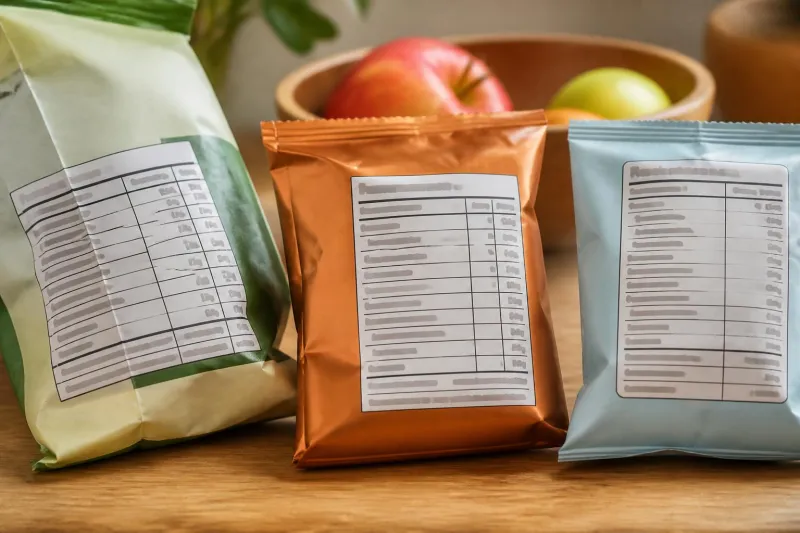
Most label confusion starts when people compare one product per 100g with another per serving and do not realise they have switched basis halfway through. The NHS explains that both are useful, but they answer different questions (how to use food labels to compare foods).
Use per 100g when you want a standard comparison between products. This is the fairest basis because every item is measured the same way. If one cereal bar shows 12g sugars per 100g and another shows 18g sugars per 100g, you can say the first is lower in sugar on a like for like basis. That remains true even if the bars come in different sizes.
Use per serving when you want to know what you are more likely to eat at one time. This matters when packet sizes vary, or when a product is clearly intended to be eaten as a single unit. A 25g bar and a 50g bar might look similar on the shelf, but the larger bar can deliver much more sugar in one go even if the per 100g figure is lower.
Packet size matters because manufacturers define servings differently. One brand may call half a pack a serving. Another may call the whole pack one serving. A bag that looks individual may contain two servings on the label. If you are going to eat the entire packet, then the relevant figure is the whole packet, not the manufacturer’s suggested portion.
A practical way to compare without getting lost is this:
- Start with per 100g to compare similar foods fairly.
- Check the stated serving size.
- Check how many servings are actually in the pack.
- Decide how much you would realistically eat.
- Recalculate mentally if needed.
That last step is often where the useful answer appears. If a pot says 8g sugars per serving but contains two servings and you would finish it, your real intake from that pot is 16g. If a bag says 20g sugars per 100g but weighs only 30g and you will eat the whole bag, then the amount you actually eat is much lower than the per 100g headline may first suggest.
Per 100g is usually more useful when comparing foods with different manufacturer serving sizes, or when products are sold in resealable packs that people dip into over time. Per serving is usually more useful when the food is clearly portioned and likely to be eaten once, such as a single pot, a wrapped bar, or a small snack pack.
This is also where front of pack impressions can mislead. A product may look modest because it is sold in a small format, but if it is dense and the serving size is set unrealistically low, the only way to know what you are comparing is to use the back of pack figures properly. If you want a closer look at this process, our guide on study snacks that are easier to compare on the label uses the same comparison logic in a practical setting.
What claims like no added sugar actually mean
Front of pack wording is often treated as a shortcut, but it is not a substitute for reading the label. The phrase no added sugar has a specific meaning in use, but people often hear more in it than it actually says.
In plain terms, no added sugar means sugar has not been added during manufacture in the way the claim rules allow. It does not mean the food contains no sugar at all. Ingredients such as fruit, milk and some cereals can contribute sugars naturally present in the product. So a food can carry no added sugar and still show a noticeable sugar figure on the nutrition panel.
That is why the front of pack claim should send you to the back of pack, not stop you there. You still need the nutrition table to see the sugar amount, and the ingredients list to understand where the sweetness is coming from and what else is in the product.
This also matters because no added sugar and low sugar are not interchangeable phrases. They answer different questions. No added sugar is about what has or has not been added. Low sugar is about the sugar content meeting the conditions for that claim. A product can meet one description without matching what a shopper assumes from the other. We cover that distinction in more detail in our explainer on no added sugar and low sugar label claims.
The ingredients list gives useful context that the claim alone cannot. If a snack relies heavily on fruit purée, fruit juice concentrate, dried fruit or sweetened dairy ingredients, the total sugar figure may still be higher than you expect from the front of pack wording. That does not automatically make it unsuitable, but it does mean the claim is not the whole story.
The safest habit is simple. Treat no added sugar as one piece of information, not a verdict. Compare the actual sugar figure, read the ingredients in order, and look at the portion you are likely to eat. If you want to compare products carrying that wording more systematically, our article on how to compare no added sugar snacks without guesswork sets out a straightforward method.
How to build practical snack options for home work and travel
A snack that looks ideal on paper is not much use if it leaks in a work bag, needs refrigeration you do not have, or leaves you rummaging for something else an hour later because it was never convenient enough to eat properly. Practicality is not a side issue. It is part of choosing well.
The NHS Eatwell Guide is helpful here because it frames eating patterns as something built over time, not solved by one perfect item (overview of the Eatwell Guide). In real life, snack choices work better when they fit routine, storage and appetite.
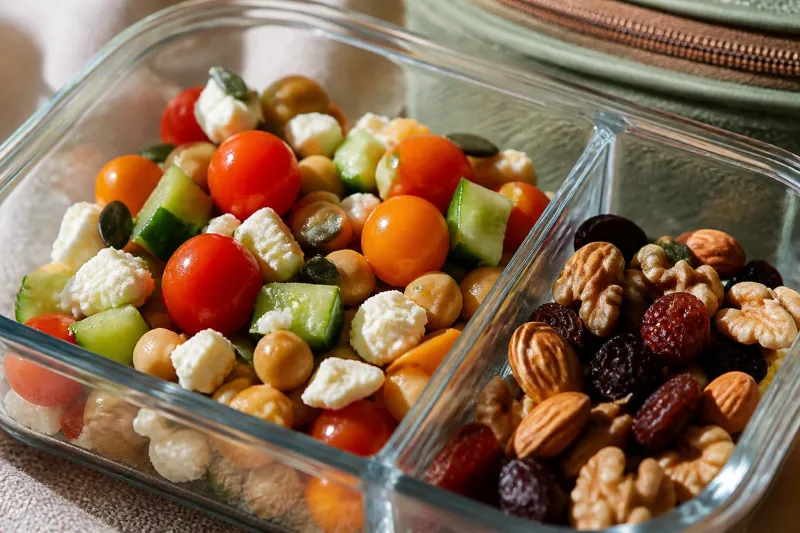
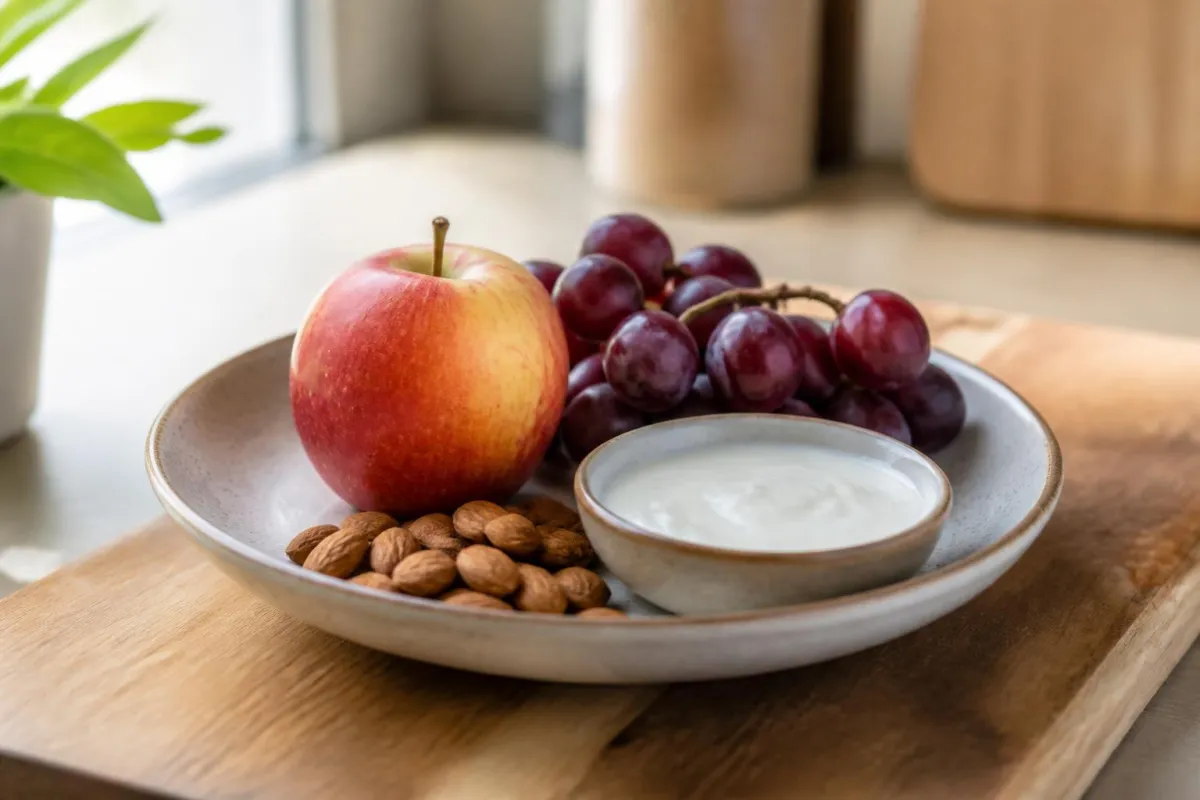
At home, you usually have the most flexibility. You can keep chilled options available, portion foods into bowls or containers, and pair items more easily. This is the easiest setting for snacks that need refrigeration or preparation, such as yoghurt with a handful of nuts, chopped vegetables with a dip, or toast with a topping. The lower sugar question is still relevant, but the bigger advantage is that you are not limited to shelf-stable packets.
At work, convenience and mess matter more. A snack needs to survive a commute, fit into a break, and be easy to store. Wrapped items, small tubs, crackers, nuts, seeds, and fruit that travels well often work better than anything that needs assembling at your desk. If you have access to a fridge, your options widen. If not, shelf stability becomes part of the decision.
For travel, especially longer journeys, the useful questions are even more practical. Will it squash, melt, spill, spoil, or become unpleasant to eat? Can you carry it through the day without special storage? Is the packet resealable if you do not want it all at once? The Food Standards Agency advises following storage instructions and keeping chilled foods properly chilled where required (food storage and chilling guidance). That means some snacks are fine for a short trip in an insulated bag, while others are better left for home or office fridges.
It can help to think in categories rather than one fixed list:
- Keep-at-home snacks, where refrigeration and preparation are available.
- Desk or locker snacks, where shelf stability matters.
- Bag snacks, where portability, crush resistance and resealing matter.
- Short-gap snacks, for a brief break.
- Longer-gap snacks, when the next meal is further away.
This approach tends to produce more realistic choices than chasing a single ideal product. It also reduces the temptation to buy whatever is nearest simply because the better option was inconvenient to store or carry.
If you are building a regular rotation, aim for a small set of options that cover different situations rather than one "best" snack. A few lower-sugar choices for home, a few for work, and a few for travel will usually serve you better than a long theoretical list. Our everyday snack guidance is built around that kind of ordinary routine rather than restrictive rules.
When ingredients and allergen information matter more than a sugar number
Sometimes the sugar figure is not the most important thing on the label. For many people, ingredients and allergen information decide suitability before nutrition comparisons even begin.
The Food Standards Agency is clear that consumers need to check ingredient and allergen information carefully, and that general impressions from packaging are not enough (consumer advice on food allergy and intolerance). A product described in broadly healthy terms is not automatically suitable for someone with an allergy or intolerance. Nor is a familiar product guaranteed to stay the same, because recipes can change.
That is why we should not infer personal suitability from a category label such as "natural", "wholesome", "plant-based", "protein", or lower sugar. None of those tells you whether the product contains nuts, milk, soya, sesame, gluten-containing ingredients, or other substances relevant to you.
Check every time, especially when:
- the packaging has changed
- the product is a different flavour
- the item is in a multipack
- the retailer has switched supplier
- you have not bought it for a while
In the UK, allergen labelling follows domestic rules. Since the UK is no longer in the EU, food law can diverge even where many principles remain familiar. For everyday shoppers, the practical point is not to assume that a rule, symbol or wording seen in EU-wide discussions will map perfectly onto every UK product. Read the actual UK pack in front of you.
Ingredients also matter for reasons beyond allergens. If you are comparing two snacks with similar sugar figures, the ingredient list may tell you which one is closer to what you actually meant by a simpler everyday option. It can also explain why two apparently similar products taste very different, keep differently once opened, or need different storage.
This is one reason we are cautious about broad labels such as healthy low sugar snacks when they are used as if they describe a single obvious group. In practice, that phrase covers everything from plain dairy foods to nut mixes, savoury crackers, fruit-based products and cereal snacks. The sugar number can help narrow the field, but the ingredient list often tells you whether the food belongs in your routine at all.
The most reliable habit is not complicated. Read the front of pack, but do not stop there. Compare per 100g first. Check per serving against the amount you will really eat. Look at the packet size. Read the ingredients. Check allergen information every time. Then decide whether the snack fits where you will use it, at home, at work, or on the move.
That is how we avoid label guesswork. Not by hunting for one magic phrase, but by using the information on the pack for what it can genuinely tell us, and not asking it to do more than that.