Why packet portions and what you eat often differ
per 100g and per serving answer different label questions.
On this page
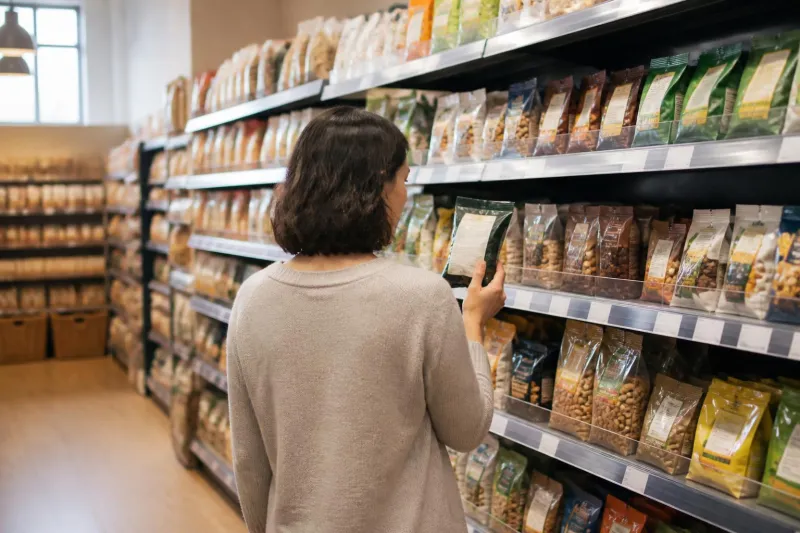
Packet portions are not a record of what you ate. They are label tools. One number helps you compare products on a standard basis, and another helps you estimate a stated portion from that specific pack. The reason packet portions and the amount you eat can differ is simple, the label is fixed, but real eating is not.
In the UK, the NHS is clear that nutrition information is often shown both per 100g and per serving, and those are different bases for different jobs, not interchangeable numbers (NHS guidance on reading food labels). A packet may say one serving is 30g, but you may eat 18g, 45g, half the pack, the whole pack, or a portion spread across the day. That is normal household use, not a failure to follow the packet.
What a packet portion is actually for
A food label usually gives nutrition information in at least one standard format, and often two. The first is per 100g. The second may be per serving.
The per 100g basis exists so that foods can be compared like with like. If one cereal bar is sold as a 28g bar and another as a 40g bar, their per pack figures are awkward to compare directly, a point further explored in Healthy Food Reviews. Per 100g removes the pack size difference and gives a common yardstick. This is why the NHS points readers to per 100g when comparing foods, while also noting that portions and 100g are not the same thing (NHS guidance on reading food labels).
Per serving does a different job. It tells you the nutrition for the manufacturer’s stated portion of that product. That can be useful if the serving reflects how the item is commonly used, such as one biscuit pack, one yoghurt pot, or one individually wrapped bar. It can also be useful for foods people often portion out, such as breakfast cereal or nuts.
What it does not do is tell you what you actually ate unless your amount matched that stated serving. If the label says one serving is 25g and you poured 40g into a bowl, the per serving figure is not wrong, but it is not your amount.
This is also where readers get tripped up by packaging language. “Contains 3 servings” is not a rule and not a recommendation that every adult should stop at one third of the pack. It is a label basis. The legal and technical details of food labelling differ across product types and markets, and some rules are set at Great Britain or UK level while others reflect wider retained or aligned frameworks, but the practical reading point is the same here: per 100g is a standard comparison basis, and per serving is the stated portion basis for that pack. They answer different questions.
At Healthy Snacking, we keep those two jobs separate because mixing them causes most of the confusion. If you want broader label basics, our guide to understanding food labels in plain English covers the main parts of the pack without treating one number as the only truth.
Why your eating amount may not match the packet
Manufacturers have to choose a serving assumption if they provide per serving values. Real life does not have to match it.
At home, many snacks are decanted. You open a large bag of popcorn, crackers or dried fruit, put some in a bowl, and put the rest away. Unless you weighed the bowl, you probably ate neither exactly one serving nor exactly 100g. You ate “some”. That is ordinary use.
At work, the packet can stop being the portion as soon as the food leaves the packet. A desk tub of mixed nuts may have started life as several labelled servings, but by Thursday it is just a shared container. A multipack may be bought for the week, then one day you have two units because lunch was late, and another day none. The manufacturer’s assumption is tidy. Office life is not.
While travelling, portions often drift even further. You might start a sharing bag on a train, put it away at the next stop, and finish it later. You might buy a large bottle, drink part at the station and part at your desk. You might split a packet with someone else without counting how much each person took. Again, the packet portion has not failed. It was never a live tracker.
Whole-pack eating is another obvious reason for a gap between label serving and actual intake. Some products are clearly designed as single units, but others are sold in packs that technically contain multiple servings even though many adults will reasonably eat the whole thing in one sitting. This is especially common with medium bags, bakery items, chilled desserts and “meant for sharing” formats used by one person.
Sharing creates the opposite issue. A packet may say one serving is 30g, but if three people pick from the same bowl, no one has a clean label-based serving unless it is weighed or counted out first.
Eating in stages adds one more layer. Suppose a flapjack pack contains two bars and the label gives values per bar. You eat one at 11am and one at 4pm. The pack was one purchase unit, but not one eating occasion. If you are trying to understand what happened in your day, “I ate the pack” is true in one sense and unhelpful in another. Timing matters too.
This is one reason we avoid moral language around portions. The label is a measurement aid, not a behavioural scorecard. The NHS Eatwell Guide also frames dietary balance across a day or week rather than demanding that every single snack carry the whole burden of balance (NHS Eatwell Guide).
The arithmetic that replaces a 100-calorie target
A fixed calorie target for every snack often creates more confusion than clarity, because packets are sold in different sizes and serving assumptions. Transparent arithmetic is more useful. It tells you what was in the amount you actually ate.
Take a simple example.
A bag of savoury crackers weighs 150g.
The label says:
- per 100g: 480 kcal
- per serving: 30g, 144 kcal
- servings per pack: 5
Now imagine what really happened. You took the bag to work, poured some into a tub in the morning, had more straight from the bag in the afternoon, and by the end of the day about two fifths of the pack was gone. You did not weigh each handful.
You still have enough information to estimate the amount eaten.
Step 1, convert the fraction of the pack into grams.
Two fifths of 150g is 60g.
Step 2, use either label basis correctly.
Using per 100g:
- 60g is 0.6 of 100g
- 0.6 × 480 kcal = 288 kcal
Using per serving:
- one serving is 30g
- 60g is 2 servings
- 2 × 144 kcal = 288 kcal
Same result, because you used each basis properly.
Now change the scenario slightly. Instead of two fifths of the pack, you ate “about half a serving in the morning and one full serving later”.
Step 1:
- one serving is 30g
- half a serving is 15g
- total eaten is 45g
Step 2:
- per serving route: 1.5 × 144 kcal = 216 kcal
- per 100g route: 0.45 × 480 kcal = 216 kcal
Again, the arithmetic is straightforward once the amount eaten is expressed in grams or servings.
The useful lesson is not “hit a perfect number”. It is that the packet’s serving is only helpful if it matches what happened. If it does not, use the pack weight, the stated serving size, the servings per pack, and the label values to estimate your actual amount instead of forcing everything into a neat round target.
If you want to do that without scribbling on the packet, our tool for calculating nutrition from a label and your chosen amount does exactly that. It is there to make the arithmetic visible, not to turn snacks into an exam.
When per serving helps and when it misleads
Per serving helps most when the product is naturally used in the same unit the label describes.
Examples include:
- a single wrapped bar where one pack is one serving
- a yoghurt pot intended to be eaten in one go
- a soup carton clearly divided into bowls
- a biscuit mini-pack taken to work as one item
In those cases, per serving can save time. If you routinely pack one unit in a bag or keep one pot in the office fridge, the serving figure may line up closely with real use.
It also helps with repeated planning. If you usually put roughly 30g of nuts into a small container for the train, and the label serving is 30g, the per serving figure is a quick shorthand. It is not morally better than per 100g, just more convenient for that routine.
But per serving can mislead when the declared serving is not how adults commonly use the product.
That happens with:
- sharing bags often eaten by one person
- large drink bottles consumed across several occasions
- cereals poured freely rather than weighed
- sweets, crackers or popcorn eaten from an open pack
- products where the serving is an odd count or a very small gram amount compared with the pack size
It can also mislead across brands. One granola brand may state a 45g serving and another 60g. Comparing only the per serving figures can make the first look lighter simply because the serving is smaller. Per 100g is fairer for comparison because it removes that difference in declared portion size.
The same applies across formats. A 25g crisp bag and a 150g sharing bag may both report per serving values, but those servings may not reflect how people actually eat them. Per 100g gives you a standard comparison basis across both.
This is also why front-of-pack impressions can be incomplete. Words such as no added sugar tell you something specific about formulation, but not everything about the overall nutrition profile or the amount eaten. Claims, ingredients, allergens and nutrition numbers all do different jobs. The Food Standards Agency guidance is especially important where ingredients and allergens are concerned, because no general label summary can tell an individual whether a product is suitable for them (Food Standards Agency allergy guidance).
A balanced approach is usually best:
- use per serving when the serving matches the way the product is actually used
- use per 100g when comparing brands, formats or products with very different stated servings
- check the pack size and how much of it you really ate before drawing conclusions
How to organise snacks without treating the label as a rule
Useful snack organisation starts with visibility, not strictness. The point is to make packet information easier to use when you want it.
At home, one practical method is to group snacks by how they are usually eaten:
- single-unit items, such as bars or pots
- pourable items, such as nuts, cereal, popcorn or crackers
- larger packs that are often shared or eaten in stages
That simple split tells you which labels are likely to work well per serving and which ones may need a quick amount check.
For cupboards, keep a small bowl, scoop or reusable container near foods that are usually decanted. This does not need to become a weighing ritual. It just makes it easier to notice whether you are taking “a little”, “about one serving”, or “quite a lot more than the packet serving”. Better awareness is the goal, not precision theatre.
For desks, avoid mixing multiple original packets into one unlabelled tub unless you know you will not care about the label later. If you do decant, keep the outer packet until the food is finished, or take a quick photo of the nutrition panel. That preserves the information without requiring memory.
For bags and travel, think in units that make sense for the situation. If you often nibble from large packs on trains or in the car, it may help to portion some foods before leaving home. Not because the packet serving is a rule, but because open-ended packs are easy to lose track of when attention is elsewhere.
At work, routine matters more than ideals. A drawer with a mix of single items and larger packs can work well if you know which is which. Single items are easier when the day is rushed. Larger packs are fine too, but they are easier to use deliberately if you have a container available rather than eating from the bag between emails. Our guide to practical snacking at work without overcomplicating it goes further into that everyday setup.
It also helps to separate label reading from judgement. If you realise you usually eat double the stated serving of a particular snack, that is information. It does not automatically mean the snack is unsuitable, and it does not require a compensating rule. It may simply mean the packet serving is smaller than your normal use.
That is the core answer to why packet portions and the amount you eat can differ. Packet portions are label conventions. Your actual amount depends on context, appetite, timing, sharing, pack format and how the food is handled once opened.
If you want the broader basics of traffic lights, ingredients and nutrition panels, see our Healthy Snacking label guide for understanding food labels. This article is narrower on purpose. We are not trying to duplicate that guide. We are showing how to bridge the gap between the packet’s stated portion and the amount that was really eaten, using plain arithmetic and a bit of household realism.
Healthy Snacking is published by Fleeta Limited, and our approach is to keep evidence, uncertainty and practical use in the same place. If you want to see how we handle that more generally, our page on how we write and correct food information explains the editorial method behind the articles.