Is 1,200 calories a day healthy for most adults?
A fixed calorie number does not suit every adult.
On this page
- What this question gets right and wrong
- What UK guidance does and does not say about calorie targets
- Why 1,200 calories can mean very different things in real life
- How to spot when the number is crowding out food quality and routine
- Using labels without turning every snack into maths
- A steadier way to judge your eating than one daily figure
For most adults, 1,200 calories a day is not a useful general benchmark for whether eating is "healthy". It may be enough for some people in some circumstances, but for many adults it will feel restrictive, hard to sustain, or too low once real life is taken into account, especially work, commuting, activity, appetite and the need to eat a varied diet.
That is why the better question is not simply whether 1,200 calories is healthy in the abstract. It is whether your overall eating pattern is regular, varied, practical for your routine, and based on sensible label reading rather than a single daily number. When people ask whether eating 1,200 calories a day is healthy, they are usually trying to find a clear rule. The problem is that adult eating rarely works well as a pass-fail rule.
What this question gets right and wrong
The question gets one thing right straight away. Energy intake matters. Calories are not meaningless, and labels can be helpful when we want to compare foods, spot large differences between similar products, or understand why one snack keeps us going longer than another.
What the question gets wrong is the idea that one number can tell us enough on its own.
"Healthy" is doing too much work in that sentence. A day of eating can be low in calories and still be poor in variety, awkward to organise, or built around foods that leave someone hungry and distracted by mid-morning. Equally, a day that goes above an arbitrary target might include regular meals, fruit and vegetables, satisfying snacks, and enough flexibility for a long shift or a delayed train home.
For adults in the UK, context matters. A desk-based office worker, a nurse on rotating shifts, a warehouse worker, a driver covering long distances, and someone in later life with a small appetite are all adults, but their routines and eating pressures are not interchangeable. Body size, age, sex, medication, disability, activity, household routine and work pattern can all affect how manageable a given intake feels. So can less obvious things such as whether someone has access to a fridge at work, whether they eat alone, and whether they regularly miss meals.
Food quality matters too. If someone fixates on staying under 1,200 calories, they may start stripping out parts of meals that make them workable, such as a sandwich with a filling that actually satisfies, or a yoghurt and banana that prevents a vending-machine dash at 4 pm. Numbers can be useful, but they cannot tell us whether an eating pattern is practical enough to repeat without constant effort.
What UK guidance does and does not say about calorie targets
UK public guidance does not present 1,200 calories as a universal healthy target for adults.
The NHS puts the emphasis on dietary balance across the day or week, rather than expecting every meal or snack to be nutritionally perfect in isolation. The NHS Eatwell Guide is about the overall pattern of foods and drinks, and it explicitly frames balance over time rather than treating one item or one day as a complete judgement.
That distinction matters. Public guidance is not the same as internet interpretation. It is easy to turn broad advice into a rigid personal rule, but that is our interpretation, not what the guidance itself says.
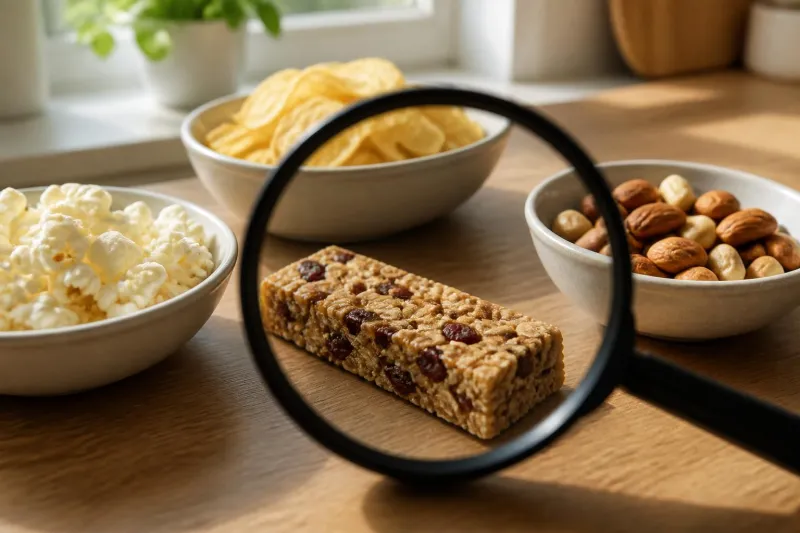
The NHS also explains how to use food labels to compare products, and makes an important practical point that often gets lost in calorie talk. Per 100g and portion information are not the same thing. If one cereal bar is listed per 100g and another looks lower only because the bar is smaller, the comparison can be misleading unless we check both bases. This is one reason why calorie ceilings can create false precision. The maths looks tidy, but the label basis may not be.
In the UK, food labels are regulated and structured in ways that help comparison, but they still need reading carefully. The term no added sugar, for example, does not mean sugar-free, and it does not tell us everything about the food overall. A product can contain naturally occurring sugars and still carry that wording if no sugar was added during manufacture. That is useful label information, but not a verdict on whether the food does or does not belong in someone’s routine.
Where UK and EU practice overlap, label formats are often familiar, especially around energy and nutrient declaration. Since the UK left the EU, however, we should not assume every rule is identical in wording or administration. For a UK reader using products bought here, NHS and Food Standards Agency guidance is the better reference point for everyday use.
Why 1,200 calories can mean very different things in real life
On paper, 1,200 calories is just a number. In real life, it can represent very different days.
For one adult, it might mean three modest meals and a snack, because they are small, not very active, and prefer lighter eating. For another, it might mean skipping breakfast, stretching lunch too far, arriving home ravenous, and treating every biscuit as a negotiation.
Body size is one obvious factor. Larger adults generally need more energy than smaller adults, though labels and public guidance are not designed to calculate personal needs from a webpage. Activity matters too, and not only formal exercise. Walking to the station, carrying equipment, being on your feet all day, climbing stairs at work, or travelling with irregular meal breaks can all change what feels realistic.
Age can matter in more than one direction. Some older adults have smaller appetites and may genuinely eat less, while younger adults with physically demanding routines may find 1,200 calories completely out of step with daily life. Sex can also affect typical energy needs at population level, but again, that does not turn one number into a universal rule for individuals.
Then there is routine. A person who works predictable hours from home can plan meals differently from someone with night shifts, split shifts or long journeys. If your day starts at 5.30 am and dinner happens at 8.30 pm, a low daily ceiling can make the entire middle of the day feel like rationing.
Appetite is not a character test either. Some people are comfortable with small meals. Others become distracted, irritable or preoccupied with food when intake is too low for their routine. That does not mean they are "bad at discipline". It usually means the target is not matching the day.
This is why we are cautious about the question is eating 1200 calories a day healthy. As a broad claim about most adults, it is too blunt to be very helpful. It tells us almost nothing about whether the person is eating regularly, getting enough variety, or managing food in a way that works at home, at work and while travelling.
How to spot when the number is crowding out food quality and routine
A calorie target becomes less helpful when it starts making ordinary eating harder to organise.
One sign is when meals become structurally thin. That might look like toast without anything substantial on it, a salad that is mostly leaves and little else, or lunch chosen mainly because the packet is small rather than because it will carry you through the afternoon.
Another sign is when snacks stop being planned and start being feared. If someone avoids bringing food because they do not want to "use up" calories, they may end up with a long gap, then buy whatever is easiest at the station, petrol stop or office kitchen. In practice, over-control often creates less control later in the day.
A third sign is loss of variety. People chasing a strict number often cycle through the same narrow set of foods because they feel predictable. That can make labels easier to total, but it can also make eating dull, socially awkward and less flexible. We see this especially with workday snacks. Instead of asking, "What would be practical here?", the question becomes, "What has the lowest number?" Those are not the same thing.
Watch for routine strain as well. If your eating pattern depends on saying no to every unplanned biscuit, every delayed meal, every shared lunch, and every longer-than-usual day, the system may be too brittle. An eating pattern does not need to be perfect to be useful. It needs enough slack to survive meetings that overrun, trains that are cancelled, and evenings when dinner happens later than expected.
This is one reason we often write about healthy eating in the UK without turning snacks into rules. A workable routine usually beats a rigid one.
Using labels without turning every snack into maths
Labels are useful, but they work best as comparison tools, not as a full-time scoring system.
Start with the basis. If you are comparing similar foods, check the energy figure per 100g first. That gives a standardised way to compare one product with another. Then check the per serving figure, but only after looking at what the serving actually is. A packet may contain more than one serving, and a declared serving may be smaller than what many adults would realistically eat. The NHS explains this clearly in its guide to using nutrition information to compare foods.
This matters because false precision is common. Someone may think they are making a low-calorie choice, but the label is being read on different bases from product to product. Per 100g helps standardise. Per serving helps with real life. We need both.
Ingredients and allergen information matter as well, especially if a food is for mixed households, shared offices or travel. The Food Standards Agency consumer guidance is the right reference point here. We should not infer personal suitability from a general article or from front-of-pack wording alone.
In practice, a simple label routine is enough for most snack decisions:
- compare similar items on a per 100g basis
- check what the stated per serving amount actually is
- look at ingredients if the food is something you eat often
- notice claims such as no added sugar, but do not treat them as the whole story
- check storage instructions if the food needs chilling, especially for packed lunches or travel, following Food Standards Agency food storage guidance
That is usually more helpful than turning every banana, cracker or yoghurt into a spreadsheet. For a broader approach to this kind of everyday decision-making, our piece on healthy eating activities that make snacks easier to manage may be useful.
A steadier way to judge your eating than one daily figure
If 1,200 calories is not a reliable pass-fail rule for most adults, what should replace it?
A steadier test is whether your eating pattern works across an ordinary week.
First, look at meal regularity. Are you leaving such long gaps that you become overly hungry and grab whatever is nearest? Regular meals do not need to be identical every day, but they usually make snack choices easier rather than harder.
Second, plan snacks around real pinch points. Mid-morning at work, the commute home, and the dead zone between an early lunch and a late dinner are common pressure points. A snack is not a dietary failure. Often it is simply part of making the day run properly.
Third, look for variety over time. Not every day needs to include every type of food in textbook proportions, but a narrow, repetitive pattern is worth noticing. Variety tends to improve flexibility, and flexibility matters in adult life.
Fourth, use labels to compare, not to punish. Per 100g is useful for product comparison. Per serving is useful for understanding what you are likely to eat. Neither figure can tell you, on its own, whether a food fits your day well.
Fifth, judge your routine by how manageable it is in ordinary settings. Can you keep it going at home, at work, in the car, on the train, and during a busy week? If not, the problem may not be your willpower. It may be the rule.
Finally, keep food quality in view without making it moral. Nuts, yoghurt, fruit, crackers, sandwiches, cereal bars and leftovers all have different strengths depending on timing and context. The better question is often not "Is this healthy?" in the abstract, but "Is this a sensible choice for this part of my day?" Our article on nuts in an overall eating pattern looks at that kind of question in a more grounded way.
At Healthy Snacking, published by Fleeta Limited, our view is simple. A single calorie figure rarely tells the whole story for adults. If a number helps you compare labels or notice patterns, fine. If it starts crowding out regular meals, practical snack planning and dietary variety, it is probably doing too much.