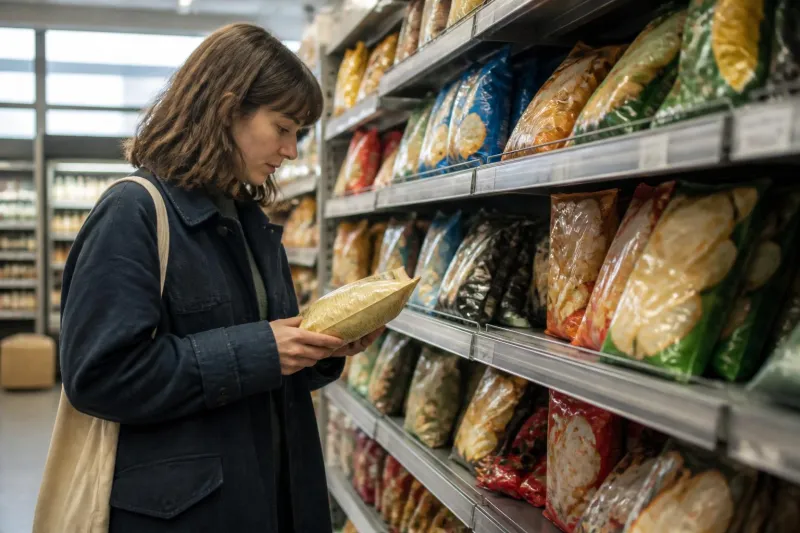
How to read snack labels without getting misled
Use per 100g to compare similar foods fairly across different pack sizes.
On this page
- What a food label is actually for
- Why per 100g and per serving are not interchangeable
- How to read the ingredients list and allergen information
- What front-of-pack claims can and cannot tell you
- Storage, dates and pack instructions that affect everyday use
- A quick method for comparing two packets in the aisle
Reading snack labels properly is mostly about knowing what each part is for, and not asking one number or one claim to answer every question. On most UK packs, the useful information is already there, but it is easy to compare the wrong columns, treat a marketing phrase as if it were the whole story, or miss storage instructions that matter once the packet is open.
For everyday use, we find it helps to read food packaging labels in a set order. Start with the product name and quantity so you know what you are comparing. Then check the nutrition table on a like for like basis, usually per 100g. After that, read the ingredients and allergen information, then any storage and date guidance. Front of pack claims can be useful, but only as one part of the picture, not the summary of the food.
What a food label is actually for
A food label is there to identify the food, tell you what is in it, and give you practical information for buying, storing and using it. For snacks, that usually means helping you compare similar products in ordinary situations, such as choosing something for a desk drawer, a train journey, or the cupboard at home.
On a typical UK snack packet, the main parts are:
- the name of the food
- the net quantity, such as 25g, 40g or 150g
- the nutrition declaration
- the ingredients list
- allergen information
- storage instructions
- date marking
- business name and address
- sometimes country of origin or place of provenance, where required
- any preparation or handling instructions that matter for use
The nutrition declaration usually includes energy, fat, saturates, carbohydrate, sugars, protein and salt. In the UK, this is commonly shown per 100g or per 100ml, and sometimes also per portion. Front of pack traffic light labelling is widely used on many products, but it is not mandatory on every pack. Where it appears, it is meant to help with quick comparison, not replace the full table. The NHS explains that food labels can be used to compare foods, and that per 100g and portions do different jobs NHS guidance on reading food labels.
That matters because snacks do not all serve the same purpose. A bag of roasted nuts, a cereal bar, a pack of oatcakes and a chocolate biscuit may all be called snacks, but they differ in weight, ingredients, texture, shelf life and how people actually use them. Some are meant for one sitting, some are resealable, some are designed to be shared, and some are more useful as a practical standby than as a precise nutritional unit.
So the label is not there to tell you whether a food is morally good or bad. It is there to help you answer practical questions, including:
- What is this, exactly?
- How much is in the pack?
- What am I comparing it with?
- What ingredients does it contain?
- Are any allergens declared?
- How should it be stored?
- Is the packet one portion, or several?
If you want a fuller walkthrough of the standard parts, our guide to understanding food labels sets them out in more detail.
Why per 100g and per serving are not interchangeable
This is where many quick comparisons go wrong. The most reliable comparison base is per 100g, because it standardises the numbers across products of different pack sizes and different suggested portions. The NHS states this clearly, and it is the reason per 100g is the normal basis for comparing one food with another NHS guidance on reading food labels.
If one bar shows 95 kcal per serving and another shows 120 kcal per serving, that does not automatically mean the first is lower in energy on a like for like basis. The servings may be different weights. One serving might be 21g and the other 35g. Until you check the per 100g column, you are not comparing the foods on equal terms.
Per 100g is especially useful when:
- two products come in different pack sizes
- one brand uses a very small stated portion
- a multipack item is smaller than a standard single pack
- you want to compare nutrients such as salt, fibre, sugars or protein fairly
Per serving is still useful, but for a different reason. It helps you estimate what you are likely to eat from that packet, if the stated serving is realistic and clearly defined. For example, if a packet contains one wrapped flapjack and the serving is the whole bar, per serving may be a practical guide to what that item contributes. If a sharing bag says there are 3.5 servings inside, per serving is less intuitive unless you weigh it out or already know how much you usually eat.
This is why we separate the two questions:
- Per 100g asks, “How does this compare with a similar food?”
- Per serving asks, “What does the stated amount come to if I eat that amount?”
Neither column is wrong. They just answer different questions.
For snacks used in real life, it often helps to check both. Start with per 100g to compare products fairly. Then look at per serving and the pack weight to see what the packet means in practice. Our page on comparing per 100g and per serving on food labels goes into that process step by step.
One more point matters in the UK context. Some foods are sold in formats where portion expectations are obvious, while others are not. A small pot, a wrapped biscuit bar or a single savoury pack may be straightforward. A pouch, tub or large bag often is not. If the stated serving size does not match how the pack is likely to be used, treat the per serving column as a scenario, not a fact about what everyone eats.
How to read the ingredients list and allergen information
The ingredients list tells you what was used to make the product. Ingredients are generally listed in descending order by weight at the time of manufacture, so the first few ingredients often give you the clearest sense of what the product mainly consists of. That can help when comparing snacks that sound similar but are built quite differently.
For example, two oat bars may both look like simple cereal snacks from the front of the pack. One may begin with oats, dried fruit and seeds. Another may begin with glucose syrup, sugar and vegetable oil, with oats further down the list. That does not make one automatically suitable or unsuitable for any individual, but it does tell you they are not the same kind of product.
What the ingredients list can tell you:
- the named ingredients used
- the relative order by weight
- whether sweeteners, flavourings, oils or fruit concentrates are present
- whether an ingredient you personally avoid is included
What it cannot tell you on its own:
- whether the food is right for your personal diet
- how an ingredient affects you individually
- whether a broad impression from the front of pack is accurate without checking the full label
- whether a product is suitable for an allergy sufferer beyond the actual allergen information and their own professional advice
In the UK, allergens that must be declared are typically emphasised in the ingredients list, often in bold. You may also see a separate “contains” statement. The Food Standards Agency advises consumers to read ingredient and allergen information carefully and not rely on assumptions based on product type, brand familiarity or packaging design Food Standards Agency consumer allergy guidance.
This is important because similar snacks can differ a lot. One savoury cracker may contain milk powder, another may not. One cereal bar may contain peanuts, another tree nuts, another sesame, and another none of those but still carry a precautionary statement. A recipe can also change.
Where readers sometimes get misled is by treating a general label cue as if it settled personal suitability. Phrases such as “plant-based”, “gluten free”, “dairy free” or “high protein” do not remove the need to check the ingredients and allergen information on the actual packet. We also would not infer suitability from a category name alone. “Fruit bar”, “protein snack” and “baked crisps” are not allergy advice.
For general background, labels can inform personal decisions, but they do not replace individual medical or allergy advice. The NHS also notes that overall dietary balance is considered across the day or week, not demanded from every single item NHS Eatwell Guide.
What front-of-pack claims can and cannot tell you
Front of pack claims are designed to catch the eye quickly. Some are regulated nutrition or health related claims. Others are simply emphasis, such as “made with oats” or “oven baked”, which may be factually true but do not summarise the whole product.
A claim can be useful, but it is narrow. It tells you one thing, not everything.
Take no added sugar. In plain terms, this means sugar has not been added as an ingredient in the way the rules define for that claim. It does not mean the product contains no sugar at all. A snack made with fruit puree or dried fruit may still contain sugars that are naturally present in those ingredients. So if sugars matter to your comparison, you still need the nutrition table and ingredients list. We explain this in more detail in our guide to what no added sugar and low sugar claims mean.
The same principle applies to other common claims:
- “source of fibre” or “high fibre” says something specific about fibre content, not the whole nutritional profile
- “source of protein” or “high protein” does not tell you the salt, sugars or saturated fat content
- “baked not fried” may describe a process, but not the final nutrition on its own
- “natural”, where used in branding or general marketing, is not a shortcut for nutritional comparison
In the UK, regulated food information and claims sit alongside marketing design on the same packet, which is why it helps to separate them mentally. The nutrition declaration, ingredients, allergens, net quantity, date marking and storage instructions are there to inform practical use. Promotional wording is there to attract attention. Both appear on the pack, but they are not doing the same job.
There is also a UK specific point worth noting. Since EU exit, food law in Great Britain and the EU is no longer identical in every detail, even though much labelling practice remains familiar. For ordinary snack comparisons, the core habit is the same, read the actual UK pack in your hand rather than assuming a rule from another market applies unchanged.
Storage, dates and pack instructions that affect everyday use
Storage and handling information is easy to skip, especially on snacks, but it affects quality and sometimes safety. Look for it on the back or side panel, near the ingredients, date mark or manufacturer details.
Typical instructions include:
- store in a cool, dry place
- once opened, keep in an airtight container
- consume within a stated time after opening
- keep refrigerated after opening
- not suitable for freezing, or freeze on day of purchase if relevant
These are not filler lines. They tell you how the product is intended to keep. A resealable pouch of dried fruit, a chilled dip with crackers, and a packet of oat biscuits all have different needs once opened.
Date marking also matters. In UK food labelling, “use by” is about safety on foods that go off quickly, while “best before” is more about quality. Snacks are often marked with “best before”, but not always. If a product needs refrigeration after opening, the opened life may be much shorter than the unopened date suggests.
The Food Standards Agency’s storage guidance is straightforward, appropriate chilling and storage help control food safety, and product instructions should be followed Food Standards Agency storage guidance.
This matters in everyday situations:
- keeping snacks in a hot car can affect products with chocolate, yoghurt coatings or fillings
- carrying opened packs in a work bag may not suit products that need cool storage
- decanting food into another container can separate it from its allergen and date information
- buying a multipack for the week only works if the individual items or opened outer pack store as expected
For adults organising food at home or work, this is often the difference between a packet being genuinely convenient and only looking convenient on the shelf.
A quick method for comparing two packets in the aisle
When you are standing in front of two similar snacks, you do not need to analyse every line. A calm comparison usually takes less than a minute if you follow the same order each time.
- Check what the products actually are.
Read the name of the food, not just the branding. Two packets may both look like cereal bars, but one may be nut based and the other biscuit based.
- Check the pack weight.
A 20g pack and a 45g pack should not be read as if they are the same unit.
- Compare the nutrition per 100g first.
Use this for like for like comparison. Look at the nutrients that matter for the specific comparison you are making, such as fibre, salt, sugars, saturates or protein, rather than only one headline number.
- Then check per serving if it is clearly defined.
Ask whether the serving matches the actual item. One wrapped bar is clearer than a serving taken from a large bag.
- Read the first few ingredients.
This often tells you more about the type of snack than the front of pack design does.
- Check allergen information carefully.
Especially if the snack is for a household, office or journey where someone needs to avoid certain ingredients.
- Look at any front of pack claim in context.
If one packet says no added sugar or high fibre, confirm what the full label says rather than stopping there.
- Check storage and date practicality.
A snack that needs prompt use after opening may not suit the way you plan to keep it.
- Decide based on purpose, not on winning one number.
A desk snack, a train snack, and a cupboard standby do not always need to be the same kind of food.
That last step is the one people often miss. Not every snack has to do the same job. Sometimes you want something sturdy and non-crumbly for travel. Sometimes you want something that can be split over several breaks. Sometimes you want a packet that keeps well once opened. Labels help most when they are used to match the food to the situation, rather than to chase a single supposedly perfect choice.
If you want a simple follow-up, our practical food comparison tools and label guides on Healthy Snacking are designed for exactly this kind of everyday decision making. As an editorial publication by Fleeta Limited, we focus on what labels can show, what they cannot, and how to use them without turning every snack into a test.