How to read snack labels without getting misled
Use per 100g to compare similar foods fairly.
On this page
- Start with the comparison basis
- What the traffic light label can and cannot tell you
- How to read the nutrition table without overcomplicating it
- What ingredients lists and claims really mean
- Allergens, storage and other checks that matter in real life
- A quick label routine for busy shops and packed cupboards
Reading snack labels without getting misled starts with one simple question, what are you comparing? A label can tell you how a food stacks up against similar products, how much of something is in the amount you are likely to eat, and whether there are practical issues such as allergens or storage instructions. Those are different jobs, and one number rarely does all three well.
For everyday choices, we find it helps to read labels in layers. First compare like with like. Then check the actual portion you are likely to eat. Then look at the ingredients, allergens and storage details that matter in real life. That keeps food labels useful without turning a quick shop or a desk drawer refill into a spreadsheet exercise.
Start with the comparison basis
The most common source of confusion on food labels is the difference between values given per 100g and values given per serving. They answer different questions, and both are useful.
Per 100g is the cleanest basis for comparing similar foods. If you want to compare two cereal bars, two bags of crisps, or two pots of yoghurt-coated snacks, per 100g strips out the serving size chosen by the manufacturer. The NHS uses this approach too, because a portion and 100g are different comparison bases, and per 100g lets you compare products on a level footing (NHS guidance on reading food labels).
Per serving tells you what you might actually consume in one go, if the serving reflects reality. That matters for snacks because many are sold as single packs, and many others are not. A 25g packet of baked snacks and a 180g sharing bag of tortilla chips can both show per serving figures, but the meaning is very different if one serving is the whole packet and the other is an idealised handful that few people measure out.
So when should you use each?
Use per 100g when:
- comparing similar items on the shelf
- deciding which product is generally higher or lower in salt, sugar, fibre or saturated fat
- checking whether a front-of-pack claim sounds more impressive than the nutrition table suggests
Use per serving when:
- the pack is clearly one portion and you are likely to eat all of it
- you want to know what your actual snack break looks like in practice
- a product is usually eaten in repeated units, such as one bar, one pot or one mini pack
The key is not to let per serving hide the size of the serving. If a packet contains three servings and you routinely eat the lot, the per serving figures are not wrong, but they are not the full picture either. Equally, per 100g can make some foods look more dramatic than your real intake. A dip might look high in salt per 100g, but if you use a small spoonful, your intake from that item alone may be modest.
That is why we treat per 100g as the best comparison tool, and per serving as the best reality check. If you want a more detailed walk-through, our guide to comparing per 100g and per serving on labels breaks down when each basis is most useful.
What the traffic light label can and cannot tell you
The traffic light label on the front of many UK packs is designed to help you compare foods quickly. It usually shows energy, fat, saturates, sugars and salt, often with red, amber or green colour coding. For a rushed supermarket stop or a station shop, that can be genuinely useful. You can often spot, at a glance, whether one option is notably saltier or sweeter than another.
This is mainly a UK front-of-pack system. Packaging sold more broadly across the EU may use different front-of-pack formats, or none at all, even though back-of-pack nutrition information is still regulated. So if you buy imported snacks or products packaged for more than one market, the traffic light panel may be absent or presented differently.
What the traffic light can do well:
- help you compare similar products quickly
- flag when a snack is relatively high in salt, saturates or sugars
- reduce the amount of label reading needed for routine choices
What it cannot do on its own:
- tell you whether the serving size matches what you will actually eat
- show the full ingredient list
- tell you much about fibre
- explain context, such as whether a food is eaten occasionally, shared, or combined with something else
A common trap is to read a green or amber light as a general seal of approval. It is not. It is a shorthand for specific nutrients in a stated amount. A product could show an appealing front panel and still be easy to overpour, low in fibre, or awkward for someone with an allergy. A red light is not a ban either. It simply means that nutrient is high in that stated amount.
This is where the wider dietary context matters. The NHS Eatwell Guide is about balance over time, not making every single snack fit a perfect profile (NHS Eatwell Guide). In practice, a traffic light label is a useful shortcut, not a full verdict.
How to read the nutrition table without overcomplicating it
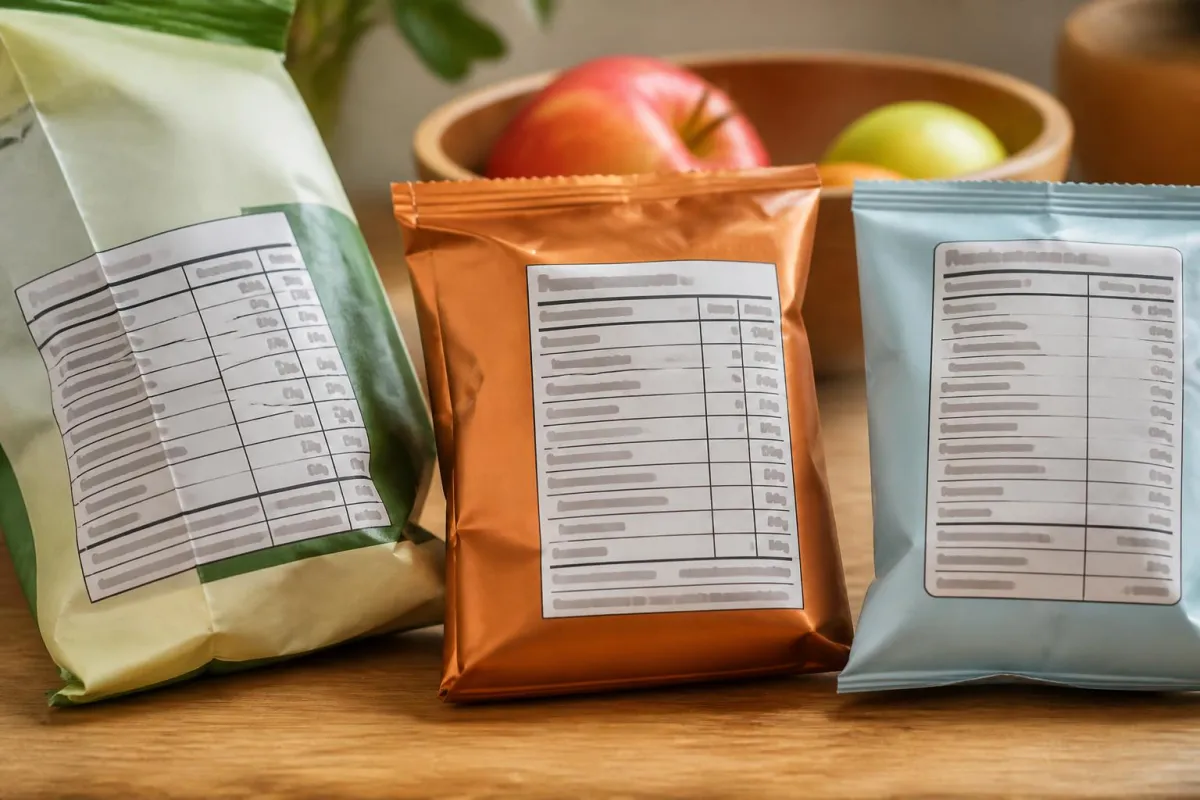
The nutrition table is where the detail sits. You do not need to analyse every line every time. For most snack decisions, six entries do most of the work, energy, fat, saturates, sugars, salt and fibre.
Energy is listed in kJ and kcal. For quick comparison, it tells you how concentrated the food is. Nuts, seeds and chocolate-coated snacks often look high per 100g because they are dense. That is not a moral judgement, just a description of how much energy is packed into a given weight. For everyday use, energy matters most when comparing products you would otherwise treat as interchangeable.
Fat is the total fat content. On its own, it is not the most helpful comparison point unless you are choosing between similar items. A snack can be high in total fat because it contains nuts or seeds, or because it is fried, or because it contains a lot of added fat. The line below it, saturates, is often more informative for quick comparisons of biscuits, pastries, chocolate snacks and crisps.
Saturates refers to saturated fat. For similar products, lower saturates can be a useful distinction, especially when one item is heavily buttery, creamy or coconut based and another is not. Again, compare like with like. A seeded cracker and a fudge brownie are different foods with different roles.
Sugars needs careful reading. The number in the table includes sugars naturally present in ingredients as well as sugars added during manufacture. Dried fruit, milk-based snacks and fruit purées can all contribute to the sugars figure. That is why the claim no added sugar does not mean sugar-free, and it does not tell you the whole story without the rest of the label. We cover that more below.
Salt is one of the most practical figures for everyday savoury snack comparisons. Crisps, crackers, pretzels, popcorn and coated nuts can vary a lot. Per 100g is especially useful here because serving sizes on savoury snacks are often inconsistent. If you are choosing between similar products, the salt line can quickly separate them.
Fibre is often overlooked because it is not always highlighted on the front of the pack. For snacks that are meant to keep you going between meals, fibre can be a genuinely useful figure to compare, especially in cereal bars, crackers, popcorn, pulses and fruit-based products. Not every label claim about fibre means the same thing, so if you want the thresholds behind those claims, our guide to high fibre and source of fibre wording explains how the terms are used on labels.
A practical way to read the table is this:
- compare per 100g first if you are choosing between similar products
- check the per serving column if the pack is likely to be eaten in one go
- focus on one or two numbers that matter for that comparison, not every number on the panel
For example, if you are comparing two savoury biscuits for work, salt and fibre may be more useful than staring at every line. If you are comparing two sweet bars, sugars, saturates and fibre may tell you more.
What ingredients lists and claims really mean
Ingredients are listed in descending order by weight at the time the food is made. In plain terms, the first few ingredients usually tell you most about what the product is mainly made from. If sugar, glucose syrup or refined flour appears near the top, that is worth noticing. If oats, peanuts or chickpeas appear first, that tells a different story about the base of the product.
This does not mean the first ingredient tells you everything. Water can appear high in some foods. Similar ingredients can be split into several forms. A product can also contain small amounts of ingredients that matter a great deal for allergens, flavourings or sweeteners. So use the list as a clue to the overall make-up, not as a single-pass judgement.
Claims on the front of packs are often technically true but incomplete on their own.
Take no added sugar. This means sugar has not been added as an ingredient, but it does not mean the product contains little sugar overall. A fruit bar made from dates and apple purée may legitimately say no added sugar while still being high in sugars according to the nutrition table, because the sugars come from the ingredients themselves. That is why the claim should always be read alongside the full label. If you want the distinction set out more fully, our page on what no added sugar and low sugar actually mean covers the difference.
The same logic applies to claims such as source of fibre, high fibre, source of protein or high protein. These are regulated phrases, not casual marketing language, but they still only describe one aspect of the product. A high-protein snack can also be salty. A high-fibre biscuit can still be very sweet. A no added sugar fruit bite can still be sticky and easy to overeat if you treat it like a plain fresh fruit equivalent.
Another point that matters in the UK is that labels can differ depending on whether a product is made for the UK market or imported from the EU. The broad structure is familiar, but front-of-pack claims and presentation can vary. Where there is any doubt, the back-of-pack nutrition table and ingredients list are usually the steadier ground.
Allergens, storage and other checks that matter in real life
Nutrition is only part of reading labels properly. In real life, allergen information, date marking and storage instructions can matter more than whether one snack has slightly less sugar than another.
For allergens, never rely on the front of pack alone. Check the ingredients list and the allergen emphasis used on the label. UK guidance from the Food Standards Agency is clear that consumers should use the ingredient and allergen information provided, and not assume suitability from general wording or product type (Food Standards Agency allergy guidance). For someone with an allergy, a snack that looks simple can still contain or reference milk, nuts, peanuts, sesame, soya, wheat or other allergens. We do not treat a general article like this as a personal suitability judgement.
Date marks also matter. Use by and best before are not interchangeable. A use by date is about safety on foods that go off quickly. A best before date is about quality. Many shelf-stable snacks carry best before dates, but chilled snack pots, dairy items and some fresh products may carry use by dates. If you are stocking a work fridge, packing travel food or organising a shared kitchen, that difference is practical, not fussy.
Storage instructions are easy to ignore until they matter. Some snacks are fine in a cupboard until opened, then need sealing carefully or chilling. Others are vulnerable to heat, especially chocolate-based items, yoghurt coatings, fresh dips and cut fruit. The Food Standards Agency’s storage guidance is straightforward, follow the product instructions and chill foods appropriately where required (Food Standards Agency storage guidance).
A few real-life checks worth making:
- is the pack resealable, or will it go stale once opened?
- does it need refrigeration after opening?
- is it realistic for your commute, desk, glove compartment or hotel room?
- if it is a multi-pack, is each unit labelled clearly enough for busy households or workplaces?
These are not side issues. A snack you can store properly, identify clearly and use up sensibly is often more practical than one with marginally tidier nutrition numbers but awkward handling.
A quick label routine for busy shops and packed cupboards
Most people do not want to perform a label audit in the biscuit aisle. A short routine is usually enough.
First, decide what you are comparing. Compare biscuits with biscuits, popcorn with popcorn, nut mixes with nut mixes. Labels are most useful when the products are broadly similar.
Second, look at per 100g for the main comparison. Pick one or two numbers that matter for that category. For savoury snacks, salt is often a good starting point. For sweet cereal bars, sugars and fibre may be more useful. For creamy or chocolatey snacks, saturates may help separate similar items.
Third, sense-check the pack size and the per serving column. Ask yourself, would I actually eat this amount? If the answer is no, the per serving figure may not reflect reality. If the answer is yes, it becomes more relevant.
Fourth, scan the ingredients list. The first few ingredients tell you the broad make-up. Then check for any claims that need context, especially no added sugar, high fibre or high protein.
Fifth, check the practical details. Allergens, date mark, and storage instructions are part of reading the label properly, not an afterthought.
At home, the same routine works in reverse when you are sorting cupboards. Group similar snacks together, keep an eye on date marks, and avoid letting half-used packets become mystery items at the back of a shelf. Our guide to stocking a varied snack cupboard without food rules goes into the household side of that in more detail.
If you want a simple principle to remember, use this one. Food labels are best for comparison, not perfection. Per 100g helps you compare fairly. Per serving helps you think about what you will actually eat. The traffic light panel helps you scan quickly. The nutrition table fills in the detail. The ingredients list and practical checks stop you being misled by a neat claim on the front.
That approach is how we use labels at Healthy Snacking. It is also why we treat them as tools, not verdicts. A label can inform a choice, but it does not need to turn an ordinary snack into a moral test.